
Die Application Gallery bietet COMSOL Multiphysics® Tutorial- und Demo-App-Dateien, die für die Bereiche Elektromagnetik, Strukturmechanik, Akustik, Strömung, Wärmetransport und Chemie relevant sind. Sie können diese Beispiele als Ausgangspunkt für Ihre eigene Simulationsarbeit verwenden, indem Sie das Tutorial-Modell oder die Demo-App-Datei und die dazugehörigen Anleitungen herunterladen.
Suchen Sie über die Schnellsuche nach Tutorials und Apps, die für Ihr Fachgebiet relevant sind. Beachten Sie, dass viele der hier vorgestellten Beispiele auch über die Application Libraries zugänglich sind, die in die COMSOL Multiphysics® Software integriert und über das Menü File verfügbar sind.
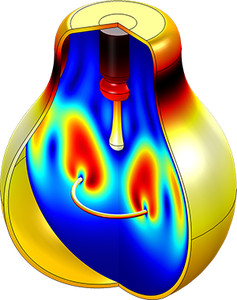
Dieses Modell behandelt die freie Konvektion von Argongas in einer Glühbirne. Es zeigt die Kopplung des Wärmetransports (Leitung, Strahlung und Konvektion) mit dem Impulstransport (nicht-isotherme Strömung), der durch temperaturbedingte Dichteänderungen verursacht wird. Das COMSOL ... Mehr lesen
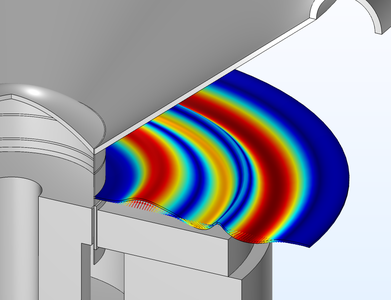
Die Aufhängung eines Lautsprechers ist so konzipiert, dass sie die Membran an Ort und Stelle hält und ein Schaukeln der Schwingspule verhindert. Bei niedrigen Frequenzen, bei denen die Auslenkung der Membran erheblich ist, variiert die Steifigkeit der Aufhängung entlang der Bewegung der ... Mehr lesen
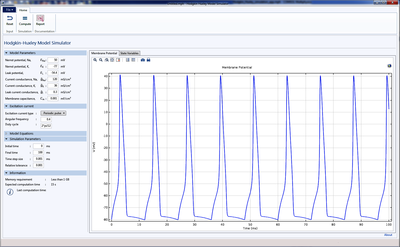
This app allows you to simulate the action potential in a cell's membrane using the Hodgkin-Huxley model. As it is presented in the form of a simulation app, you can change the input parameters for potential, conductance, and membrane capacitance to study their effects on the dynamics ... Mehr lesen
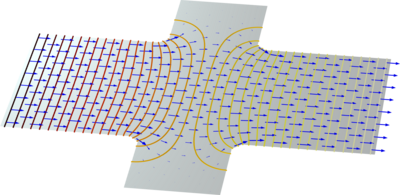
This example uses the Electric Currents in Layered Shells interface and the Layered Shell interface to model a piezoresistive pressure sensor. The tutorial considers the design of the MPX100 series pressure sensors originally manufactured by Motorola Inc. Although the sensor is no ... Mehr lesen
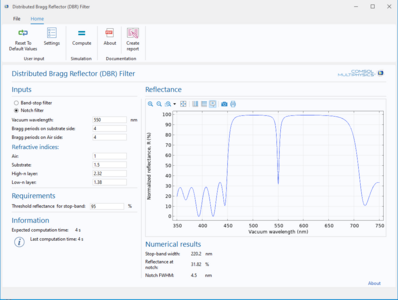
A distributed Bragg reflector (DBR) is a periodic structure formed from alternating dielectric layers that can be used to achieve nearly total reflection within a range of frequencies. The main advantage of DBRs over ordinary metallic mirrors is that DBRs can be engineered to have custom ... Mehr lesen
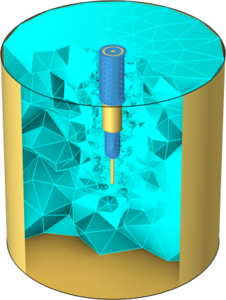
This model compares the results of five different formulations and approaches to solving an RF heating problem consisting of a coaxial cable inserted into a sample of lossy dielectric material. Results show that the different formulations agree over a wide frequency band. To learn more ... Mehr lesen

This example of a plasmonic waveguide filter shows that the waveguide rejects the electromagnetic radiation of the wavelength between 1.4 um and 1.6 um, but allows the rest of the wavelength. The silver material can be modeled using the Drude-Lorentz approximation, with ε∞ = 3.7, ωp = 13 ... Mehr lesen
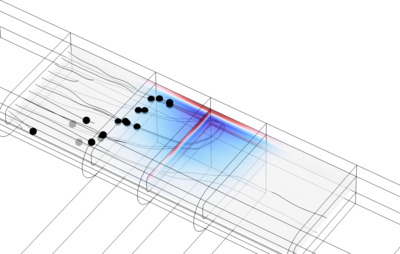
Ein 3D-Modell einer akustischen Falle in einer Glaskapillare mit einem Bias-Flow durch die Kapillare. Die Akustik wird durch ein oszillierendes elektrisches Potential über einen piezoelektrischen Wandler angeregt, das mechanische Schwingungen im Festkörper und ein akustisches Druckfeld ... Mehr lesen
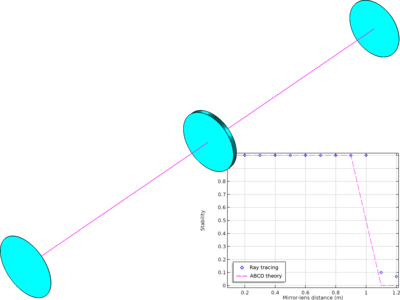
In this model, two flat end mirrors are placed at a distance and a spherical lens is inserted in the middle of the cavity. A ray is released from a point inside the cavity. Then the ray is traced for a predefined time period that is sufficiently long. Ray tracing continues until the ... Mehr lesen

This type is one of the most popular laser cavities. In particular, it is often used for the Ti-doped sapphire femto-second laser. The stability of the laser cavity is analyzed by releasing a ray inside the cavity and is traced for a predefined time period that is sufficiently long. ... Mehr lesen


