
Die Application Gallery bietet COMSOL Multiphysics® Tutorial- und Demo-App-Dateien, die für die Bereiche Elektromagnetik, Strukturmechanik, Akustik, Strömung, Wärmetransport und Chemie relevant sind. Sie können diese Beispiele als Ausgangspunkt für Ihre eigene Simulationsarbeit verwenden, indem Sie das Tutorial-Modell oder die Demo-App-Datei und die dazugehörigen Anleitungen herunterladen.
Suchen Sie über die Schnellsuche nach Tutorials und Apps, die für Ihr Fachgebiet relevant sind. Beachten Sie, dass viele der hier vorgestellten Beispiele auch über die Application Libraries zugänglich sind, die in die COMSOL Multiphysics® Software integriert und über das Menü File verfügbar sind.

In the chemical and biochemical industries, for instance in fermentation processes, reactors having well-mixed conditions and liquid level control are common. This example shows modeling of a 0D ideal system of tank reactors in series with controlled feed inlet and product outlet ... Mehr lesen

This model presents a solution to the Transient Electromagnetic Analysis Methods (TEAM) workshop problem 28, “An Electrodynamic Levitation Device”- a benchmark problem involving the dynamic coupling of electromagnetics and rigid body dynamics. An electrodynamic levitation force is ... Mehr lesen
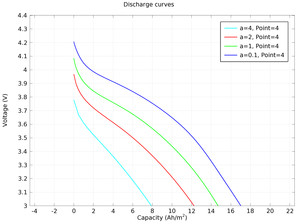
Dieses Modell demonstriert das Interface Lithium-Ion Battery für die Untersuchung der Entladung und Ladung eines Lithium-Ionen-Akkus für eine gegebene Reihe von Materialeigenschaften. Die Geometrie ist eindimensional und das Modell ist isotherm. Entwickler von Akkus können das Modell ... Mehr lesen
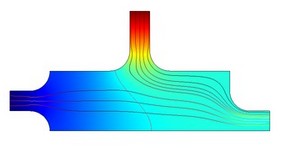
Dieses Modell zeigt, wie ein Strömungsmodell mit einem Prozesssteuerungsmechanismus gekoppelt werden kann. Die Steuerung von Anwendungsparametern in Abhängigkeit von anderen Anwendungsparametern ist in der Verfahrenstechnik wichtig. Die meisten Steuerungsmechanismen verwenden die Daten ... Mehr lesen
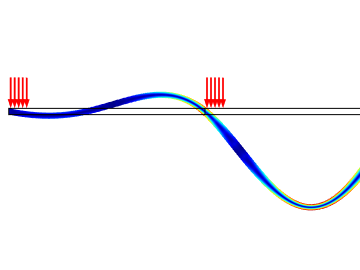
Dieses Beispiel zeigt, wie Sie eine räumlich und zeitlich variierende Last modellieren können. Eine Reihe von Lastimpulsen bewegt sich entlang eines Balkens, der in gleichen Abständen gestützt wird. Für einige Kombinationen der Laufgeschwindigkeit der Lastimpulse und des Abstands ... Mehr lesen
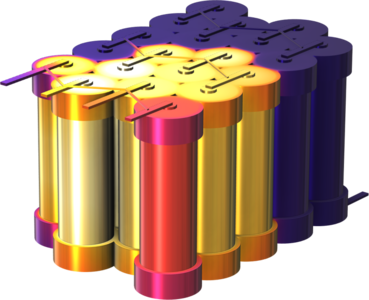
Durch unsachgemäßen Gebrauch, wie zum Beispiel interne oder externe Kurzschlüsse oder übermäßige Erwärmung, kann eine einzelne Akkuzelle thermisch durchgehen, wobei die Akkuzelle eine erhebliche Menge an Wärme erzeugt. Wenn während eines thermischen Durchgehens genügend Wärme zwischen ... Mehr lesen
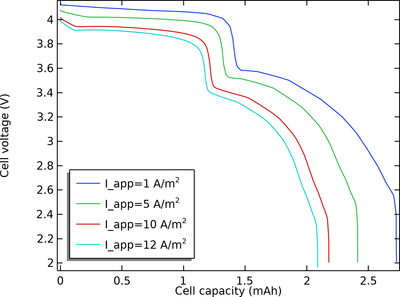
Sodium-ion batteries (SIB) are commonly presented as an alternative to lithium-ion batteries (LIB). The SIB chemistry uses Na+ instead of Li+ for electrolyte charge transport and as redox species in the electrode reactions, with the advantage of Na+ being more abundant and with a ... Mehr lesen
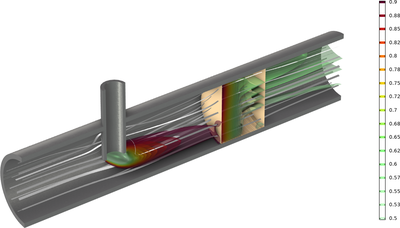
Die Modellierung von Festbetten, monolithischen Reaktoren und anderen katalytischen heterogenen Reaktoren wird mit dem Multiphysik-Interface Reacting Flow in Porous Media erheblich vereinfacht. Es definiert die Diffusion, Konvektion, Migration und Reaktion von chemischen Spezies für die ... Mehr lesen
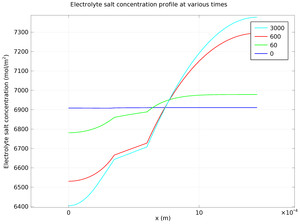
This model simulates the discharge of a Nickel-Metal Hydride (NiMH) battery using the Battery with Binary Electrolyte interface. The geometry is in one dimension and the model is isothermal. The model serves as an introduction to NiMH modeling, and can be further extended to include ... Mehr lesen
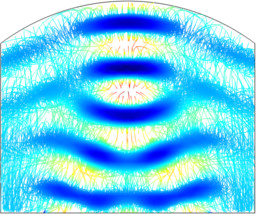
An ultrasonic standing wave levitator, also called acoustic levitator, is a device used for levitating fluid and solid particles in an acoustic field. The standing acoustic waves exert an acoustic radiation force on the particles. The force is a second order effect and stems from a ... Mehr lesen


