
Die Application Gallery bietet COMSOL Multiphysics® Tutorial- und Demo-App-Dateien, die für die Bereiche Elektromagnetik, Strukturmechanik, Akustik, Strömung, Wärmetransport und Chemie relevant sind. Sie können diese Beispiele als Ausgangspunkt für Ihre eigene Simulationsarbeit verwenden, indem Sie das Tutorial-Modell oder die Demo-App-Datei und die dazugehörigen Anleitungen herunterladen.
Suchen Sie über die Schnellsuche nach Tutorials und Apps, die für Ihr Fachgebiet relevant sind. Beachten Sie, dass viele der hier vorgestellten Beispiele auch über die Application Libraries zugänglich sind, die in die COMSOL Multiphysics® Software integriert und über das Menü File verfügbar sind.
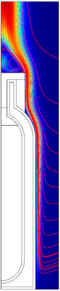
Das folgende Beispiel löst ein reines Konduktions- und ein freies Konvektionsproblem, bei dem eine Thermoskanne mit heißem Kaffee Wärmeenergie abgibt. Das Hauptinteresse besteht darin, die Kühlleistung der Thermoskanne zu berechnen, d.h. wie viel Wärme sie pro Zeiteinheit verliert. In ... Mehr lesen
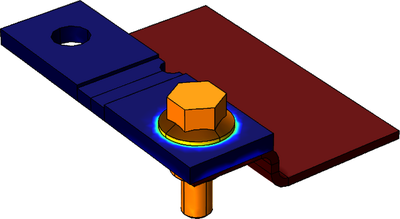
This model simulates atmospheric galvanic corrosion of a busbar, which includes a copper flange, an aluminum alloy flange in contact with a zinc nut and bolt. The Secondary Current Distribution interface is used to solve for the electric potential in electrode domain and Current ... Mehr lesen

Many applications involve simulating the electromagnetic behavior of relatively thin material in voluminous domains. To save computer memory and processing time, the thin materials can be treated differently by resolving them with 3D meshes. Here, the modeling domain is a box filled ... Mehr lesen
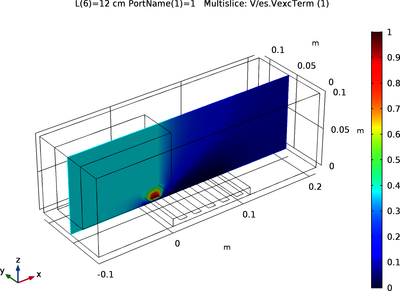
This tutorial model explains how to extract lumped matrices by means of the Stationary Source Sweep study. The capacitance matrix of a five-terminal system is used to infer the position of a metallic object similar to real-world capacitive position sensors. The example illustrates the ... Mehr lesen
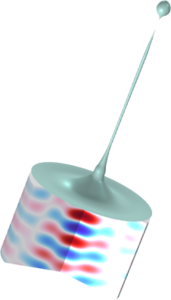
Acoustic droplet ejection is a non-contact, highly controllable method for liquid handling emerging in applications such as printing, biomedical, semiconductor assembly, and mass spectroscopy. The modeling approach assumes separation of acoustic and flow time scales. First, a focused ... Mehr lesen
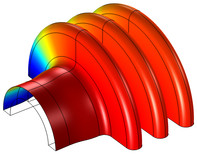
A cooling flange in a chemical process is used to cool the process fluid, which flows through the flange. The surrounding air cools the flange via natural convection. In the stationary model, the forced convection to the process fluid is modeled using a constant heat transfer ... Mehr lesen
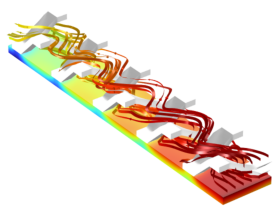
Dieses Tutorial modelliert die miteinander gekoppelten elektrochemischen Reaktionen, den Ladungs- und Speziestransport sowie den Wärmetransport in einer Polymer-Elektrolyt-Membran-Brennstoffzelle. Für die Gasströmungsfelder werden auf der Wasserstoffanodenseite gerade Kanäle verwendet, ... Mehr lesen
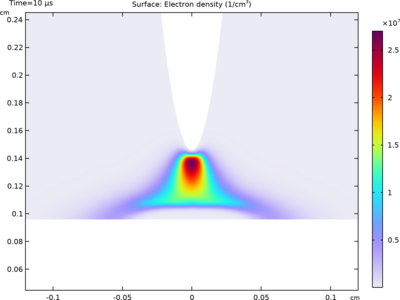
This model simulates a negative dielectric barrier discharge under a point-to-plate electrode configuration. Two solid dielectric layers are inserted into the air gap. A negative voltage of 2.5 kV is applied to the cathode electrode, initiating a corona streamer that propagates and ... Mehr lesen

Thermal management has become a critical aspect of today’s electronic systems, which often include many high-performance circuits that dissipate large amounts of heat. Many of these components require efficient cooling to prevent overheating. Some of these components, such as processors, ... Mehr lesen
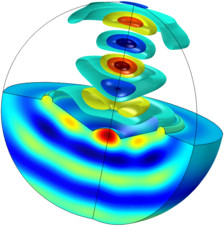
Beispiel eines Schwingspulen-Lautsprechers, bei dem Lumped-Parameter das Verhalten der elektrischen und mechanischen Komponenten darstellen. Die Thiele-Small-Parameter (Kleinsignalparameter) dienen als Eingabe für das Lumped-Modell, das über das Interface Electric Circuit dargestellt ... Mehr lesen


