
Die Application Gallery bietet COMSOL Multiphysics® Tutorial- und Demo-App-Dateien, die für die Bereiche Elektromagnetik, Strukturmechanik, Akustik, Strömung, Wärmetransport und Chemie relevant sind. Sie können diese Beispiele als Ausgangspunkt für Ihre eigene Simulationsarbeit verwenden, indem Sie das Tutorial-Modell oder die Demo-App-Datei und die dazugehörigen Anleitungen herunterladen.
Suchen Sie über die Schnellsuche nach Tutorials und Apps, die für Ihr Fachgebiet relevant sind. Beachten Sie, dass viele der hier vorgestellten Beispiele auch über die Application Libraries zugänglich sind, die in die COMSOL Multiphysics® Software integriert und über das Menü File verfügbar sind.
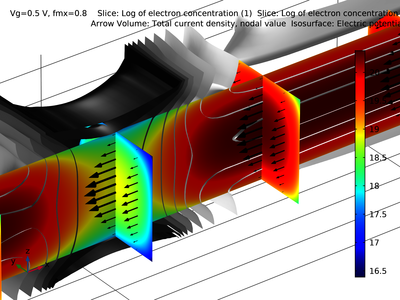
This 3D model of a nanowire MOSFET employs the density-gradient theory to add the effect of quantum confinement to the conventional drift-diffusion formulation, without requiring excessively high computational costs. The oxide layer is simulated explicitly with geometric domains, and ... Mehr lesen
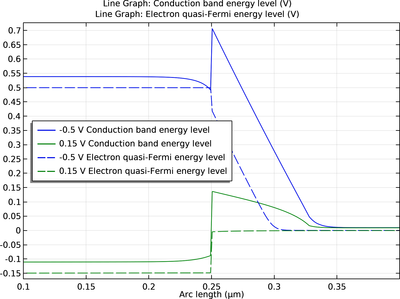
This benchmark model simulates a graded heterojunction using the thermionic emission formulation for the charge transfer over the junction. It shows the additional contribution to the current density from the quantum tunneling effect across the potential barrier, using the WKB ... Mehr lesen

With an increase in the parallel component of the applied field, carriers can gain energies above the ambient thermal energy and be able to transfer energy gained by the field to the lattice by optical phonon emission. The latter effect leads to a saturation of the carriers mobility. The ... Mehr lesen
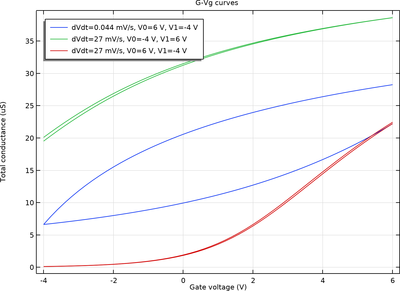
This tutorial analyzes the hysteresis of the conductance-gate-voltage (G-Vg) curves of an InAs nanowire FET, using the density-gradient theory to add the effect of quantum confinement to the conventional drift-diffusion formulation, without a large increase of computational costs. The ... Mehr lesen
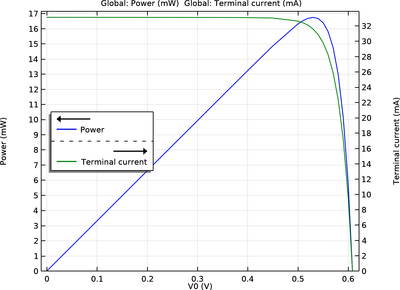
This tutorial uses a simple 1D model of a silicon solar cell to illustrate the basic steps to set up and perform a device physics simulation with the Semiconductor Module. A user-defined expression is used for the photo-generation rate and the result shows typical I–V and P–V curves of ... Mehr lesen
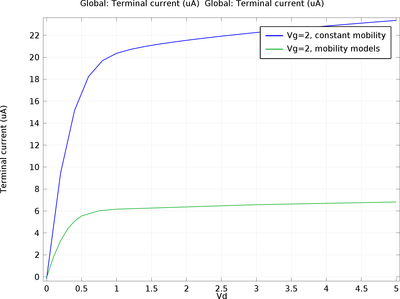
This model shows how to add several linked mobility models to the simple MOSFET example. Mehr lesen
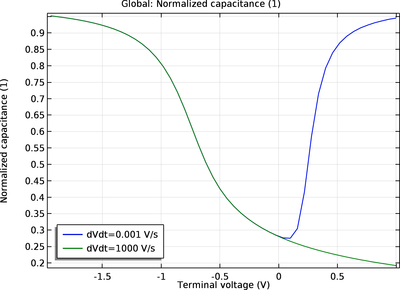
The metal-silicon-oxide (MOS) structure is the fundamental building block for many silicon planar devices. Its capacitance measurements provide a wealth of insight into the working principles of such devices. This tutorial constructs a simple 1D model of a MOS capacitor (MOSCAP). Both ... Mehr lesen
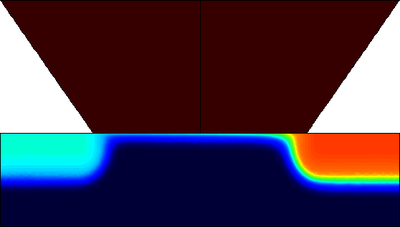
An ion-sensitive field-effect transistor (ISFET) is constructed by replacing the gate contact of a MOSFET with an electrolyte of interest. The concentration of a specific ionic species in the electrolyte can be determined by measuring the change in the gate voltage due to the interaction ... Mehr lesen
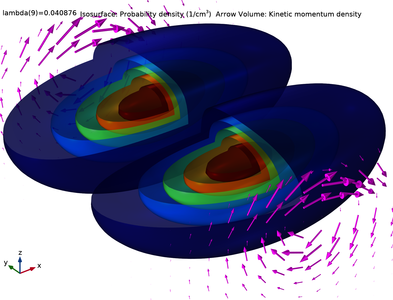
This tutorial model solves a two-component Schrödinger equation for the eigenstates of a simple silicon quantum dot in a uniform magnetic field, based on the paper by Jock et al. on the topic of spin-orbit qubits. The built-in domain condition Lorentz Force for the Schrödinger Equation ... Mehr lesen
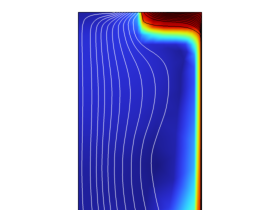
In this first half of a two-part example, a 2D model of a trench-gate IGBT is built, which will be extended to 3D in the second half. In general, it is the most efficient to start with a 2D model to make sure everything works as expected, before extending it to 3D. The Caughey&ndash ... Mehr lesen


