
Die Application Gallery bietet COMSOL Multiphysics® Tutorial- und Demo-App-Dateien, die für die Bereiche Elektromagnetik, Strukturmechanik, Akustik, Strömung, Wärmetransport und Chemie relevant sind. Sie können diese Beispiele als Ausgangspunkt für Ihre eigene Simulationsarbeit verwenden, indem Sie das Tutorial-Modell oder die Demo-App-Datei und die dazugehörigen Anleitungen herunterladen.
Suchen Sie über die Schnellsuche nach Tutorials und Apps, die für Ihr Fachgebiet relevant sind. Beachten Sie, dass viele der hier vorgestellten Beispiele auch über die Application Libraries zugänglich sind, die in die COMSOL Multiphysics® Software integriert und über das Menü File verfügbar sind.
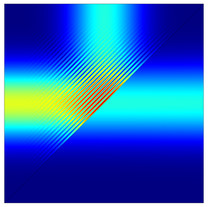
A beam splitter is used to split a single beam of light into two. One way of making a splitter is to deposit a thin layer of metal between two glass prisms. The beam is slightly attenuated within the layer, and split into two paths. In this example, the thin metal layer is modeled using ... Mehr lesen
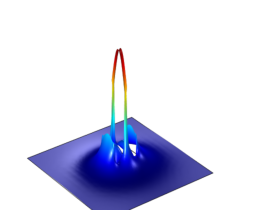
Das Modell analysiert die Modenausbreitung in einem Nano-Schlitzwellenleiter. In einer Schlitzwellenleiterkonfiguration sind zwei Platten mit hohem Brechungsindex (~3,48) neben dem Schlitz mit niedrigem Brechungsindex (~1,44) angeordnet. Die Modenanalyse wurde an einem 2D-Querschnitt ... Mehr lesen
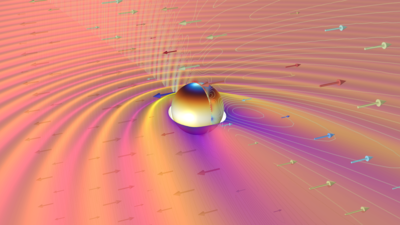
This model illustrates the process of evaluating the radar cross section (RCS) of a metallic sphere through the utilization of the boundary element method (BEM). By taking advantage of a vertical symmetry plane that is parallel to the polarization of an incident background field, the ... Mehr lesen
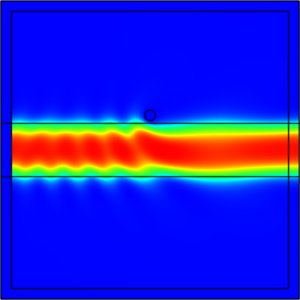
This model includes a dielectric slab waveguide with a small lossy metallic object nearby. The object causes light to be scattered, absorbed, and both reflected and transmitted along the waveguide. Learn more in this accompanying blog post: Modeling a Scatterer Near an Optical Waveguide Mehr lesen
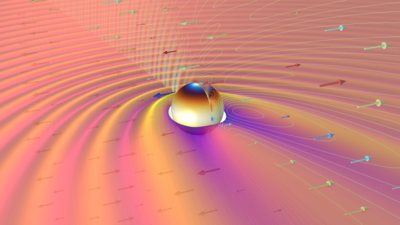
This verification model uses the Electromagnetic Waves, Boundary Elements interface to simulate the RCS of perfectly conducting sphere. The simulated result is compared to analytical calculation to verify the accuracy. Mehr lesen

Die Übertragungsgeschwindigkeit von Lichtwellenleitern ist der von Mikrowellenleitern überlegen, da optische Geräte eine viel höhere Betriebsfrequenz als Mikrowellen haben, was eine viel höhere Bandbreite ermöglicht. Singlemode-Stufenindexfasern werden für die Langstreckenkommunikation ... Mehr lesen
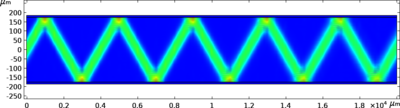
The bidirectional formulation of the Beam Envelopes interface can be used not only for counter-propagating wave simulations but also for waves propagating to up to two directions. In this model, an almost collimated Gaussian beam is excited at the left boundary and exhibits total ... Mehr lesen
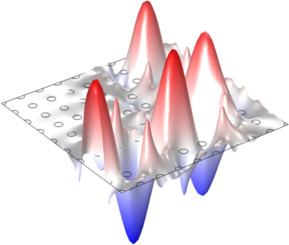
Photonische Kristalle sind periodische Strukturen aus abwechselnden Schichten von Materialien mit unterschiedlichen Brechungsindizes. Wellenleiter, die in einem photonischen Kristall eingeschlossen sind, können sehr scharfe, verlustarme Biegungen aufweisen, was eine Erhöhung der ... Mehr lesen

A planar dielectric slab waveguide demonstrates the principles behind any kind of dielectric waveguide such as a ridge waveguide or a step-index fiber. This model solves for the effective index and fields of a dielectric slab waveguide and compares the solution to analytic results. Mehr lesen

This example demonstrates a simulation setup for exciting surface plasmon polaritons using Otto and Kretschmann configurations. The underlying mechanism is enabled by the interplay between total internal reflection and evanescent-wave coupling phenomena. It also calculates the ... Mehr lesen


