
Sehen Sie, wie die Multiphysik-Simulation weltweit in der Forschung eingesetzt wird
Multiphysik-Modellierung und -Simulation treiben Innovationen in Industrie und Wissenschaft voran – wie die zahlreichen Anwendungsbeispiele zeigen, die jedes Jahr in den Fachbeiträgen und Postern von Ingenieuren, Forschern und Wissenschaftlern auf der COMSOL Conference vorgestellt werden. Lassen Sie sich von den unten aufgeführten aktuellen Beiträgen inspirieren oder nutzen Sie die Schnellsuche, um eine bestimmte Präsentation zu finden oder nach Anwendungsbereich oder Konferenzjahr/-ort zu filtern.
Sehen Sie sich die Sammlung für die COMSOL Conference 2026 an

Surface aeration systems are used in the wastewater treatment industry for the transfer of oxygen in the activated sludge process. These systems are capital intensive and also require a significant amount of energy to operate. Scale-up and design of these systems is largely empirical, ... Mehr lesen

This paper reports the design of a piezoelectric energy harvesting micro generator for an energy autonomous tire pressure monitoring wireless sensor node. For our design we use a piezoelectric MEMS generator approach without additional mass. The intrinsic mass of the cantilever is in the ... Mehr lesen

The model proposed by Schneider et al., for polymers is herein adapted in order to assess its suitability in elucidating the thixotropic behavior of aluminum alloys. The COMSOL Multiphysics program is employed to solve the inherent coupled mathematical problem, consisting in the ... Mehr lesen

All particles in suspension have a zeta potential, or surface potential. Its measurement is extremely important for predicting the formulation stability across a wide range of industries including food, ink and pharmaceuticals, water purification and medical devices. Zeta potential is ... Mehr lesen

The aim of the study is to predict the formation of porosities in the case of spot laser welding of tantalum. During the interaction, a deep and narrow cavity, called the keyhole, is generated. At the end of the interaction, surface tension provokes the collapse of the keyhole. Gas ... Mehr lesen
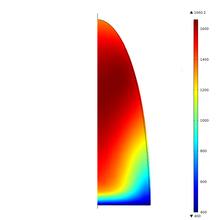
This paper describes a numerical solution method for the simulation of a cold crucible induction melting (CCIM) process involving the coupling of electromagnetic, temperature and turbulent velocity fields. During the CCIM process, the metal charge is contained on a water cooled ... Mehr lesen

In many metallurgical processes metals are (heated and) stirred by an oscillating external magnetic field. The magnetic field induces electric currents in the metal and the currents interact with the magnetic field to create a force, the Lorentz force. For high frequencies induction only ... Mehr lesen

Lorentz Force Velocimetry (LFV) is a non-contact measurement technique used to determine flow rates in electrically conducting fluids by exposing the flow to an external magnetic field and measuring the Lorentz force acting on the magnet system. Typically, for LFV applications real and ... Mehr lesen


