COMSOL Multiphysics Version 4.3b
|
|
Cross-section,A 2D cross-section is created from a 3D geometry of a heat exchanger using tools available in COMSOL Multiphysics. Incremental analysis of 2D cross-sections provides additional insight into the underlying physics in complex models. |
|
|
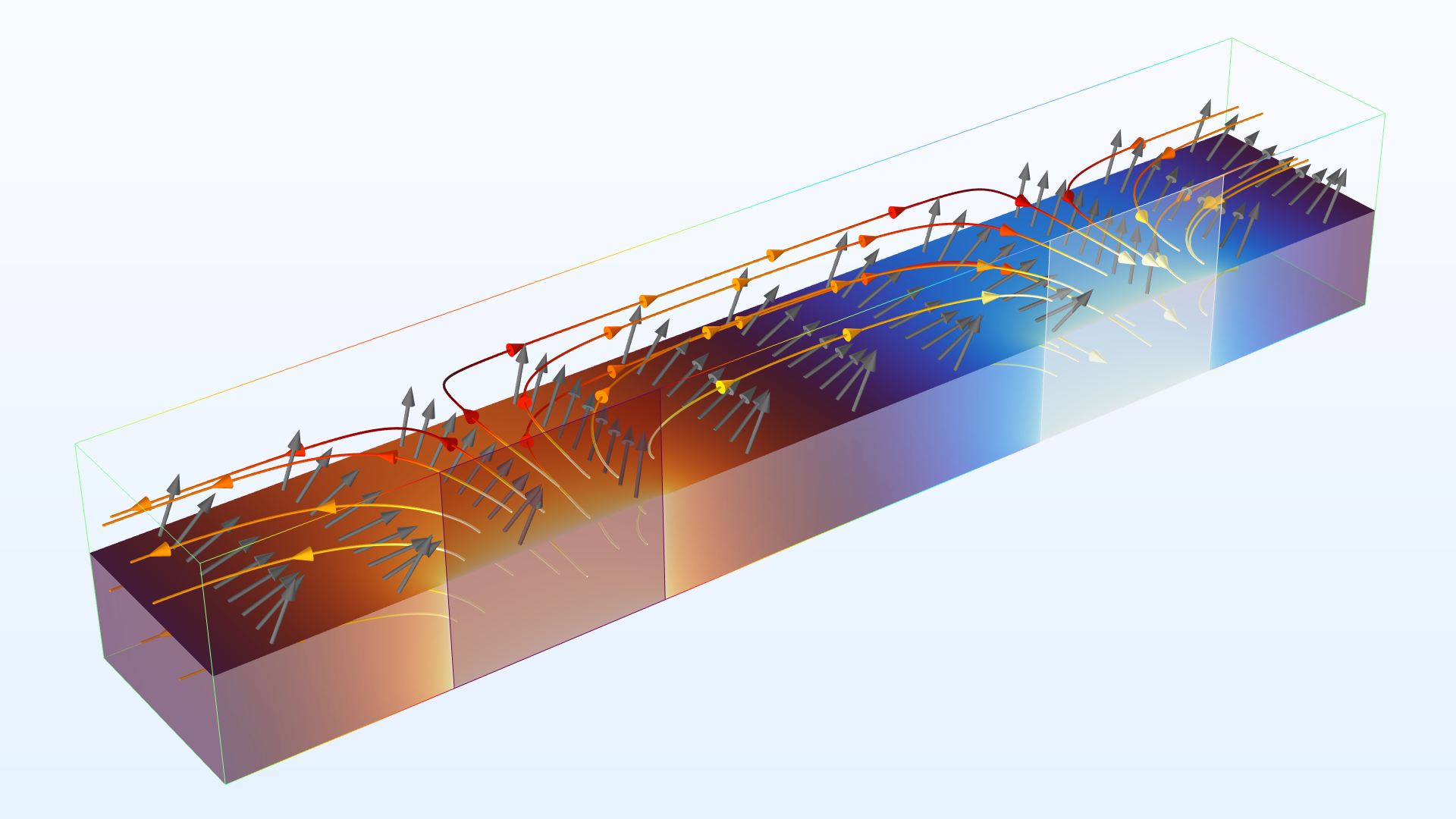
Curvilinear Coordinates,A model of an anisotropic s-shaped material was generated using the automated curvilinear coordinates feature in COMSOL Multiphysics. Simulation results reveal highly directed heat conduction through the material with heat originating at the center disk. These types of materials are used as passive coolers for flat screens and smart phones. |
|
|
Swept Mesh,A model of silicon ICs soldered onto a circuit board was meshed using the enhanced automatic sweeping feature available in COMSOL Multiphysics. Automated sweeping substantially reduces the amount of user interaction required to create a structured mesh.
|
Multibody Dynamics Module
|
|
Helicopter Swashplate Mechanism, Multibody Dynamics ModuleA model of the swashplate mechanism to control orientation of helicopter rotor blades was developed using the Multibody Dynamics Module. Transient simulation with both rigid and flexible blade designs provides insight into useful performance metrics such as blade deformation and lift force.
|
|
|
Reciprocating Engine, Multibody Dynamics ModuleModel of a three-cylinder reciprocating engine developed using the Multibody Dynamics Module. Simulation results show the von Mises stress in a connecting rod during crankshaft rotation. |
Wave Optics Module
|
|
Directional Coupler, Wave Optics ModuleA model of a directional coupler formed from two interacting waveguides was developed using the Wave Optics Module. The left waveguide is excited and the simulation results reveal the optical coupling between the waveguides through visualization of the electric field. |
|
|
Self-focusing, Wave Optics ModuleA model of a self-focusing Gaussian beam was developed using the Wave Optics Module and is important in the design of high-power laser systems. The simulation demonstrates 3D nonlinear wave propagation and the distribution of the index of refraction within the lens.
|
Molecular Flow Module
|
|
Film Deposition, Molecular Flow ModuleA model of gold film deposition via thermal evaporation was developed using the Molecular Flow Module. Transient simulation results confirm gold film thickness on both the sample and structures within the evaporator chamber.
|
|
|
Vacuum Systems, Molecular Flow ModuleA model of the adsorption and desorption of water in a load-lock vacuum system was developed using the Molecular Flow Module. Simulation results confirm the pressure in the vacuum chamber and load lock segments. |
Semiconductor Module
|
|
Semiconductor Analysis, Semiconductor ModuleModel of the DC characteristic of a MOS transistor was developed using the Semiconductor Module. Simulation results demonstrate transistor operation where an applied gate voltage turns the device on and then determines the drain saturation current.
|
Heat Transfer Module
|
|
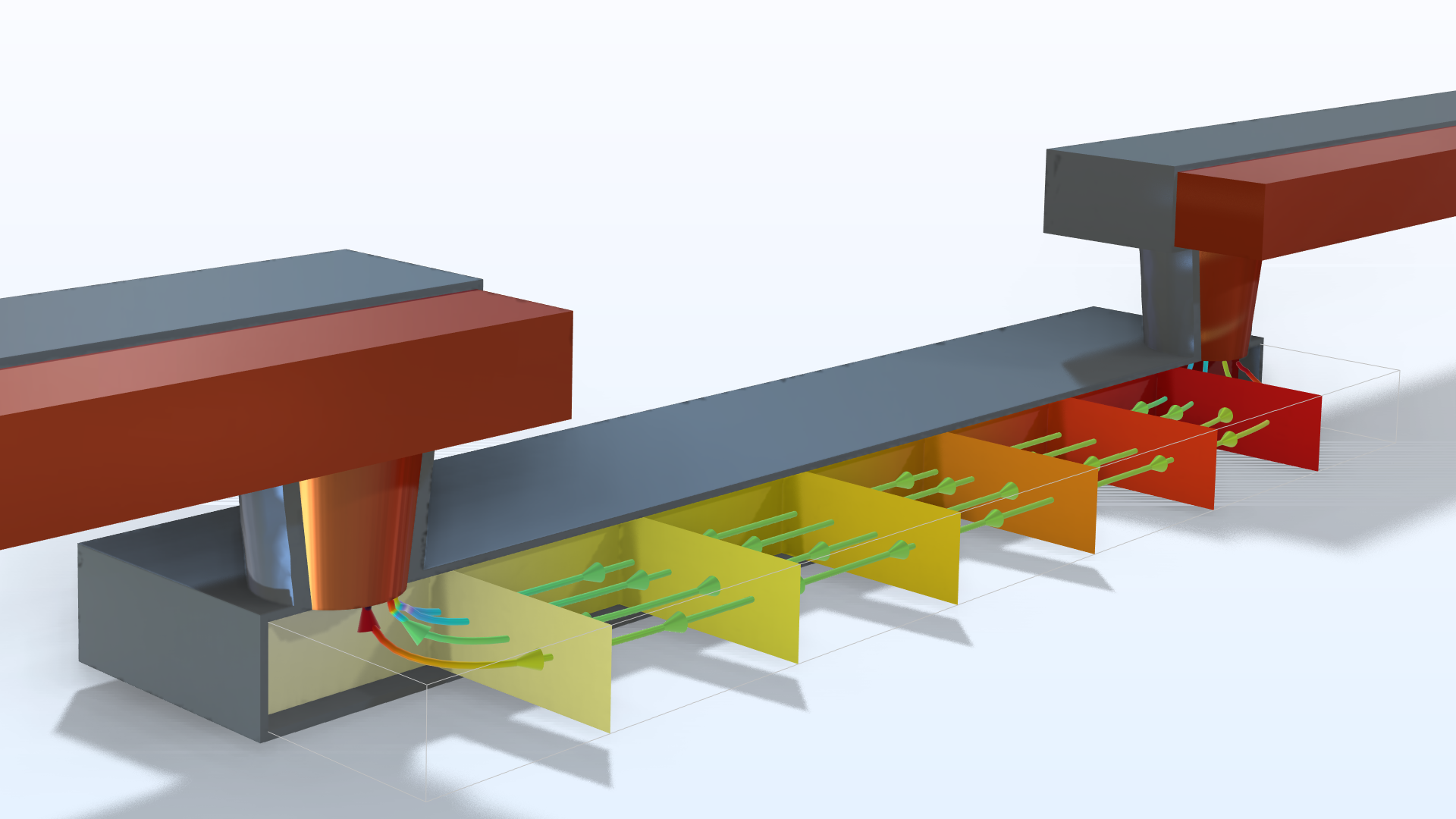
Contact Switch, Heat Transfer ModuleA model of the electrical current and heat flow in a contact switch was developed using the Heat Transfer Module along with AC/DC and Structural Mechanics Modules. In this multiphysics simulation, the thermal and electrical apparent resistances of the contacts are coupled to the mechanical contact pressure at the interface.
|
|
|
Power Supply Cooling, Heat Transfer ModuleThe thermal behavior of a computer power supply unit (PSU) is simulated. These electronic enclosures typically include cooling devices to prevent electronic components from being damaged by excessively high temperatures. An extracting fan and a perforated grille induce an air flow in the enclosure to abate internal heating. |
|
|
Greenhouse Heating, Heat Transfer ModuleThe greenhouse effect represents a well-known case of multi-wavelength radiative heating. This and similar phenomena can be simulated with the multi-wavelength surface-to-surface heat radiation from the Heat Transfer Module. Short-wavelength infrared radiation entering the structure is re-emitted from the ground as long-wavelength infrared and is trapped within the greenhouse thereby heating the interior in combination with convection.
|
|
|
Heat Exchanger, Heat Transfer ModuleA model of a shell and tube heat exchanger was developed using the Heat Transfer Module. Heat exchange occurs between flowing water in the inner pipes and the air-filled shell. Simulation results reveal flow velocity, temperature distribution, and pressure within the vessel. |
Electrochemistry Module
|
|
Impedance Spectroscopy, Electrochemistry ModuleA model of electrochemical impedance spectroscopy (EIS) was developed using the Electrochemistry Module. Simulation reveals the system impedance displayed in Bode and Nyquist plots to illustrate the transition between kinetic and transport control for a range of reaction rates. |
|
|
Cyclic Voltammetry, Electrochemistry ModuleA model of cyclic voltammetry was developed using the Electrochemistry Module. During simulation, the potential at the working electrode is swept up and down while the current is recorded. This waveform provides information about the reactivity and mass transport properties of an electrolyte. |
AC/DC Module
|
|
Single-turn Coil, AC/DC ModuleA model of a thin coil can be represented by an infinitely thin single-turn coil boundary using the AC/DC Module. The use of a coil boundary greatly simplifies simulation by eliminating the need to mesh the thickness of a thin coil thereby reducing the mesh count and memory usage. |
RF Modules
|
|
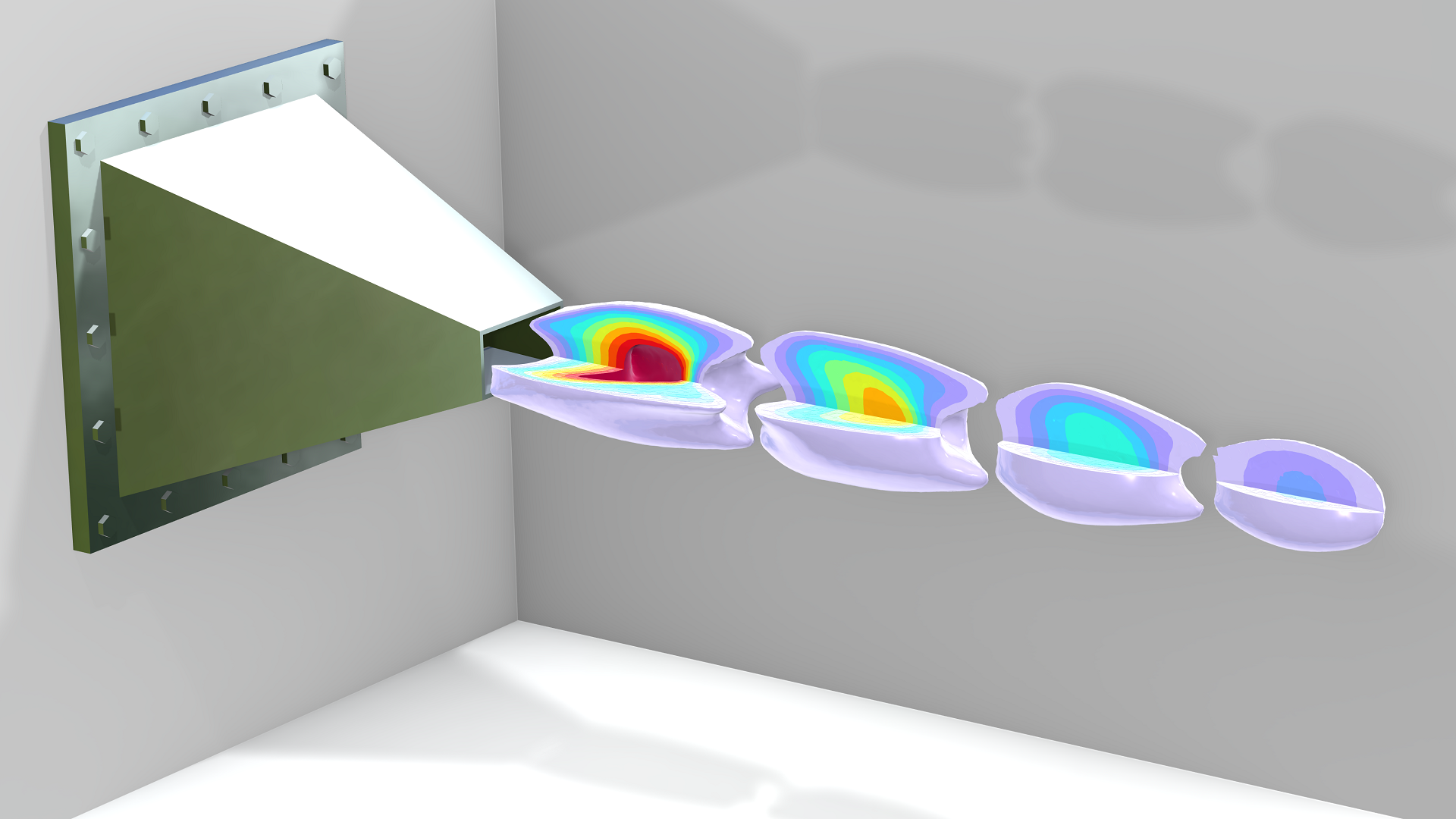
Plasmonics, RF ModulesA model of a wire grating on a dielectric substrate was developed using the RF Module. Simulation of an electromagnetic plane wave at different angles of incidence (AOI) relative to the wire grating provides the transmission and reflection coefficients of refraction, diffraction, and specular reflection.
|
As editors or journalists, you are more than welcome to use the images here in any appropriate
article as long as you insert the phrase "Image made using COMSOL Multiphysics® and is provided
courtesy of COMSOL®." This should appear in the vicinity of any image or at the bottom of the article.
Others interested in using the images here can gain permission by contacting your local sales representative or
COMSOL office (http://www.comsol.com/contact/) or by writing to .
Available Images
- COMSOL Multiphysics Version 4.3b
- COMSOL Multiphysics Version 4.3a
- COMSOL Multiphysics Version 4.3
- COMSOL Offices
- RF Tutorial Package
- COMSOL Version 4.2a
- Geomechanics Module
- Microfluidics Module
- Acoustics Module
- Electrodeposition Module
- COMSOL Version 4.2
- COMSOL Version 4.1
- Batteries and Fuel Cells
- Plasma Module
- Chemical Reaction Engineering Module
- COMSOL Multiphysics 4.0 Images
- COMSOL Multiphysics 3.5a Images