
W. Lee, K. Jensen
MIT, MA, USA
The chemical reactions used to generate solvents and certain pharmaceuticals rely on organic synthesis, a process of combining individual chemicals that can be accelerated through microwave heating. A microreactor system facilitates the direct, localized, and efficient temperature change necessary for successful synthesis. However, a uniform temperature distribution is crucial to the chemical process, and these reactions can be inhibited by unwanted temperature changes or heating that occurs too slowly. Wen-Hsuan Lee, a researcher at the Massachusetts Institute of Technology (MIT), fabricated a borosilicate glass microreactor to conduct this microwave organic synthesis, but when she tested her design in a microwave system, she discovered that the heating was uneven and below the desired temperature. Using COMSOL Multiphysics, she modeled the microreactor to investigate the effects of its geometry and orientation on the heating process. From her simulation results, she was able to redesign the microreactor and optimize its location and orientation in the microwave system to achieve successful organic synthesis.
Suggested Stories
Prototyping Antennas for Mobile Recording of TV Sports Events with Simulation
Researchers at Radiotelevisione Italiana (RAI) are optimizing circularly polarized antenna designs for recording live ...
Improving Gas Pipeline Squeeze-Off Standards with Numerical Simulation
Gas Technology Institute (GTI), a leader in natural gas research, development, and training, investigated industry ...
Kompression der Wartezeit auf eine Zukunft mit Fusion
General Fusion hat mithilfe von Multiphysik-Simulationen erfolgreich eine Fusionsdemonstrationsanlage entwickelt und ...
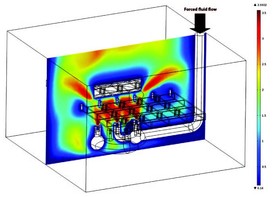
Conjugate Heat Transfer
This is an application brief describing the concept of Conjugate Heat Transfer, which is important in many industrial ...


