
Amazon Uses Multiphysics Methodology for Loudspeaker Thermal Performance Prediction
Engineering Great Sound: Predicting Loudspeaker Thermal Performance at Amazon
The audio technology team at Amazon develops audio systems for a variety of consumer device categories to empower its customers to stay connected, informed, and entertained. The COMSOL Multiphysics software is an integral piece of the team's design evaluation and optimization process.
By Steven Collins
November 2026
Think back to the last time a piece of media deeply affected you; how important was sound to that experience? Well-designed audio equipment plays an enormous role in the immersion we feel when watching a movie or listening to an album, as shown through the tension created by a pulsing synth in a horror movie score or the rock that appears in our throats when an orchestrated piece builds into a somber swell of strings. These emotional responses are made possible in large part by a series of complex multiphysics interactions at play within the audio system, enabling accurate sound reproduction that is immersive enough to be moving.
In the words of Lakshmikanth Tipparaju, a hardware development engineer at Amazon Devices, "Loudspeakers are multiphysics systems in nature. The more faithfully we capture the different physical fields in the model, the closer we get to real world performance prediction." For this reason, his team uses the COMSOL Multiphysics software in their audio device evaluation process to develop great sounding products for their customers.
Looking Past the Speaker Grille
Consumer devices developed by Amazon cast a wide net in terms of audio goals and capabilities. Some examples include Echo Frames® smart glasses that deliver premium sound quality from small form factors, Echo Show® smart displays with audio-based ultrasound presence detection to enable more personalized Alexa+® experiences, and Echo® smart speakers that can be paired with Fire TV® devices to create immersive surround sound experiences through Alexa Home Theater. These systems and capabilities, while all different, have an integral commonality: They each depend on loudspeaker drivers that convert electrical signals into sound waves. This operation includes two transduction mechanisms; the first focuses on converting electrical signal to mechanical motion (via a motor system), and the second focuses on converting mechanical motion to sound waves (via a moving-parts system).
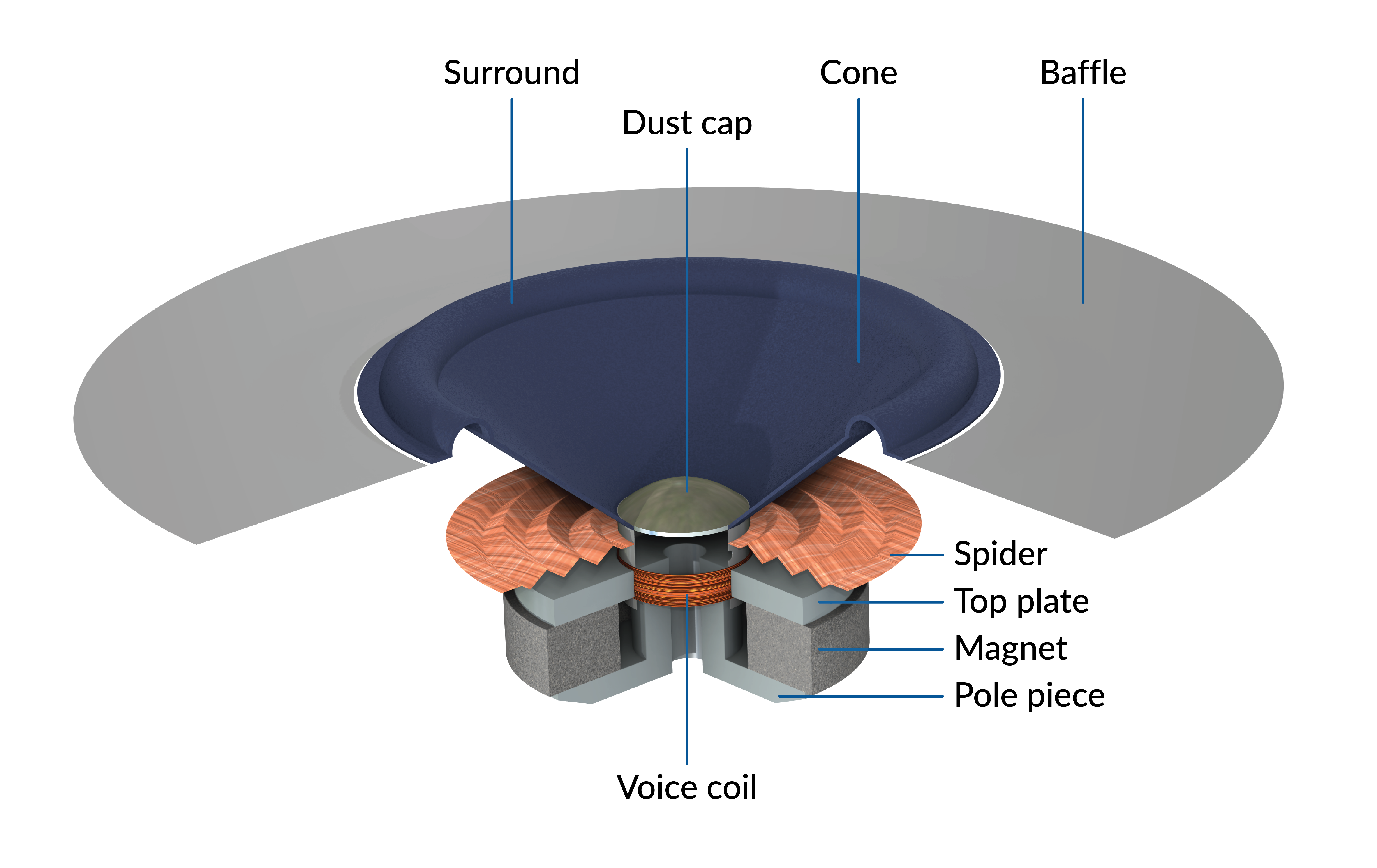
Most of the energy in this process is turned into heat due to resistive heating of the voice coil (Figure 1). As the voice coil temperature rises, its electrical resistance increases, reducing the current flowing through the coil and acoustic output of the driver — a phenomenon known as thermal power compression. To accurately predict loudspeaker driver coil and magnet temperature, the audio technology team at Amazon uses a multiphysics methodology that captures both thermal conduction as well as convection cooling from voice coil motion-induced oscillating airflow in the motor gap.
The Simulation Workflow
The multiphysics simulation workflow developed by Tipparaju for evaluating loudspeaker thermal performance can be boiled down to four general steps. First, a fully coupled transient loudspeaker driver model must be solved for a few cycles to reach steady state behavior, accounting for electromagnetics, structural mechanics, thermal, and fluid flow interactions.
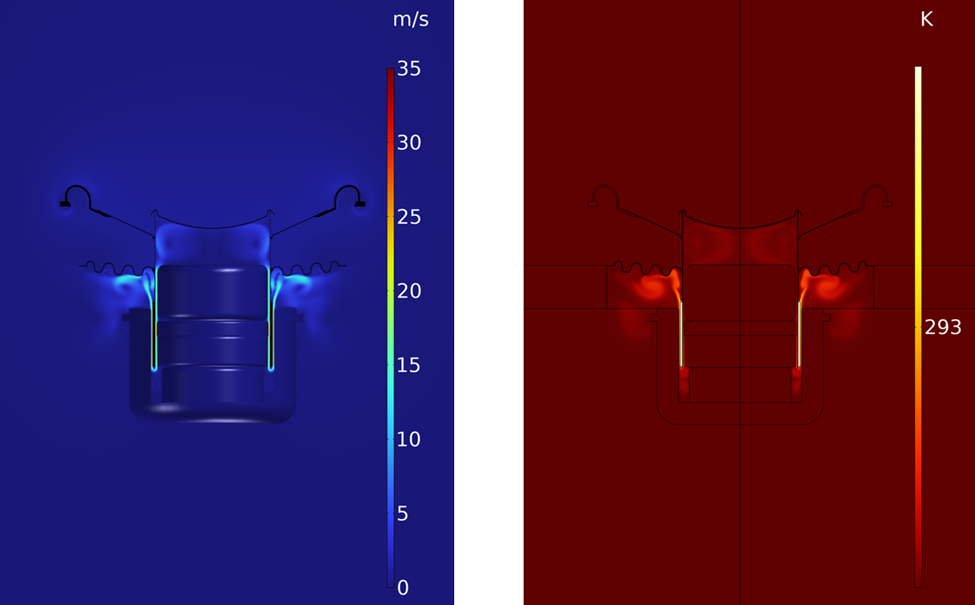
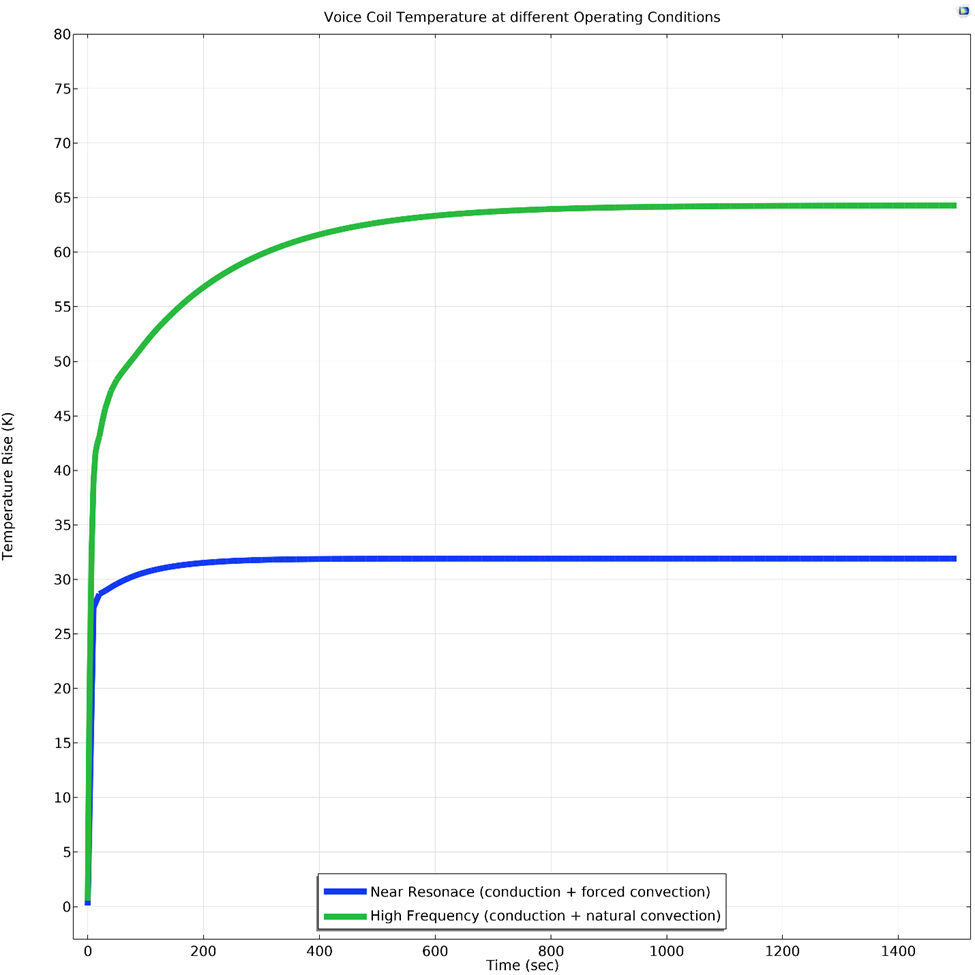
From there, the cycle-averaged voice coil currents and heat transfer coefficients can be extracted. This data is then used to solve long-term thermal simulations that, in turn, enable the generation of transient voice coil temperature response and prediction of thermal parameters (Figures 2 and 3).
"We are a fast-paced and collaborative team — simulation helps us get results faster while maintaining accuracy," said Tipparaju. "When solving transient electro-thermal studies, I use a two-stage simulation workflow to account for different time cycles. For loudspeakers in particular, coupling fast electromechanical analyses with slower thermal aspects in a two-stage simulation workflow can reduce a multimillion time-step problem to just a few thousand time-steps without losing physical accuracy."
Tipparaju continues, “Once we generate the simulated thermal parameters of the loudspeaker driver, the parameters are then fed into a broader reduced network model to predict power compression and magnet temperature under system level constraints, enabling the assessment and mitigation of any design risks before building physical prototypes.”
The team is able to numerically solve the complex multiphysics interactions in their loudspeaker designs with COMSOL Multiphysics, including the effect of the coil voltage, the voice coil displacement, and — based on the displacement — the fluid flow and heat transfer coefficient.
For their simulation work, Tipparaju and his colleagues employ the built-in functionality of COMSOL Multiphysics as well as the software's add-on products, including the AC/DC Module, Acoustics Module, CFD Module, Heat Transfer Module, and Structural Mechanics Module. In particular, the team utilizes the software's ability to study moving mesh. As explained by Tipparaju, "Voice coil motion introduces geometric nonlinearity in the narrow motor gap. Moving-mesh modeling enables us to capture this motion and the resulting fluid-flow behavior without remeshing at each time step." Additionally, a feature dedicated to thin layers is an integral part of the workflow, as it makes it possible for the team to analyze the effect of bonding glues in designs.
Multiphysics simulation offers a holistic view of loudspeaker designs before building physical prototypes, further strengthened by the ability to zoom in to specific, minute design details for deeper levels of control. Given the interactive relationship of the many components found in loudspeakers, this range of observation is vital for ensuring optimal acoustic performance. When describing his workflow, Tipparaju states, "The work that I have done involves coupling multiple physical fields across different spatial and temporal scales. With COMSOL, I can seamlessly use different physics-based modeling techniques to capture these interactions within a unified simulation workflow."
Expanding Simulation Access at Amazon
Further driving Amazon's integration of simulation technologies, Tipparaju developed a custom simulation app in the software's Application Builder. Simulation apps offer simplified, customizable user interfaces that only include settings relevant to the intended users, enabling even those with no prior simulation experience to efficiently run their own simulations.
Simulations are integral to product development for the Amazon Devices Audio Technology team.– Lakshmikanth Tipparaju, a hardware development engineer at Amazon Devices
Tipparaju notes his appreciation of the app's capabilities, as it has freed up his time for new projects and offers his teammates more versatility in testing and verifying their designs. The app is particularly powerful for product development, where there are strict performance requirements and tight deadlines that must be met, since steps such as geometry creation, assigning physics or boundary conditions, and post-processing simulation results can be automated.
Optimizing Processes and Products with Simulation-Based Design
Simulation has influenced numerous design decisions and accelerated audio technology development at Amazon. Multiphysics modeling and simulation, in particular, empowers Tipparaju's team to gain an accurate, real-world understanding of loudspeaker designs before building physical prototypes.
"Simulations are integral to product development for the Amazon Devices Audio Technology team," said Tipparaju.
With established, simulation-based design processes, Tipparaju's team continues to advance loudspeaker designs, ensuring that the complex physics behind the technology fades into the background, leaving only the immersive listening experiences that stick with audiences long after they end.
Suggested Stories
The Sight of Sound: Revealing the Effects of Enclosure Design on Loudspeaker Performance
L-Acoustics uses acoustics simulation to optimize their bass reflex speakers for sound systems in arenas and concert ...
Virtually Optimizing Metasurface Topology with a Genetic Algorithm
To optimize a metasurface topology for an optical antenna design, an engineer from the Air Force Institute of ...
Dielectric Stress Simulation Advances Design of ABB Smart Grid-Ready Tap Changers
Consumers of power rely on fairly stable voltages. Transformers contain tap changers which vary the ratio of secondary ...
Magnets Improve Quality of High-Power Laser Beam Welding
High-power laser beam welding uses a localized heat source to achieve narrow deep welds and high welding rates. ...


