
General Atomics Designs Helicon Antenna for Tokamak with Simulation
Humberto Torreblanca, General Atomics, USA
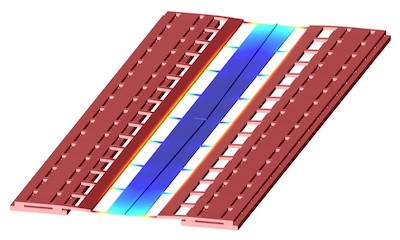
Built by engineers at General Atomics, the DIII-D tokamak needs to achieve temperatures that are 10 times hotter than the core of the Sun to achieve nuclear fusion. To accomplish this, a novel heating system using a helicon antenna that can inject 1 megawatt of RF power is being designed and built. Humberto Torreblanca, the DIII-D tokamak chief operator, and his team are using multiphysics simulation to model all aspects of the design, such as the magnetic field distribution inside and outside the tokamak vessel as well as the electric field distribution and RF losses of the helicon antenna.
Suggested Stories
Magnetic Transmissions Increase Lifespan of Offshore Wind Farms
Sintex is a developer and manufacturer of magnetic couplings, systems that transmit torque and power with ...
Entwicklung eines photonischen MEMS-Phasenschiebers aus Silizium mit Simulation
Forscher der Eidgenössischen Technischen Hochschule Lausanne optimieren mit Hilfe von Simulationen die optische und ...
Bosch elektrifiziert die Zukunft der Automobilbranche
Für die Entwicklung von dreiphasigen Wechselrichtern und Zwischenkreiskondensatoren, zwei integralen Komponenten des ...
Man-Made Stars: Evaluating Structural Integrity in High-Performance Nuclear Fusion Machines for Power Generation
For over 50 years, power generation through nuclear fusion has been the focus of international research efforts to ...


