
NEXT ENERGY Analyzes Heat Transfer in Lithium-Ion Batteries
Gerd Liebig, Pamina Bohn, NEXT ENERGY EWE Research Centre for Energy Technology, Germany
Lithium-ion batteries, which have a tendency to degrade at high temperatures, must adhere to stringent regulations guaranteeing their ability to withstand operating temperature fluctuations. Researchers at NEXT ENERGY used heat transfer modeling to study whether high welding temperatures can create enough temperature propagation within cells to cause irreversible damage, such as electrolyte decomposition and capacity loss. They discovered that tab welding can, in fact, induce irreversible damage, but laser welding is significantly less detrimental.
Suggested Stories
Illuminating the Physics Behind Electromagnetics Concepts with Applications
Electrical engineering students find it hard to visualize the electromagnetics concepts they are learning. To remedy ...
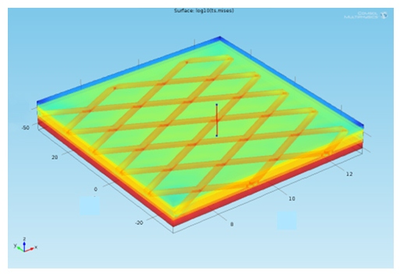
Boeing Simulates Thermal Expansion in Composites with Expanded Metal Foil for Lightning Protection of Aircraft Structures
Carbon fiber composites are used extensively throughout the body of modern aircraft, such as the Boeing 787 ...
Magnetic Transmissions Increase Lifespan of Offshore Wind Farms
Sintex is a developer and manufacturer of magnetic couplings, systems that transmit torque and power with ...
Optimizing Screen Protection During the Manufacturing Process
Cover glass, the screen surface material used for tablets and cell phones, offers exceptional smoothness, a mark-free ...


