
Konica Minolta Uses Simulation to Study and Optimize OLED Devices
Leiming Wang, Konica Minolta Laboratory, USA
As the demand for lightweight and flexible electronics continues to increase, so does the demand for lightweight and flexible light sources. Organic LEDs (OLEDs) have garnered tremendous interest because of their inherent elasticity, but suffer from a lack of brightness and efficiency. Researchers at Konica Minolta are working to alleviate these limitations and minimize light lost in their OLED designs. Using the COMSOL Multiphysics® software, they simulated the electromagnetic field and light emission distribution for a variety of nanostructured cathode geometries, determined the optimal configuration, and were able to cut light losses in half.
Suggested Stories

Optimization Slashes Energy Consumption in Silicon-Based MEMS CO2 Detectors
CEA-MINATEC is an international center for micro and nano-technologies which is funded by CEA, a French government ...
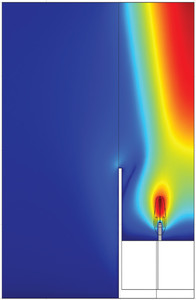
Multiphysics Analysis of a Burning Candle
Using COMSOL Multiphysics, AltaSim Technologies were able to predict the temperature distribution and flow pattern of ...
Manipulate and Control Sound: How Mathematical Modeling Supports Cutting-Edge Acoustic Metamaterials Research
Researchers at Duke University are using numerical modeling to develop metamaterial structures for acoustic cloaking. ...

Fine Tuning for Water Purification
Amsterdam Water Supply (AWS) of the Netherlands produces some of the cleanest drinking water in the world using an ...


