
Clemson Simulates Electrode Setup for Dielectrophoresis
G. Zhang
Clemson U, SC, USA
J. Brcka, J. Faguet, E. Lee
Tokyo Electron, TX, USA
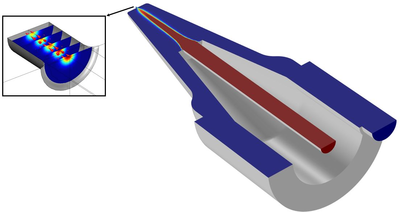
Dielectrophoresis (DEP) is a method of patterning cells and particles used in medical, electronics, and energy applications. When an electric field is applied to an array of cells or dielectric particles suspended in a medium, they become polarized, causing movement that reorganizes the particles. This is an efficient way to assemble materials layer by layer at the nanoscale, and is sometimes used in mass production of materials. Through a partnership between Clemson University and Tokyo Electron U.S. Holdings, Inc., researchers are analyzing unexpected particle rotation and alignments they have observed during cell patterning. They have used COMSOL Multiphysics models to understand cell patterns and material assembly; their simulations account for nonhomogeneous cell properties and electric field distortions, which they are analyzing to predict the influence of DEP force on this behavior.
Suggested Stories
Optimizing Hematology Analysis: When Physical Prototypes Fail, Simulation Provides the Answers
Hematology analysis, the analysis of a blood sample to determine a variety of hematological parameters, is a major ...
Entwicklung des Gold-Standards für immersives Audio in Virtual-Reality-Spielen
Tectonic Audio Labs setzt elektromagnetische, mechanische und akustische Simulationen ein, um einen hochmodernen ...
Prototyping Antennas for Mobile Recording of TV Sports Events with Simulation
Researchers at Radiotelevisione Italiana (RAI) are optimizing circularly polarized antenna designs for recording live ...
From Spreadsheets to Multiphysics Applications, ABB Continues to Power Up the Transformer Industry
The buzzing sound you sometimes hear when walking past high-voltage transmission lines is caused by transformers used ...


