
S. Yushanov, J. Crompton, and K. C. Koppenhoefer, Altasim Technologies, OH, USA
When electromagnetic waves propagate through matter, they interact with inhomogeneities and particles that can locally disrupt the electron distribution, causing electromagnetic radiation and scattering. One mathematical model used to describe the scattering of electromagnetic waves is called Mie scattering, which provides a general solution independent of particle size. Examples of phenomena where Mie scattering applies include dust in the air, oil in water, and measuring cell nuclei in biological systems.
In order to model Mie scattering, Maxwell's equations are used to represent the scattered, incident, and internal fields, which are represented by infinite series when solved with an analytical approach. Using COMSOL Multiphysics, AltaSim Technologies has developed a simulation to easily obtain the rates of absorption, scattering, and extinction of electromagnetic energy, and the radiation forces present. They have used a perfectly matched layer (PML), far-field calculations, and surface boundary conditions to calculate the scattered energy. Their computational model contributes to the visualization and understanding of the interactions between particles and incident electromagnetic waves.
Suggested Stories
Inspiring Young Engineers to Design for the Future at EPFL
EPFLoop, from the Swiss Federal Institute of Technology Lausanne (EPFL), designed their pod for the 2018 SpaceX ...
Fuel Cells Poised to Replace India’s Diesel Generators
Inefficient and potentially harmful diesel generators are still the prevailing method of decentralized power ...
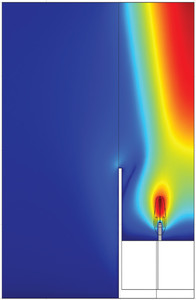
Multiphysics Analysis of a Burning Candle
Using COMSOL Multiphysics, AltaSim Technologies were able to predict the temperature distribution and flow pattern of ...

Magnets Improve Quality of High-Power Laser Beam Welding
High-power laser beam welding uses a localized heat source to achieve narrow deep welds and high welding rates. ...


