
NASA Engineers Simulate Gas Flow and Heat Transfer
J. Knox, R. Coker
NASA Marshall Space Flight Center, AL, USA
To ensure astronaut safety on space missions, it is necessary to routinely revitalize the atmosphere in manned spacecraft. Jim Knox, Rob Coker, and a team of engineers at the NASA Marshall Space Flight Center have developed a water-saving system called an Isothermal Bulk Dessicant (IBD). The IBD is used to collect water from the atmosphere for re-use. It consists of packed beds lined with silica gel; as air flows through, water is adsorbed onto the silica gel and then transferred back to the atmosphere through desorption once the air has continued on to a CO2 removal system. Using a COMSOL Multiphysics model, Knox and Coker simulated the gas flow and heat transfer in a four-bed IBD. They tracked the flow rates, pressure conditions, and water concentration as water adsorbed and desorbed. Their model predicted that the IBD successfully saved 85% of the water from the atmosphere. As they use COMSOL to optimize their designs, they hope to offer NASA integrated systems that will enable farther space travel than ever before.
Suggested Stories
Pushing the Limits of Chip Density
Chip manufacturers have been adhering to Moore’s law, a law stating that the number of transistors that can be ...
Greening the Heart of the City: An Urban Rooftop Drainage System Inside a Garden Fence
TL-Engineering, a simulation consultant, teamed up with a professor, civil engineer, and sound barrier company to ...
Multiphysics Analysis Helps Preserve the Past
Jos van Schijndel is the founder of Netherlands-based consulting firm CompuToolAble and assistant professor at ...
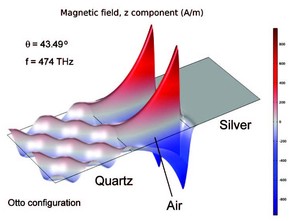
Surface Plasmon Resonance
Surface Plasmon Resonance (SPR) is created by surface plasmons, coherent electron oscillations existing between any ...


