
Defining Surface Plasmon Resonance Effects with Simulation
Sergei Yushanov, Jeffrey S. Crompton, Luke T. Gritter, and Kyle C. Koppenhoefer
AltaSim Technologies
Columbus, OH
USA
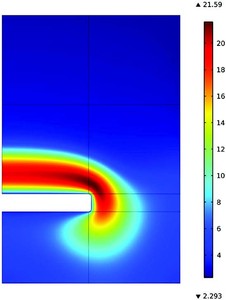
Surface Plasmon Resonance (SPR) is created by surface plasmons, coherent electron oscillations existing between any two materials where the real part of the dielectric function changes sign across the interface. SPR technology is based on the electromagnetic field component of incident light penetrating into a surface and it can be used to detect molecular adsorption on surfaces.
Plasmon excitation typically exists in two configurations: the Kretschmann-Raether configuration, where a thin metal film is sandwiched between a dielectric and air, and the incident wave is from the dielectric side; and the Otto configuration, where an air gap exists between the dielectric and the metal. Using COMSOL Multiphysics, the effect of the SPR on the electromagnetic field can be defined, which has allowed for the measurement of surface contaminants and nano-scale photonic devices.
Suggested Stories
Designing a Miniaturized Wastewater Treatment Plant for Micropollutant Degradation
Eden Tech uses multiphysics simulation to design a miniaturized wastewater treatment system made from compact discs. ...

Analysis and Simulation of Rock Properties
VSG provides high-performance 3D visualization toolkits and software for a number of industries, including materials ...
Simulations-Apps erleichtern die Entwicklung von Elektromotoren
Die Ingenieure von Volkswagen Kassel entwickeln und vertreiben Simulations-Apps, mit denen sich die Festigkeit von ...
Capacitively Coupled Plasma Analysis
AltaSim Technologies provides engineering consulting services involving advanced multiphysics modeling such as ...


