Voxelgrids Pioneers Accessible MRI Technology Through Virtual Analysis
Voxelgrids Innovations developed India's first MRI scanner that was fully produced domestically. Moreover, the machine was specifically designed to be more affordable for patients. To engineer this design, the company used multiphysics simulation.
By Dhananjay Mishra
June 2026
In the race to make advanced medical imaging more accessible, Voxelgrids Innovations faced a big challenge: the weeks-long cooldown process for traditional MRI magnets. Using the COMSOL Multiphysics® software and its add-on Heat Transfer Module, the team compressed months of trial and error into days of virtual experimentation, reducing product development time by 40% while also eliminating the need for costly helium in its MRI machine. Ultimately, the team's work resulted in India’s first indigenous commercial 1.5 Tesla (T) MRI scanner.
Challenges of MRI Systems & Voxelgrids' Solution
MRI procedures have saved countless lives, giving doctors a window into the human body unlike any other technology for decades. However, MRI tests remain out of reach for many, owing primarily to the high cost of such a procedure. A major driver of that cost is the upkeep of the enormous superconducting magnets that make the technology possible. To work, these magnets need to be bathed in thousands of liters of liquid helium, which chills the magnets to extremely cold temperatures. This helium is expensive and often hard to obtain. Additionally, the chilling process is slow, possibly taking up to three weeks before the machine can be reused.
Founded in 2017 by Dr. Arjun Arunachalam, Voxelgrids started with an ambitious goal: to make low-cost MRI procedures available to everyone. The team decided to build a powerful, compact 1.5 T scanner that relies on a conduction-based cooling system rather than liquid helium. At the core of this innovative cooling system is the cold head — a mechanically coupled cryocooler that extracts heat directly from the magnet to keep it at the superconducting state of 4.2 K. While helium-based MRI machines also incorporate a cold head, Voxelgrids’ cold head is specifically designed for conduction cooling, extracting heat away through conduction, and eliminating the need for liquid helium.
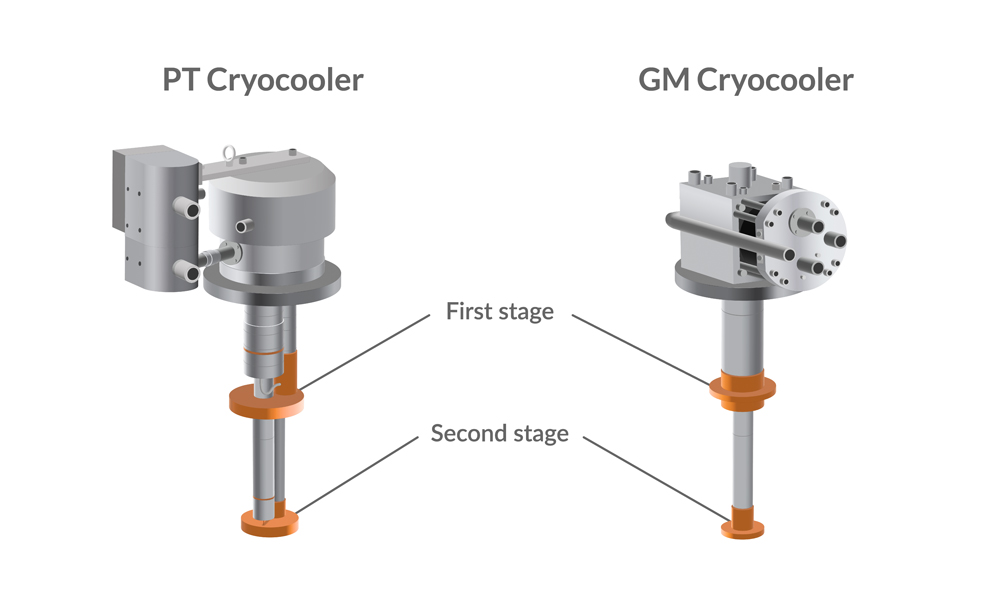
However, the team's idea came with several challenges. Firstly, not all cold heads perform the same way. Their performance is dictated by complex, interdependent two-stage cooling curves, where the cooling capacity at each stage varies nonlinearly with temperature. Additionally, the contact resistance between metal surfaces, the pressure at interfaces, and heat transfer between components could dramatically alter the system's behavior. These factors are very difficult to measure and account for. Moreover, with every new design idea, the team faced a two-week cooldown process to see if the idea worked.
"We would choose a cold head, bolt it on, and start the cooldown," said Dr. Ashok K.B, a senior simulation engineer at Voxelgrids. "Then came the hard part: waiting. For almost a month, we would watch and hope, only to find out the design had a weak spot or a heat flow issue. Back to square one."
For a startup aiming to innovate rapidly, this timeline was an operational and financial impossibility. The team needed an accurate and reliable way to test its ideas without spending weeks waiting for an answer. To choose a cold head design with more confidence and reduce timely prototyping, the team used multiphysics simulation.
Simulating the Cooldown Process
In an MRI system, a two-stage cooling mechanism is employed to maintain the superconducting magnet at the cryogenic temperatures required for operation. For the first stage, the cold head acts as a thermal barrier, operating at an intermediate temperature range of approximately 40 to 50 K to cool the surrounding radiation shield. This process effectively blocks external heat loads before they can reach the magnet assembly and creates an environment for the second stage to start. The second stage achieves the ultimate base temperature of around 4 K, which is necessary to sustain the superconducting state of the magnet coils.
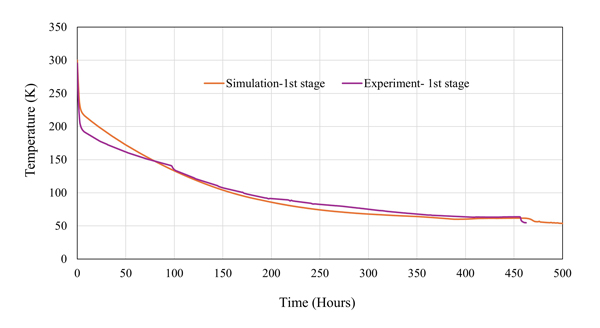
The team members at Voxelgrids built a detailed virtual model of their conduction-cooled magnet system. The first task was accurately modeling the cold head, which was useful for dynamically calculating how much heat could be removed at every temperature point during the cooldown. Figure 2 shows how the virtual model of the cold head closely agrees with the simulation results of the first stage of the cooldown process.
The simulation-driven approach gave the team the freedom to explore a wide range of design possibilities. With multiple cold head options available, where each had its own unique two-stage performance characteristics, the team was able to test different permutations and combinations virtually. By simulating various scenarios, the engineers compared cooldown behavior and temperature stability, eventually zeroing in on the design that best met their requirements. The simulation also enabled them to investigate critical failure modes. They simulated what would happen if the cold head did not operate properly and the temperatures of the first and second stage, which are vastly different, were to accidentally overlap. These simulation results confirmed that the final design would maintain proper thermal isolation under real-world operating conditions, giving the team confidence before moving to physical prototyping.
Additionally, while the engineers initially started with a basic cold head design, they then added more physical phenomena to enhance the model. Thermal contact resistance at mechanical joints, which can create significant insulating barriers, was defined based on surface finishes and clamping pressures. Radiative heat exchange between surfaces inside the vacuum chamber was also added. This multiphysics approach enabled the team to create a model that closely resembles the real world.
Visualizing Temperature Distribution
The team found that one of the most impressive outcomes of the model was being able to visualize the thermal landscape of the magnet during cooldown. The simulation generated detailed temperature contours and gradient plots of the magnetic assembly, as shown in Figure 3.
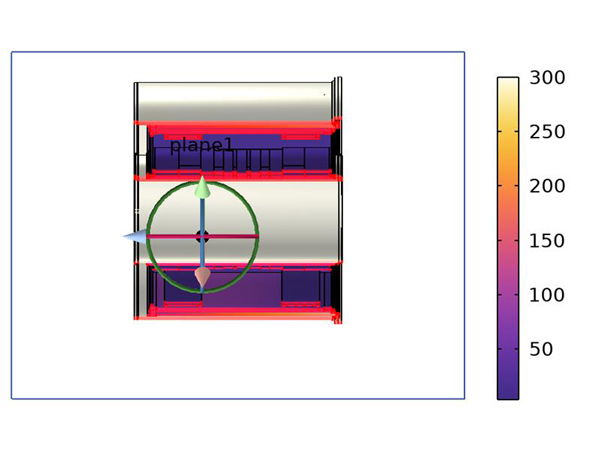
These results were essential for observing how the heat propagated from the cold head through the complex magnet structure. The areas were identified where heat was trapped due to poor thermal pathways or where excessive thermal mass was slowing the process. These results led the team to exactly pinpoint the areas that were conducting too much heat, offering critical insight for mechanical design iterations.
Validating the Simulation Results
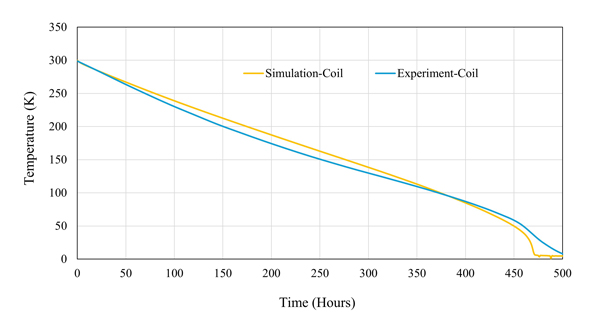
The ultimate test of any model is its agreement with the real world. After optimizing the design in the virtual space, the team built a prototype and initiated a cooldown. The team monitored the temperature drop at key locations, comparing the experimental results against the simulation's prediction curve.
The results matched almost perfectly, with the simulation predicting a cooldown time to operating temperature of approximately 20 days, whereas the physical experiment took about 21 days (Figure 4). The slight discrepancy was attributed to the electrical components that had been omitted from the initial model for simplicity. This close correlation between the experimental results and virtual model confirmed that multiphysics simulation could accurately predict the performance.
From Months to Hours: Accelerating the Path to Impact
The impact the use of simulation had on the development process was measurable. The months-long cycle of designing, building, and testing was accelerated, leading to parallel exploration of multiple designs. A single virtual cooldown analysis could be completed in less than eight hours, enabling the team to evaluate multiple cold head configurations, interface materials, and mechanical layouts in the time it would have originally taken to perform one physical test. The software also enabled the team to analyze failure modes and edge-case scenarios safely and at a low cost, as well as simulate the effects of a degraded cold head or improper assembly in order to understand the system's robustness.
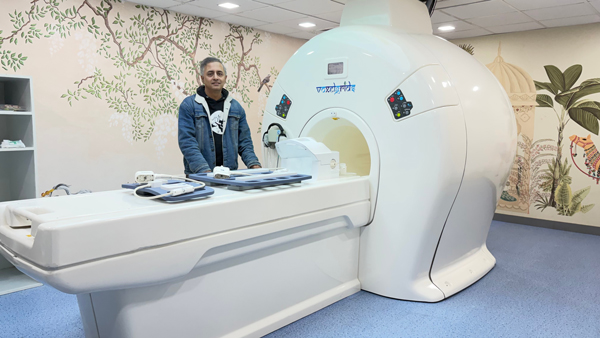
The team's accelerated innovation had a significant impact on the medtech industry: Voxelgrids developed India’s first locally made commercial 1.5 T MRI scanner (Figure 5), deployed at Chandrapur Cancer Hospital in Nagpur, India. The machine is compact, lightweight, and was designed to be deployed and operated under the most challenging installation conditions while still generating outstanding images for clinical diagnosis. With this machine, the team achieved a major goal of helping to make MRI treatments more accessible.