
In Übereinstimmung mit unserer Qualitätspolitik unterhält COMSOL eine Bibliothek aus hunderten dokumentierter Modellbeispiele, die regelmäßig mit der neuesten Version der COMSOL Multiphysics® Software getestet werden, einschließlich Benchmark-Probleme von ASME und NAFEMS sowie TEAM-Probleme.
Unsere Verification and Validation (V&V) Testsuite bietet konsistent genaue Lösungen, die mit Analyseergebnissen und etablierten Benchmark-Daten verglichen werden. Die folgenden dokumentierten Modelle sind Teil der in der COMSOL Multiphysics® Software integrierten Anwendungsbibliotheken. Sie beinhalten Referenzwerte und Quellen für eine Vielzahl von Benchmarks sowie eine Schritt-für-Schritt-Anleitung, um die erwarteten Ergebnisse auf dem eigenen Computer zu reproduzieren. Mit diesen Modellen können Sie nicht nur Ihre Aufwendungen für die Software-Qualitätssicherung (SQA) und die numerische Code-Verifikation (NCV) dokumentieren, sondern sie auch im Rahmen von internen Trainingsprogrammen einsetzen.
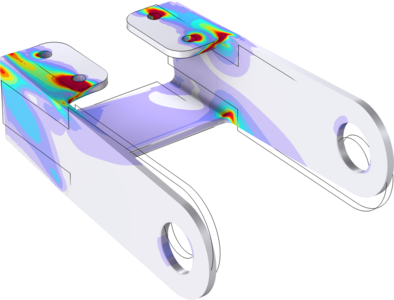
Die Halterungsmodelle dienen als Einführung in die strukturmechanische Modellierung mit dem Structural Mechanics Module. Folgende Features werden vorgestellt: Die Grundlagen: Statische lineare Analyse Parametrische Studie Einbeziehung der Anfangsdehnung Modellierung der thermischen ... Mehr lesen
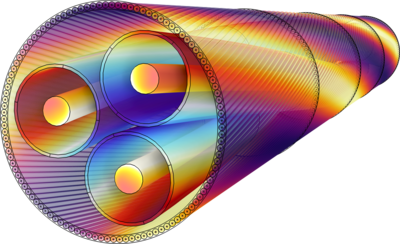
Mit dieser Serie von acht Tutorial-Modellen und der dazugehörigen Dokumentation können Sie die resistiven, kapazitiven, induktiven und thermischen Eigenschaften eines standardmäßigen dreiadrigen bleiummantelten XLPE-HVAC-Unterseekabels mit verdrillter Magnetarmierung (500 mm2, 220 kV) ... Mehr lesen
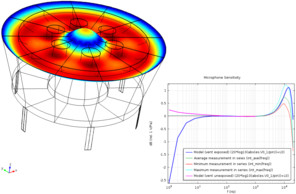
This is a model of the Brüel and Kjær 4134 (BK 4134) condenser microphone. The geometry and material parameters are those of the actual microphone. The modeled sensitivity level is compared to measurements performed on an actual microphone and shows good agreement. The membrane ... Mehr lesen

In einer Polymer-Elektrolyt-Membran-Elektrolysezelle (PEMEC) sind die beiden Elektrodenkammern durch eine Polymermembran getrennt. Flüssiges Wasser wird auf der Anodenseite zugeführt und bildet Sauerstoffgas auf der Anodenseite bzw. Wasserstoffgas auf der Kathodenseite. Die jeweilige ... Mehr lesen
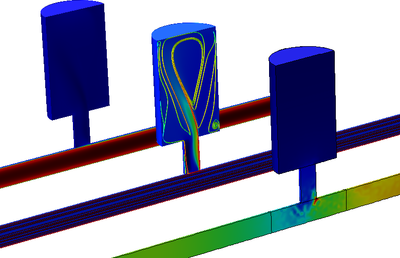
Helmholtz-Resonatoren werden in Abgassystemen eingesetzt, da sie ein bestimmtes schmales Frequenzband dämpfen können. Das Vorhandensein einer Strömung im System verändert die akustischen Eigenschaften des Resonators und den Übertragungsverlust des Teilsystems. In diesem Tutorial-Modell ... Mehr lesen

Der piezoelektrische Tonpilz ist ein Schallwandler für relativ niedrige Frequenzen und hohe Schallleistung. Der Schallwandler besteht aus piezokeramischen Ringen, die zwischen massiven Enden gestapelt und durch einen zentralen Bolzen vorgespannt sind. Die End- und Kopfmasse senken die ... Mehr lesen
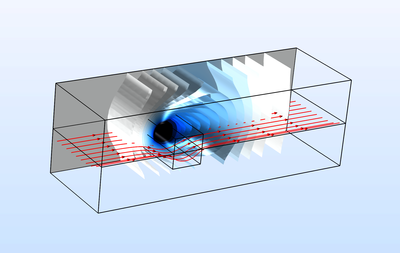
This example is a benchmark problem for simulating phase change in porous media. It studies the melting process of an ice inclusion within porous media and therefore demonstrates how to couple Darcy's Law with the Heat Transfer in Porous Media interface including phase change. Mehr lesen
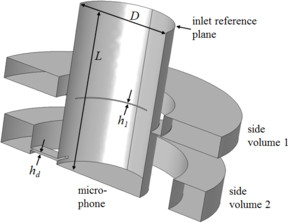
Dies ist das Modell eines verschlossenen Gehörgangssimulators (eines generischen 711-Kopplers). Abgesehen von bestimmten Details entspricht die Geometrie dem Brüel & Kjær Ear Simulator Type 4157. Die realen Koppler werden zur Simulation der Akustik eines standardisierten ... Mehr lesen


