
Die Application Gallery bietet COMSOL Multiphysics® Tutorial- und Demo-App-Dateien, die für die Bereiche Elektromagnetik, Strukturmechanik, Akustik, Strömung, Wärmetransport und Chemie relevant sind. Sie können diese Beispiele als Ausgangspunkt für Ihre eigene Simulationsarbeit verwenden, indem Sie das Tutorial-Modell oder die Demo-App-Datei und die dazugehörigen Anleitungen herunterladen.
Suchen Sie über die Schnellsuche nach Tutorials und Apps, die für Ihr Fachgebiet relevant sind. Beachten Sie, dass viele der hier vorgestellten Beispiele auch über die Application Libraries zugänglich sind, die in die COMSOL Multiphysics® Software integriert und über das Menü File verfügbar sind.
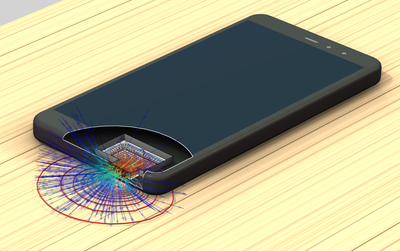
This tutorial model shows how to model a microspeaker located in a smart phone including the radiation through and interaction with the acoustic port that connects to the exterior. The model demonstrates a linear frequency domain analysis as well as a nonlinear time domain analysis. A ... Mehr lesen
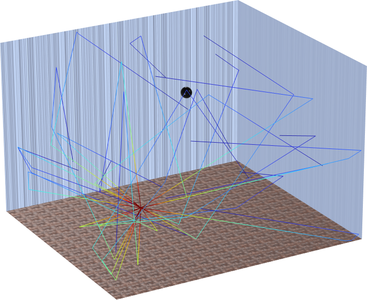
This model shows one approach for obtaining a broadband impulse response by combining ray-tracing and finite element methods. The combination is done all within COMSOL® and uses idealized filters. In this example, the simulation results are further compared to an analytical solution ... Mehr lesen
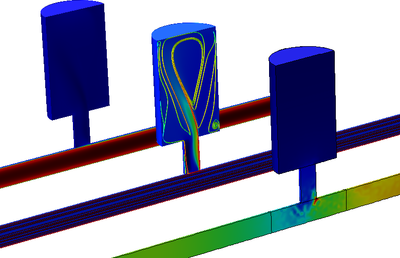
Helmholtz-Resonatoren werden in Abgassystemen eingesetzt, da sie ein bestimmtes schmales Frequenzband dämpfen können. Das Vorhandensein einer Strömung im System verändert die akustischen Eigenschaften des Resonators und den Übertragungsverlust des Teilsystems. In diesem Tutorial-Modell ... Mehr lesen
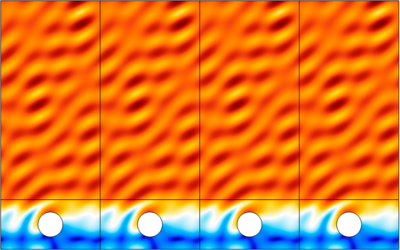
Dies ist ein Modell der Schallabsorption durch einen porösen akustischen offenzelligen Schaumstoff. In porösen Materialien breitet sich der Schall in einem Netzwerk aus kleinen, miteinander verbundenen Poren aus. Da die Dimensionen der Poren klein sind, entstehen Verluste durch ... Mehr lesen
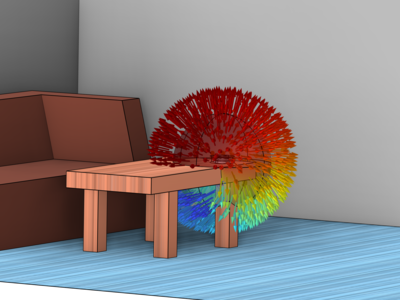
This model combines pressure acoustics and ray acoustics to perform a full frequency range analysis of the room impulse response of a small smart speaker. The source characterization in the ray tracing model is based on a full multiphysics model of the transducer and compares two source ... Mehr lesen
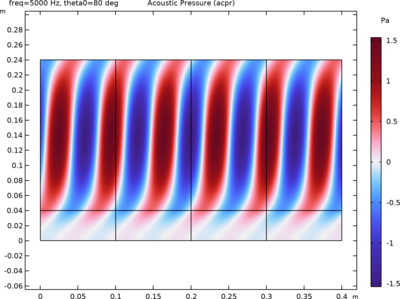
This is a 2D model of an anisotropic porous absorbing material. The absorption coefficient alpha are determined as functions of frequency for three different incidence angles. The example uses Periodic Floquet boundary conditions. The model uses two different methods for modeling the ... Mehr lesen
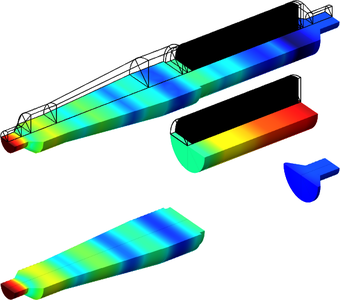
Diesel particulate filters (DPFs) are designed to remove and filter soot (diesel particles) from the exhaust of diesel engine vehicles. The filters in such systems are typically structured with long, air-filled channels surrounded by a porous medium that retains the soot. Although the ... Mehr lesen
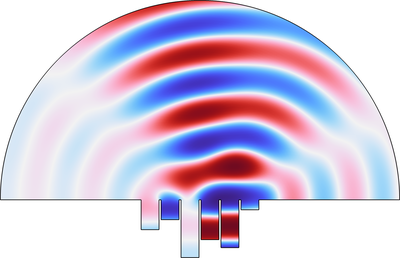
In this model, the scattering coefficient of a Schroeder diffuser is calculated. This coefficient can then be used as input to express boundary conditions in typical room acoustic simulations. The effect of periodicity is also investigated by studying the responses from different ... Mehr lesen

Model of the sound radiation from a circular duct with uniform flow. The convected acoustic problem is described using the linearized potential flow equations, solved in the frequency domain. The acoustic inlet is treated including higher order modes using the Port boundary condition and ... Mehr lesen
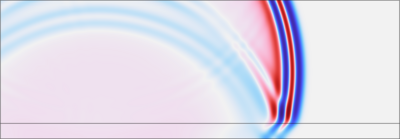
This tutorial studies the propagation of sound in the presence of a porous absorber in the time domain. It demonstrates how to model a porous absorber using the local and extended reacting approximations and compares the two approaches for absorbers of various thickness. The dissipative ... Mehr lesen