
Die Application Gallery bietet COMSOL Multiphysics® Tutorial- und Demo-App-Dateien, die für die Bereiche Elektromagnetik, Strukturmechanik, Akustik, Strömung, Wärmetransport und Chemie relevant sind. Sie können diese Beispiele als Ausgangspunkt für Ihre eigene Simulationsarbeit verwenden, indem Sie das Tutorial-Modell oder die Demo-App-Datei und die dazugehörigen Anleitungen herunterladen.
Suchen Sie über die Schnellsuche nach Tutorials und Apps, die für Ihr Fachgebiet relevant sind. Beachten Sie, dass viele der hier vorgestellten Beispiele auch über die Application Libraries zugänglich sind, die in die COMSOL Multiphysics® Software integriert und über das Menü File verfügbar sind.

This tutorial model solves for a one-dimensional capacitively coupled plasma reactor in a mixture of argon/oxygen. Important aspects and strategies for modeling electronegative discharges are discussed. Mehr lesen
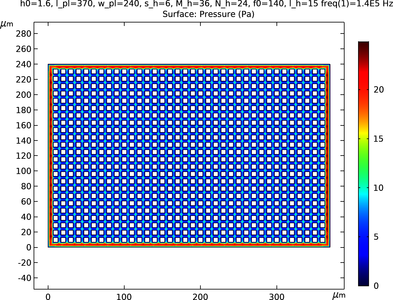
This benchmark model compares the damping coefficients of perforated plates from computation results versus experimental data. The simulation includes 18 different geometric configurations. It uses the Bao's perforation model, which is built-in in the Thin Film Flow physics interface. ... Mehr lesen
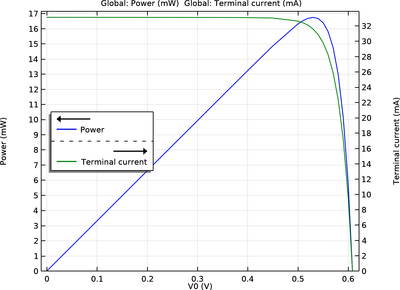
This tutorial uses a simple 1D model of a silicon solar cell to illustrate the basic steps to set up and perform a device physics simulation with the Semiconductor Module. A user-defined expression is used for the photo-generation rate and the result shows typical I–V and P–V curves of ... Mehr lesen
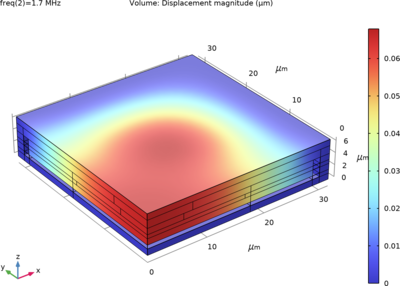
A capacitive micromachined ultrasonic transducer (CMUT) is a micro-scale receiver that converts ultrasound to electrical signal for high-resolution imaging application. This CMUT design has optimized force-displacement characteristics for increased transduction efficiency. Central to the ... Mehr lesen

Induction pumps are used in high temperature cooling systems. The principle of operation is equivalent to a linear three phase induction motor. The lack of moving parts and the pumped liquid being kept in a hermetically closed system are clear advantages. This model shows how to simulate ... Mehr lesen
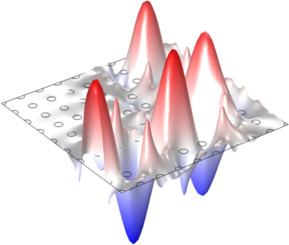
Photonische Kristalle sind periodische Strukturen aus abwechselnden Schichten von Materialien mit unterschiedlichen Brechungsindizes. Wellenleiter, die in einem photonischen Kristall eingeschlossen sind, können sehr scharfe, verlustarme Biegungen aufweisen, was eine Erhöhung der ... Mehr lesen

The mutual inductance and induced currents between a single turn primary and twenty turn secondary coil in a concentric coplanar arrangement is computed using a frequency domain model. Each turn of the secondary coil is modeled explicitly. The results are compared against analytic ... Mehr lesen
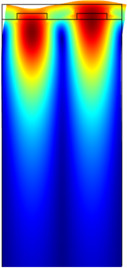
Eine akustische Oberflächenwelle (surface acoustic wave, SAW) ist eine akustische Welle, die sich entlang der Oberfläche eines festen Materials ausbreitet. Ihre Amplitude nimmt in der Tiefe des Materials schnell, oft exponentiell, ab. SAWs werden in vielen Arten von elektronischen ... Mehr lesen
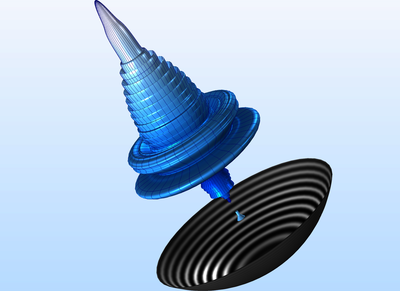
A large reflector can be modeled easily with the 2D axisymmetric formulation. In this model, the radius of the reflector is greater than 20 wavelengths and the reflector is illuminated by an axial feed circular horn antenna. The simulated far-field shows a high-gain sharp beam pattern Mehr lesen
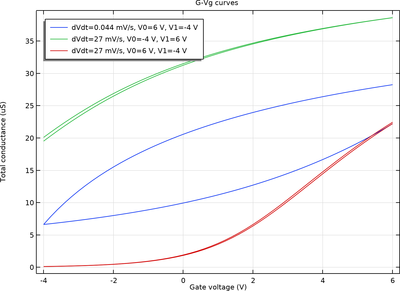
This tutorial analyzes the hysteresis of the conductance-gate-voltage (G-Vg) curves of an InAs nanowire FET, using the density-gradient theory to add the effect of quantum confinement to the conventional drift-diffusion formulation, without a large increase of computational costs. The ... Mehr lesen


