
Die Application Gallery bietet COMSOL Multiphysics® Tutorial- und Demo-App-Dateien, die für die Bereiche Elektromagnetik, Strukturmechanik, Akustik, Strömung, Wärmetransport und Chemie relevant sind. Sie können diese Beispiele als Ausgangspunkt für Ihre eigene Simulationsarbeit verwenden, indem Sie das Tutorial-Modell oder die Demo-App-Datei und die dazugehörigen Anleitungen herunterladen.
Suchen Sie über die Schnellsuche nach Tutorials und Apps, die für Ihr Fachgebiet relevant sind. Beachten Sie, dass viele der hier vorgestellten Beispiele auch über die Application Libraries zugänglich sind, die in die COMSOL Multiphysics® Software integriert und über das Menü File verfügbar sind.

In diesem Tutorial wird das Schwingungsverhalten einer kleinen Aluminiumplatte mit vier Wellenleiterstrukturen analysiert. Dies ist ein Beispiel für eine strukturelle Komponente, die sich in einem Gerät befindet, in dem sich elastische Wellen ausbreiten, wie zum Beispiel ein ... Mehr lesen

In this example, a torque is applied to the inner edge of a circular annulus-shaped membrane while the outer edge is fixed, resulting in membrane wrinkling. The wrinkling membrane model avoids the equilibrium instability that would be produced by the compressive stresses. The effect of ... Mehr lesen
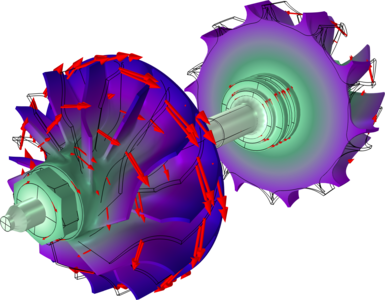
In this tutorial model, an eigenvalue analysis of a turbocharger rotor is performed. The rotor is analyzed in an unconstrained configuration, also commonly known as free–free conditions. A rotor like this is usually intended for high-speed applications, but here the analysis is performed ... Mehr lesen
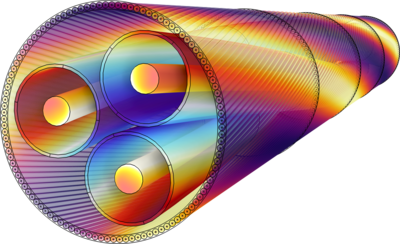
Mit dieser Serie von acht Tutorial-Modellen und der dazugehörigen Dokumentation können Sie die resistiven, kapazitiven, induktiven und thermischen Eigenschaften eines standardmäßigen dreiadrigen bleiummantelten XLPE-HVAC-Unterseekabels mit verdrillter Magnetarmierung (500 mm2, 220 kV) ... Mehr lesen
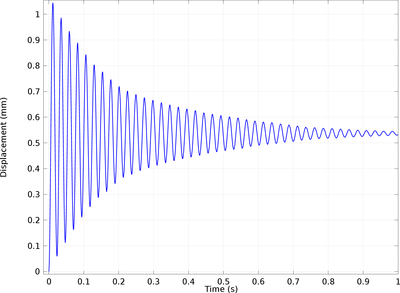
This model studies free and forced vibrations of a deep beam. Eigenfrequency, frequency response, and transient analyses are performed using a Timoshenko beam and the results are compared with analytical solutions. Mehr lesen

Micromirrors are used in certain MEMS devices to control optic elements. This model of a vibrating micromirror surrounded by air uses the Thermoacoustic-Shell Interaction user interface to model the fluid-solid interaction, and it thus includes the correct viscous and thermal damping of ... Mehr lesen
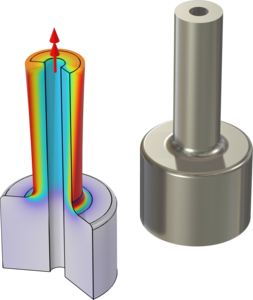
Including circumferential displacements in a 2D axisymmetric Solid Mechanics interface allows to compute twist and bending deformations. This model determines stress concentration factors for a hollow shaft for load cases of axial extension, torsion, as well as bending, using a ... Mehr lesen

Delamination or the separation of layers is a common failure mode in laminated composite materials. Various factors, including loading, defects in the material, and environmental conditions can trigger the initiation and propagation of layer separation. This leads to degraded structural ... Mehr lesen
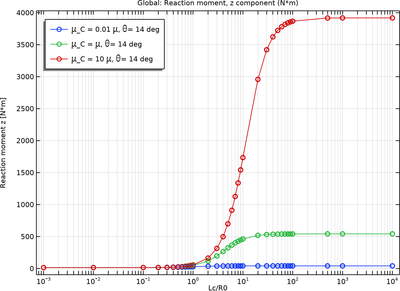
In this example, it is demonstrated how to extend the built-in linear elastic material model to a Cosserat material through the addition of microrotation degrees of freedom. A cylindrical bar under pure torsion is analyzed and the effect of the Cosserat length scale parameter on the ... Mehr lesen
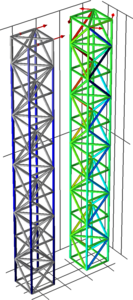
Sensitivity analysis is an efficient way of computing the gradient of an objective function with respect to many control variables. This example uses the pitch and yaw in the top of a truss tower as objective functions. It shows how to compute the sensitivity of these angles with respect ... Mehr lesen


