
Die Application Gallery bietet COMSOL Multiphysics® Tutorial- und Demo-App-Dateien, die für die Bereiche Elektromagnetik, Strukturmechanik, Akustik, Strömung, Wärmetransport und Chemie relevant sind. Sie können diese Beispiele als Ausgangspunkt für Ihre eigene Simulationsarbeit verwenden, indem Sie das Tutorial-Modell oder die Demo-App-Datei und die dazugehörigen Anleitungen herunterladen.
Suchen Sie über die Schnellsuche nach Tutorials und Apps, die für Ihr Fachgebiet relevant sind. Beachten Sie, dass viele der hier vorgestellten Beispiele auch über die Application Libraries zugänglich sind, die in die COMSOL Multiphysics® Software integriert und über das Menü File verfügbar sind.
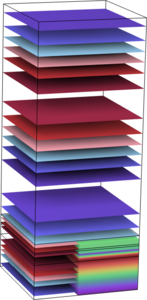
In applications where pressure waves and elastic waves propagate in porous materials filled with air both thermal and viscous losses are important. This is typically the case in insulation materials for room acoustics or lining materials in car cabins. Another example is porous materials ... Mehr lesen

In microfluidic devices, it is a challenge to mix different fluids. One method is to use acoustic streaming to create a flow which enhances the mixing of two fluids. In this model, the vibrations of PDMS structures in a channel induces fast acoustic streaming used for mixing a diluted ... Mehr lesen

In acoustofluidics, acoustics is used to manipulate particles and fluids in microfluidic devices. This model demonstrates the phenomena of the inhomogeneous acoustic body force and how it can move a fluid with an inhomogeneous density due to a solute. The model is of a 2D cross section ... Mehr lesen
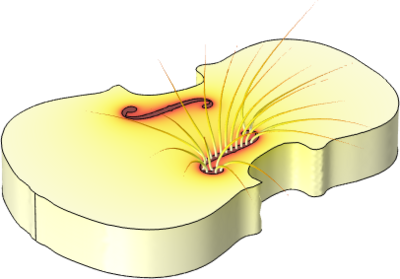
These models are featured in the blog post Analyze Violin Tone and Volume with Multiphysics Modeling. One applies acoustic-structure interaction to study how the air mode resonance is affected by the coupled vibrations in the violin body. The other uses a potential flow approximation to ... Mehr lesen
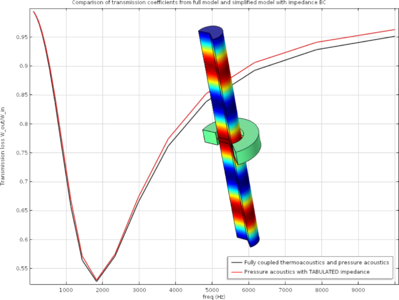
This application illustrates a modeling approach for deriving physically consistent simplified models in the Acoustics Module. The approach consists of converting complex sub-components to an impedance boundary condition and otherwise using simple acoustics throughout the COMSOL model. ... Mehr lesen

The problem of a plane wave scattering off a cylinder-shaped object suggests the use of the 2D axisymmetric formulation. This can save computation time and reduce the memory usage compared to the model in 3D space. This example demonstrates the use of the built-in plane wave expansion ... Mehr lesen
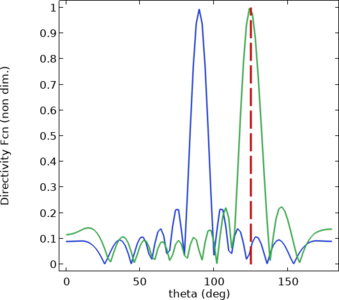
A line array of eleven spherical hydrophones embedded in a neoprene coating is modeled in 3D. The sensitivity of the array is analyzed with regard to varying angles of incidence of the background pressure field. The array directivity function is computed and compared to the analytical ... Mehr lesen
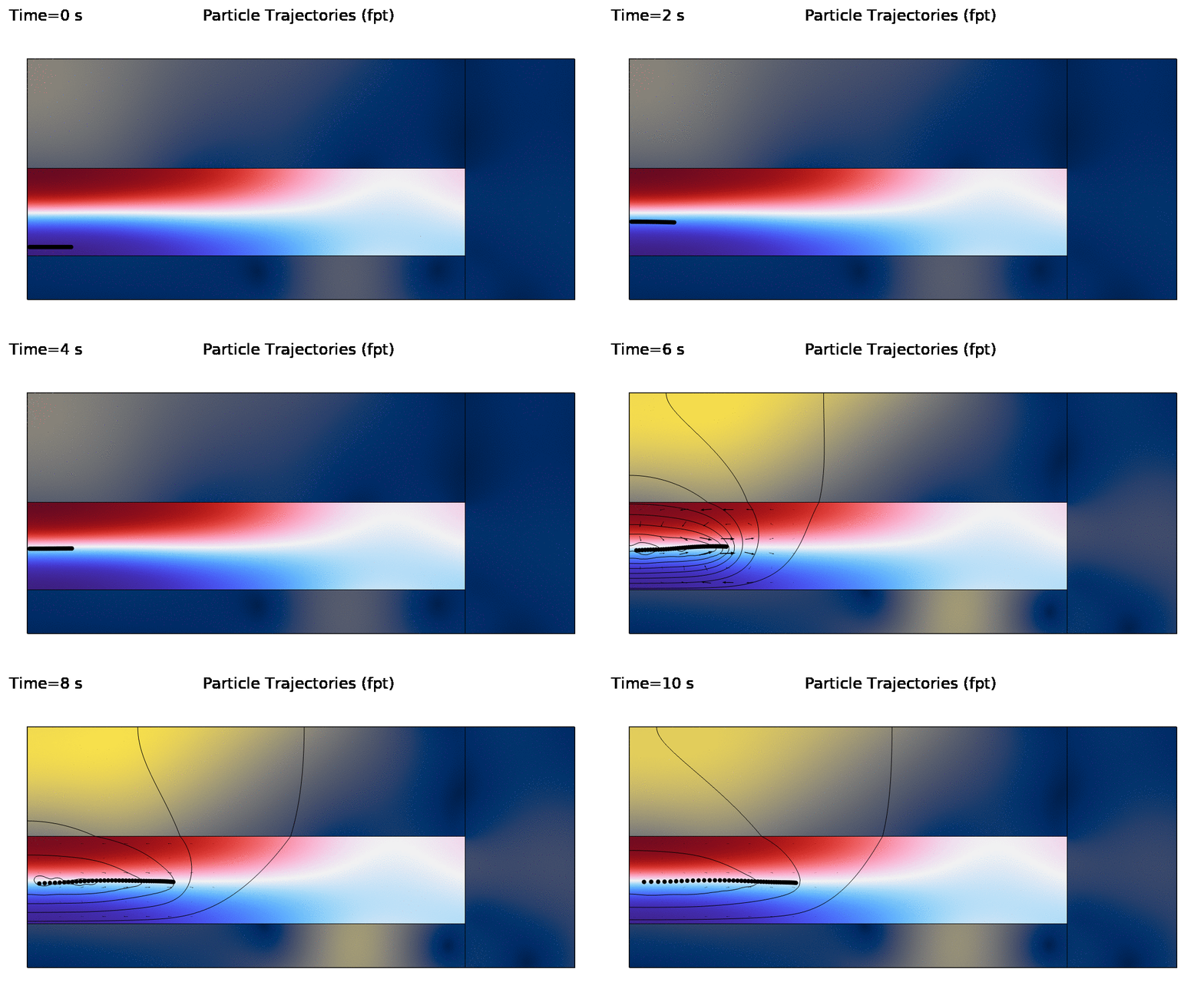
Optoakustophorese ist ein Begriff, der das Zusammenspiel zwischen Akustik und optischen Feldern beschreibt. In den meisten Fällen (so auch in diesem) erwärmt das optische Feld das Material und beeinflusst somit das akustische Feld. In diesem Beispiel einer akustischen Falle wird eine ... Mehr lesen
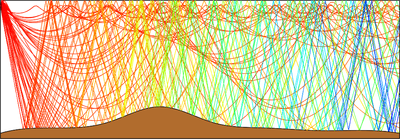
When computing ray intensity in 2D axisymmetric models, the wavefront associated with the propagating ray is treated as a spherical or ellipsoidal wave, instead of a cylindrical wave. This tutorial example illustrates how to set up several important features using the Ray Acoustics ... Mehr lesen
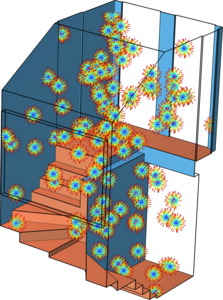
This model uses the Ray Acoustics interface to extract statistical information about a room. Two examples of rooms are analyzed: The staircase from the One-Family House Acoustics tutorial model A long corridor The models compute the mean free path as well as the reflection frequency ... Mehr lesen


