
Die Application Gallery bietet COMSOL Multiphysics® Tutorial- und Demo-App-Dateien, die für die Bereiche Elektromagnetik, Strukturmechanik, Akustik, Strömung, Wärmetransport und Chemie relevant sind. Sie können diese Beispiele als Ausgangspunkt für Ihre eigene Simulationsarbeit verwenden, indem Sie das Tutorial-Modell oder die Demo-App-Datei und die dazugehörigen Anleitungen herunterladen.
Suchen Sie über die Schnellsuche nach Tutorials und Apps, die für Ihr Fachgebiet relevant sind. Beachten Sie, dass viele der hier vorgestellten Beispiele auch über die Application Libraries zugänglich sind, die in die COMSOL Multiphysics® Software integriert und über das Menü File verfügbar sind.

Dieses Modell zeigt, wie Sie mit dem Feature Control Function die Form eines rechteckigen Horns optimieren können, um eine bessere Antwort auf der Achse zu erzielen. Die Ergebnisse des ursprünglichen Designs werden über einen Filter-Datensatz in eine neue Komponente exportiert. Außerdem ... Mehr lesen
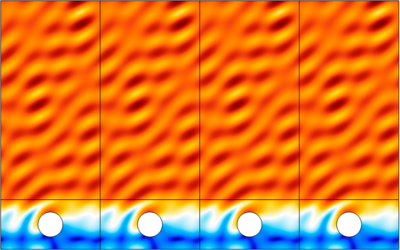
Dies ist ein Modell der Schallabsorption durch einen porösen akustischen offenzelligen Schaumstoff. In porösen Materialien breitet sich der Schall in einem Netzwerk aus kleinen, miteinander verbundenen Poren aus. Da die Dimensionen der Poren klein sind, entstehen Verluste durch ... Mehr lesen

It is often not possible to insert a normal microphone directly into the sound field being measured. The microphone may be too big to fit inside the measured system, such as for in-the-ear measurements for hearing aid fitting. The size of the microphone may also be too large compared to ... Mehr lesen
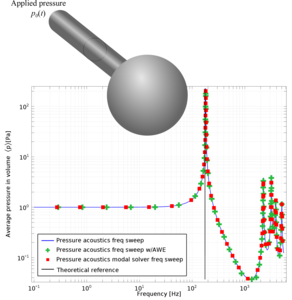
This model simulates a simple three-dimensional axisymmetric Helmholtz resonator, a classic acoustics model of a resonating circuit with a known theoretical solution. The idealized version considered here consists of a tube and a closed volume in series which are exposed to a pulsatile ... Mehr lesen

This is a tutorial model that illustrates the use of the scattered field formulation in acoustics. A solid object (here an ellipsoid) is hit by an incident plane wave field (background pressure field). The model solves for the scattered field. The model uses a PML and a far-field ... Mehr lesen

In this example, the External Stress feature in the Solid Mechanics interface is used to provide the material model with the nonsymmetric stress required in the design of an elastic invisibility cloak. The cloak is a domain with special material properties aimed at shielding a region of ... Mehr lesen
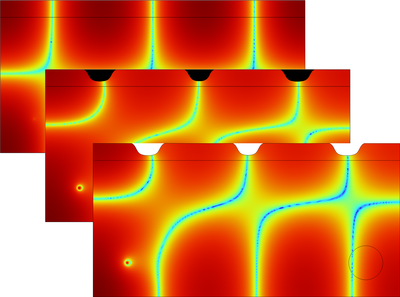
This tutorial introduces the use of topology optimization in acoustics. The goal of the optimization is to find the optimal material distribution (solid or air) in a given design domain, here the ceiling of a 2D room, that minimizes the average sound pressure level in an objective ... Mehr lesen
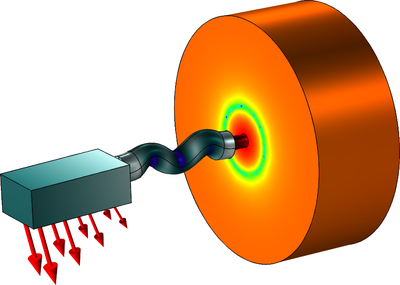
Wenn bei der Entwicklung von mobilen Geräten, Unterhaltungselektronik, Hörgeräten oder Kopfhörern Simulationen durchgeführt werden, muss berücksichtigt werden, wie die Schallwandler mit dem Rest des Systems interagieren. Hier zeigen wir eine Analyse der Wechselwirkung zwischen einer ... Mehr lesen
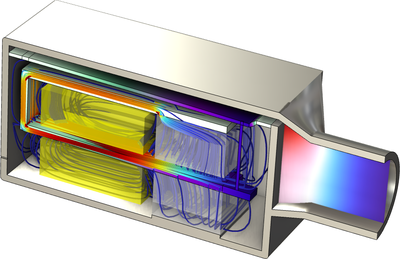
Dies ist eine vollständige vibro-elektroakustische Simulation eines Balanced-Armature-Wandlers (in einigen Branchen auch als Receiver bekannt), eines Hochleistungs-Miniaturlautsprechers, der häufig in Hörgeräten und anderen In-Ear-Audioprodukten verwendet wird. Das Modell wird mit Hilfe ... Mehr lesen
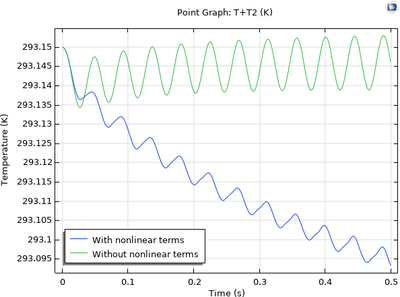
Ein thermoakustischer Motor ist ein Gerät ohne bewegliche Teile, das akustische Energie aus Temperaturgradienten innerhalb des Motors erzeugen kann. Er nutzt die Beziehung zwischen der Bewegung oszillierender Luft und den Temperaturänderungen in der durch die akustischen Wellen ... Mehr lesen


