
Die Application Gallery bietet COMSOL Multiphysics® Tutorial- und Demo-App-Dateien, die für die Bereiche Elektromagnetik, Strukturmechanik, Akustik, Strömung, Wärmetransport und Chemie relevant sind. Sie können diese Beispiele als Ausgangspunkt für Ihre eigene Simulationsarbeit verwenden, indem Sie das Tutorial-Modell oder die Demo-App-Datei und die dazugehörigen Anleitungen herunterladen.
Suchen Sie über die Schnellsuche nach Tutorials und Apps, die für Ihr Fachgebiet relevant sind. Beachten Sie, dass viele der hier vorgestellten Beispiele auch über die Application Libraries zugänglich sind, die in die COMSOL Multiphysics® Software integriert und über das Menü File verfügbar sind.
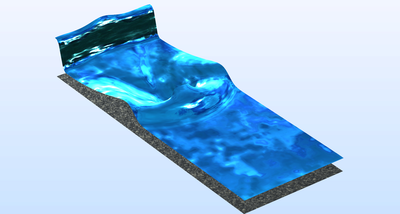
This example uses the Shallow Water equations to model the impact of a water wave on a column. A body of water with a height of 0.3 meters is initially contained behind a gate. At the start of the simulation, the gate is suddenly released and the body of water forms a wave moving toward ... Mehr lesen
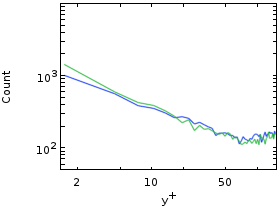
In this benchmark model, solid particles are released in a fully developed turbulent channel flow. The particles are subjected to a drag force that includes contributions from the fluid turbulence, implemented using a Continuous Random Walk (CRW) model. Because the turbulence in the ... Mehr lesen
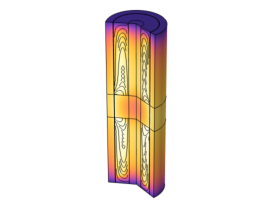
Fluid dampers are used in military devices for shock isolation and in civil structures for suppressing earthquake-induced shaking and wind-induced vibrations, among many other applications. Fluid dampers work by dissipating the mechanical energy into heat. This model shows the phenomenon ... Mehr lesen
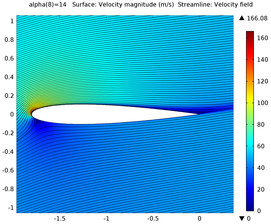
Dieses Modell simuliert die Umströmung einer geneigten NACA-0012-Tragfläche bei verschiedenen Anstellwinkeln unter Verwendung des SST-Turbulenzmodells. Die Ergebnisse zeigen eine gute Übereinstimmung mit den experimentellen Auftriebsdaten von Ladson und den Druckdaten von Gregory und O ... Mehr lesen
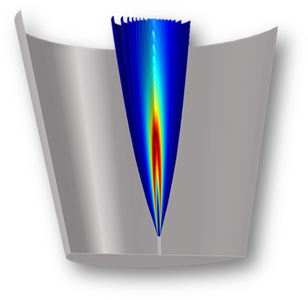
The model simulates non-premixed turbulent combustion of syngas (synthesis gas) in a simple round-jet burner. Syngas is a gas mixture, primarily composed of hydrogen, carbon monoxide and carbon dioxide. The name syngas relates to its use in creating synthetic natural gas. In the model, ... Mehr lesen

This model is a benchmark for three-phase flow commonly used in food processing, pharmaceutical industry, and chemical processing. The results are validated against data reported in the literature. A gas bubble rises through two layers of liquid, a lighter liquid resting on top of a ... Mehr lesen

This example illustrates multiphase flow modeling in an airlift loop reactor. The reactor is filled with water and air bubbles are injected at the bottom through two frits. Due to buoyancy, the bubbles rise, inducing a circulating motion of the liquid. The model specifically investigates ... Mehr lesen
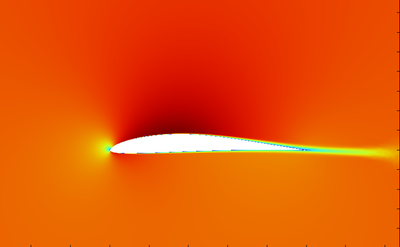
The flow around the Eppler 387 airfoil is computed with the SST turbulence model both with and without the transition model. The reuslts are compared with experimental values. Mehr lesen


