
Die Application Gallery bietet COMSOL Multiphysics® Tutorial- und Demo-App-Dateien, die für die Bereiche Elektromagnetik, Strukturmechanik, Akustik, Strömung, Wärmetransport und Chemie relevant sind. Sie können diese Beispiele als Ausgangspunkt für Ihre eigene Simulationsarbeit verwenden, indem Sie das Tutorial-Modell oder die Demo-App-Datei und die dazugehörigen Anleitungen herunterladen.
Suchen Sie über die Schnellsuche nach Tutorials und Apps, die für Ihr Fachgebiet relevant sind. Beachten Sie, dass viele der hier vorgestellten Beispiele auch über die Application Libraries zugänglich sind, die in die COMSOL Multiphysics® Software integriert und über das Menü File verfügbar sind.

Die alkalische Wasserelektrolyse ist ein gut etabliertes industrielles Verfahren zur Herstellung von Wasserstoffgas. In der Zelle bildet sich Wasserstoff an der Kathode, während sich an der Anode Sauerstoff bildet. Der Elektrolyt ist eine wässrige Flüssigkeit, und wenn die entstehenden ... Mehr lesen
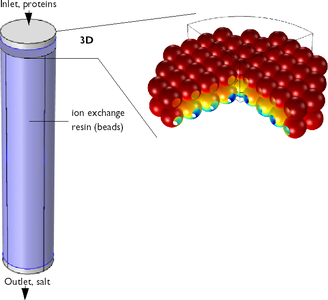
Ion-exchange is a powerful method to separate proteins from solutions and is today readily used in biotechnological and pharmaceutical industry. This model simulates an ion-exchange column for protein adsorption. The fluid phase contains four components: two proteins, solvent, and one ... Mehr lesen
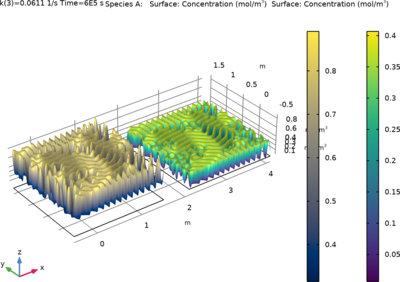
A deceptively simple system of two species and two reactions, describing the autocatalytic conversion of a substance, is shown to display a surprisingly exotic behavior. Starting from a 0D CSTR description, a 2D reaction-diffusion problem is formulated showing rich patterns stemming from ... Mehr lesen
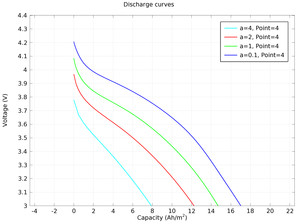
Dieses Modell demonstriert das Interface Lithium-Ion Battery für die Untersuchung der Entladung und Ladung eines Lithium-Ionen-Akkus für eine gegebene Reihe von Materialeigenschaften. Die Geometrie ist eindimensional und das Modell ist isotherm. Entwickler von Akkus können das Modell ... Mehr lesen
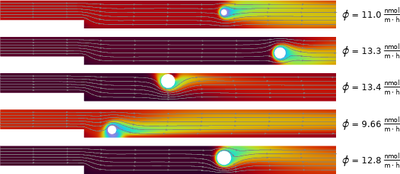
This tutorial illustrates how to use the Uncertainty Quantification (UQ) functionality to answer questions regarding sensitivity and reliability of a flow reactor with thermal decomposition. The tutorial investigates what uncertainties in parameters dominates the survival of a nutrient ... Mehr lesen
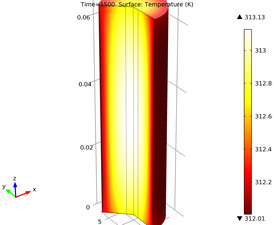
Dieses Modellbeispiel simuliert einen luftgekühlten zylindrischen 18650-Lithium-Ionen-Akku während eines Lade-Entlade-Zyklus, gefolgt von einer Erholungsphase. Ein (0D) Lumped-Modell einer Zelle wird verwendet, um die Zellchemie des Akkus zu modellieren, und ein zweidimensionales ... Mehr lesen
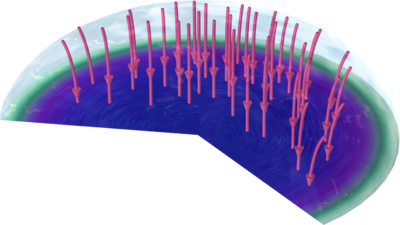
An Evans droplet experiment is a century-old corrosion experiment for demonstrating oxygen transport-limited corrosion. A droplet of water is placed on a metal surface, and over time the surface features differences in the radial direction of the surface in terms of amount of corroded ... Mehr lesen
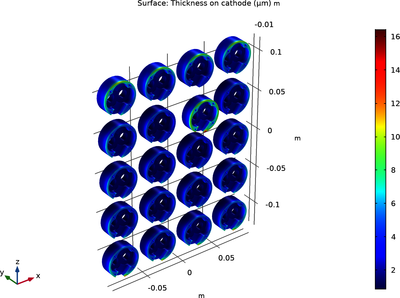
When several components are to be electroplated they are typically mounted on a rack in the electroplating bath. An important aspect is then achieving a uniform thickness of the plated layer for all components mounted on the rack. This example model allows for investigating the effect ... Mehr lesen


