
Die Application Gallery bietet COMSOL Multiphysics® Tutorial- und Demo-App-Dateien, die für die Bereiche Elektromagnetik, Strukturmechanik, Akustik, Strömung, Wärmetransport und Chemie relevant sind. Sie können diese Beispiele als Ausgangspunkt für Ihre eigene Simulationsarbeit verwenden, indem Sie das Tutorial-Modell oder die Demo-App-Datei und die dazugehörigen Anleitungen herunterladen.
Suchen Sie über die Schnellsuche nach Tutorials und Apps, die für Ihr Fachgebiet relevant sind. Beachten Sie, dass viele der hier vorgestellten Beispiele auch über die Application Libraries zugänglich sind, die in die COMSOL Multiphysics® Software integriert und über das Menü File verfügbar sind.
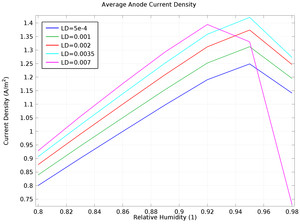
This model simulates atmospheric galvanic corrosion of an aluminum alloy in contact with steel. The electrolyte film thickness depends on the relative humidity of the surrounding air and the salt load density of NaCl crystals on the metal surface. Empirical expressions for the oxygen ... Mehr lesen
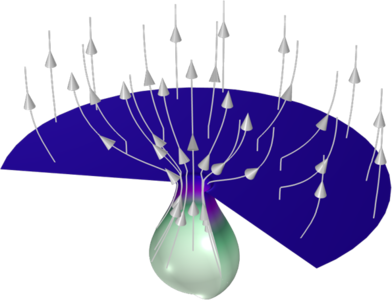
Pitting corrosion is a type of localized corrosion by which local cavities, pits, are formed on an initially smooth metal surface. A pit may be initialized by surface defects, such as an inhomogeneities in composition or shape, or mechanical abuse resulting in a small scratch or dent. ... Mehr lesen
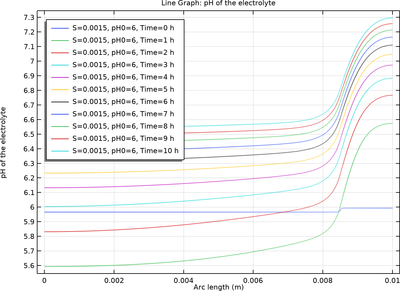
The model simulates atmospheric corrosion of a galvanic couple, comprising of an Al-Co-Ce metallic coating and an aluminum alloy, which is in contact with electrolyte film of 100 micrometer thickness. The corrosion inhibitors are released from the metallic coating and are transported ... Mehr lesen
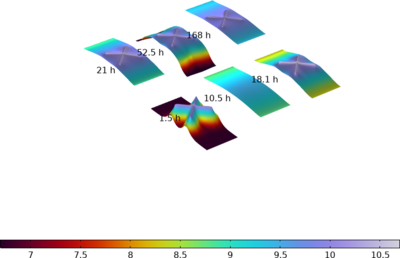
An established method for benchmarking the atmospheric corrosion resistance of materials is the use of accelerated corrosion tests (ACT) performed in climate chambers. The main purpose of the ACTs is to make reliable and fast predictions of the long time behavior. The tests expose ... Mehr lesen
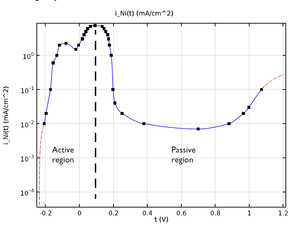
This model exemplifies the basic principles of crevice corrosion and how a time-dependent study can be used to simulate the electrode deformation. The model is in 2D and the polarization data for the corrosion reaction is taken from a paper by Absulsalam and others. The model and the ... Mehr lesen
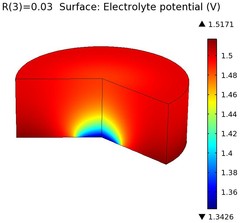
Magnesium alloys are attractive alternatives as lightweight materials in various fields of engineering. Magnesium is however relatively non-noble and may suffer considerable galvanic corrosion when being used in conjunction with other metals, for instance when mounting an Mg alloy ... Mehr lesen
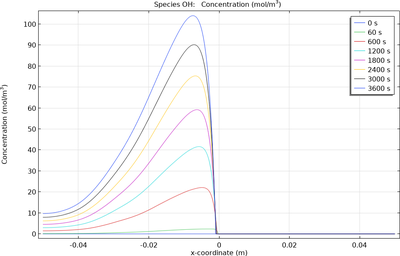
Atmospheric corrosion occurs when metallic structures are exposed to humid air forming a thin electrolyte film in the range of up to a few hundred micrometers. The model presented here accounts for charge transport as well mass transport involving 10 species and 6 homogeneous ... Mehr lesen
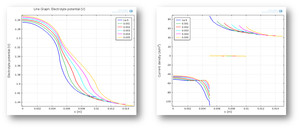
The use of Aluminum (Al) isolator is a commonly employed mitigation strategy for galvanic corrosion between magnesium alloy (Mg) and mild steel (MS). The present model demonstrates the effect of Al isolator thickness on galvanic corrosion severity using a parametric study. The electrode ... Mehr lesen


