
Die Application Gallery bietet COMSOL Multiphysics® Tutorial- und Demo-App-Dateien, die für die Bereiche Elektromagnetik, Strukturmechanik, Akustik, Strömung, Wärmetransport und Chemie relevant sind. Sie können diese Beispiele als Ausgangspunkt für Ihre eigene Simulationsarbeit verwenden, indem Sie das Tutorial-Modell oder die Demo-App-Datei und die dazugehörigen Anleitungen herunterladen.
Suchen Sie über die Schnellsuche nach Tutorials und Apps, die für Ihr Fachgebiet relevant sind. Beachten Sie, dass viele der hier vorgestellten Beispiele auch über die Application Libraries zugänglich sind, die in die COMSOL Multiphysics® Software integriert und über das Menü File verfügbar sind.
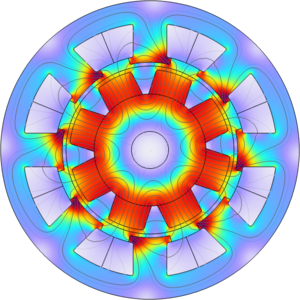
In this model, a rotor with permanent magnets and a nonlinear magnetic material rotates within a stator of the same magnetic material. The generated voltage in windings around the stator is calculated as a function of time. COMSOL Multiphysics models the rotation with assemblies and ... Mehr lesen
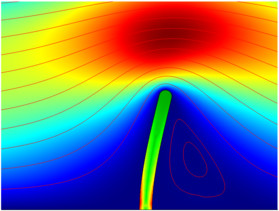
Dieses Modell zeigt, wie Sie ein Fluid-Struktur-Interaktionsproblem in COMSOL Multiphysics einrichten können. Es veranschaulicht, wie eine Strömung feste Strukturen verformen kann und wie man die Strömung in einer sich kontinuierlich verformenden Geometrie löst. Das Multiphysik ... Mehr lesen

Some conventional three-port power dividers are resistive power dividers and T-junction power dividers. Such dividers are either lossy or not matched to the system reference impedance at all ports. In addition, isolation between two coupled ports is not guaranteed. The Wilkinson power ... Mehr lesen
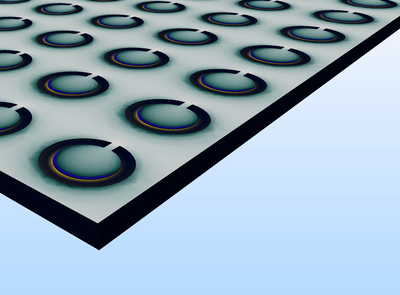
Frequency selective surfaces (FSS) are periodic structures with a bandpass or a bandstop frequency response. This model shows that only signals around the center frequency can pass through the periodic complementary split ring resonator layer. Mehr lesen
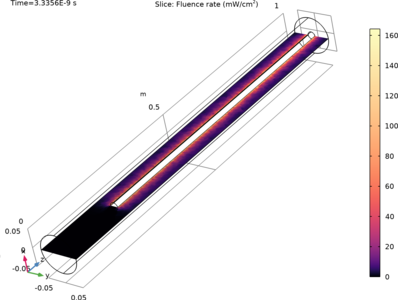
This model demonstrates how to compute the volumetric fluence rate in an ultraviolet (UV) reactor. The geometry is the annular fluid region surrounding a cylindrical lamp. The effect of reflection at the reactor walls on the radial fluence rate distribution is considered. Mehr lesen
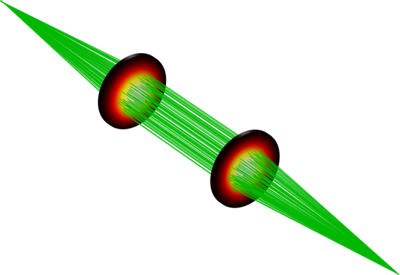
A modern high-power industrial fiber laser system can deliver up to 3kW of single-mode laser radiation on to surfaces to be cut, drilled, welded or marked. Even using highly transmissive materials, the optical component used to focus the laser beam onto target surfaces can be affected ... Mehr lesen
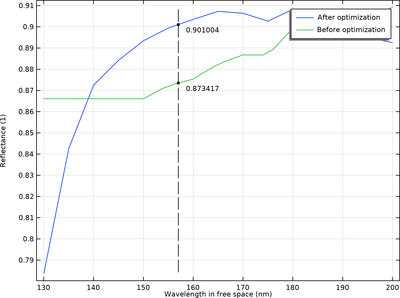
This example demonstrates how to optimize the thickness of a microelectromechanical systems (MEMS) mirror coating material for maximum reflectivity. To reduce the simulation time, a Layered Impedance Boundary Condition is used to model the thin coating material on top of the metallic ... Mehr lesen
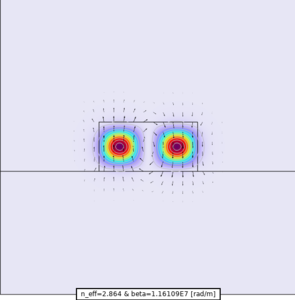
Die Modenanalyse ist ein grundlegendes Werkzeug für eine Vielzahl von Hochfrequenz- und Wellenoptikberechnungen, da sie die Untersuchung von Modeneigenschaften in komplexen Wellenleiterstrukturen ermöglicht. In diesem Tutorial-Modell finden Sie zwei Beispiele, die typische Einstellungen ... Mehr lesen


