
Die Application Gallery bietet COMSOL Multiphysics® Tutorial- und Demo-App-Dateien, die für die Bereiche Elektromagnetik, Strukturmechanik, Akustik, Strömung, Wärmetransport und Chemie relevant sind. Sie können diese Beispiele als Ausgangspunkt für Ihre eigene Simulationsarbeit verwenden, indem Sie das Tutorial-Modell oder die Demo-App-Datei und die dazugehörigen Anleitungen herunterladen.
Suchen Sie über die Schnellsuche nach Tutorials und Apps, die für Ihr Fachgebiet relevant sind. Beachten Sie, dass viele der hier vorgestellten Beispiele auch über die Application Libraries zugänglich sind, die in die COMSOL Multiphysics® Software integriert und über das Menü File verfügbar sind.
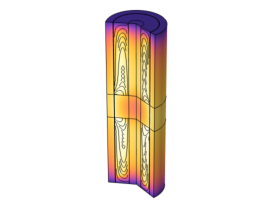
Fluid dampers are used in military devices for shock isolation and in civil structures for suppressing earthquake-induced shaking and wind-induced vibrations, among many other applications. Fluid dampers work by dissipating the mechanical energy into heat. This model shows the phenomenon ... Mehr lesen
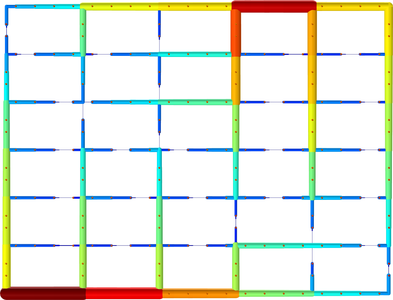
The layout of a district heating network is designed using topology optimization. Mehr lesen
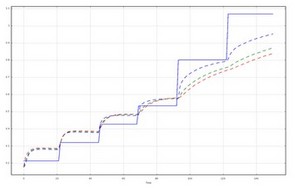
The first model describes the simultaneous flow of two immiscible fluids in porous media - here air displaces water in a multi-step inlet pressure experiment. We solve for the pressure and the degree saturation for the air and water within a representative volume and so track saturation ... Mehr lesen
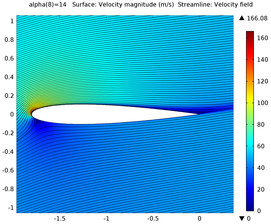
Dieses Modell simuliert die Umströmung einer geneigten NACA-0012-Tragfläche bei verschiedenen Anstellwinkeln unter Verwendung des SST-Turbulenzmodells. Die Ergebnisse zeigen eine gute Übereinstimmung mit den experimentellen Auftriebsdaten von Ladson und den Druckdaten von Gregory und O ... Mehr lesen
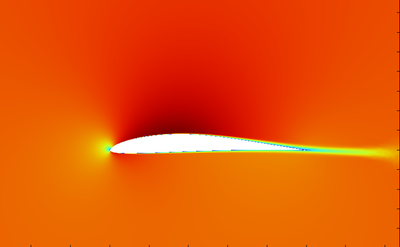
The flow around the Eppler 387 airfoil is computed with the SST turbulence model both with and without the transition model. The reuslts are compared with experimental values. Mehr lesen
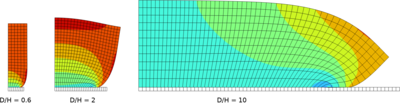
Polymer-Hydrogele bestehen aus einem Netzwerk langkettiger Polymere, in das eine große Anzahl von Lösungsmittelmolekülen eingelagert ist. Solche Materialien werden in vielen biomedizinischen Anwendungen eingesetzt, zum Beispiel bei der gezielten Abgabe von Medikamenten, der Züchtung von ... Mehr lesen
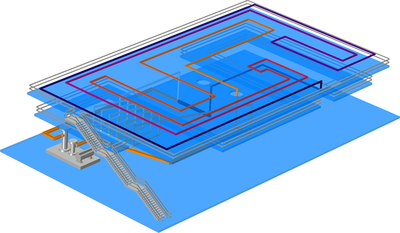
This example demonstrates how to model coupled flow, heat transfer, and structural deformation and stress in a pipeline network. Gravity loads from the pipe and fluid are also taken into account. Mehr lesen

Thermische Energiespeicher werden zur Speicherung von Wärmeenergie aus Solar-, Geothermie- oder Abwärmequellen verwendet. Die einfachsten Anlagen bestehen aus Wassertanks, die häufig in Haushalten zu finden sind und in denen die Sonnenenergie als fühlbare Wärme gespeichert wird. Die ... Mehr lesen

Gas cells have several applications in the design of scientific instruments. A gas cell is used to define a high-pressure region within the instrument's main vacuum system. For example, in this application, note we are designing a high-pressure region 100 mm long, with an operating ... Mehr lesen
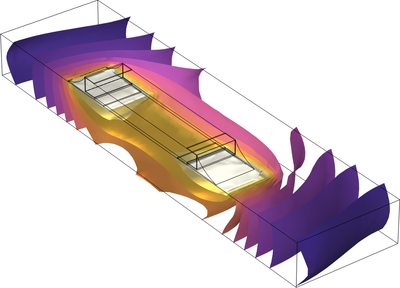
The drive for miniaturizing electronic devices has resulted in today’s extensive use of surface-mount electronic components. An important aspect in electronics design and the choice of materials is a product’s durability and lifetime. For surface-mount resistors and other components ... Mehr lesen


