
Die Application Gallery bietet COMSOL Multiphysics® Tutorial- und Demo-App-Dateien, die für die Bereiche Elektromagnetik, Strukturmechanik, Akustik, Strömung, Wärmetransport und Chemie relevant sind. Sie können diese Beispiele als Ausgangspunkt für Ihre eigene Simulationsarbeit verwenden, indem Sie das Tutorial-Modell oder die Demo-App-Datei und die dazugehörigen Anleitungen herunterladen.
Suchen Sie über die Schnellsuche nach Tutorials und Apps, die für Ihr Fachgebiet relevant sind. Beachten Sie, dass viele der hier vorgestellten Beispiele auch über die Application Libraries zugänglich sind, die in die COMSOL Multiphysics® Software integriert und über das Menü File verfügbar sind.
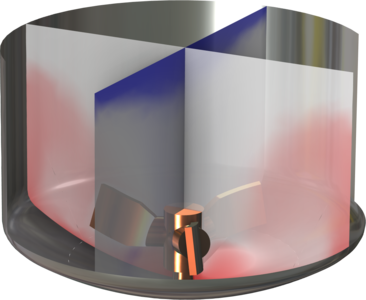
This model simulates the separation and mixing of a suspension with light and heavy particles. Initially the distribution of both particle populations is homogeneous throughout the fluid. Before the impeller starts rotating, the fluid and the two particle populations tend to separate ... Mehr lesen
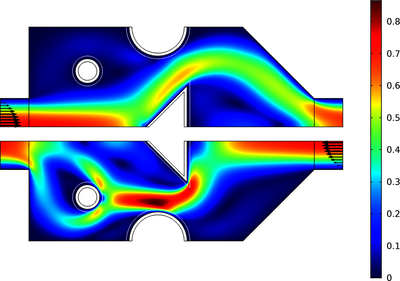
The topology optimized Tesla microvalve is used as inspiration for a parametrized geometry. The optimization of this geometry takes erosion and dilation of the geometry into account by optimizing over a parametric sweep. In this example the optimization is driven by the worst of the 3 ... Mehr lesen
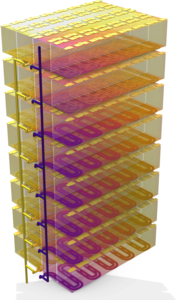
Hochleistungs-Batterie-Energiespeichersysteme (BESS) sind häufig mit Flüssigkeitskühlsystemen ausgestattet, um die von den Batterien während des Betriebs erzeugte Wärme abzuführen. Dieses Tutorial zeigt, wie man ein High-Fidelity-Modell eines flüssigkeitsgekühlten BESS-Packs definiert ... Mehr lesen
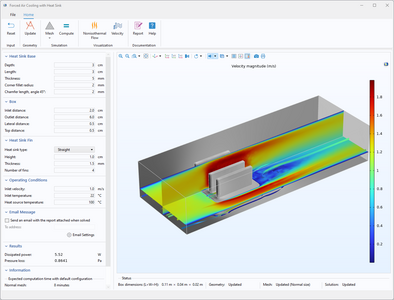
Diese Anwendung demonstriert: Geometrieteile und parametrisierte Geometrien Versenden einer E-Mail mit einem Bericht, wenn die Berechnung abgeschlossen ist Benutzerdefinierte E-Mail-Server-Einstellungen, die nützlich sind, wenn kompilierte Standalone-Apps ausgeführt werden Optionen zur ... Mehr lesen

Dieses Beispiel zeigt, wie Sie einen Phasenübergang modellieren und seine Auswirkungen auf eine Analyse des Wärmetransports vorhersagen können. Wenn ein Material die Phase ändert, zum Beispiel von fest zu flüssig, wird dem Festkörper Energie zugeführt. Anstatt einen Temperaturanstieg zu ... Mehr lesen
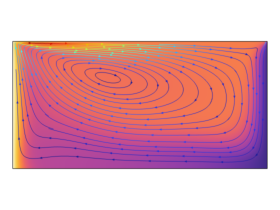
Marangoni convection occurs when the surface tension of an interface (generally liquid-air) depends on the concentration of a species or on the temperature distribution. In the case of temperature dependence, the Marangoni effect is also called thermo-capillary convection. The Marangoni ... Mehr lesen
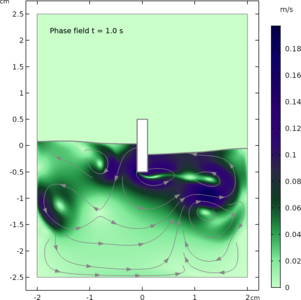
Wir präsentieren die Ergebnisse eines Vergleichs der Level-Set-, Phasenfeld- und Moving-Mesh-Methoden zur Modellierung freier Flüssigkeitsoberflächen in der Software COMSOL Multiphysics®. Der Vergleich wird anhand eines Beispielproblems durchgeführt. Das Beispiel untersucht die Bildung ... Mehr lesen

This app demonstrates the following: Multiple tabs in the ribbon Geometry parts and parameterized geometries Parts and cumulative selections can be used to automatically set domain and boundary settings in the embedded model Adding or removing geometry parts with different geometrical ... Mehr lesen

Centrifugal pumps are used in various applications and can be found in many industries. The size of the pump in this model is typical for automotive applications. This model shows how to set up rotating machinery simulations using the frozen rotor approximation for modeling centrifugal ... Mehr lesen

Density variations can initiate flow even in a still fluid. In earth systems, density variations can arise from naturally occurring salts, subsurface temperature changes, or migrating pollution. This buoyant or density-driven flow factors into fluid movement in salt-lake systems, saline ... Mehr lesen


