
Die Application Gallery bietet COMSOL Multiphysics® Tutorial- und Demo-App-Dateien, die für die Bereiche Elektromagnetik, Strukturmechanik, Akustik, Strömung, Wärmetransport und Chemie relevant sind. Sie können diese Beispiele als Ausgangspunkt für Ihre eigene Simulationsarbeit verwenden, indem Sie das Tutorial-Modell oder die Demo-App-Datei und die dazugehörigen Anleitungen herunterladen.
Suchen Sie über die Schnellsuche nach Tutorials und Apps, die für Ihr Fachgebiet relevant sind. Beachten Sie, dass viele der hier vorgestellten Beispiele auch über die Application Libraries zugänglich sind, die in die COMSOL Multiphysics® Software integriert und über das Menü File verfügbar sind.
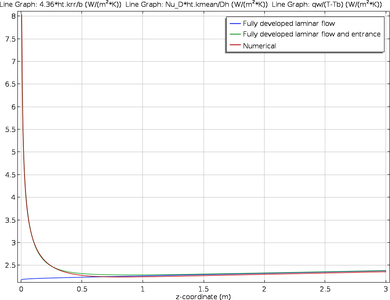
This verification model of nonisothermal laminar flow through a circular tube compares the heat transfer coefficient obtained from simulation with theoretical values based on Nusselt number correlation functions that can be found in the literature. Mehr lesen
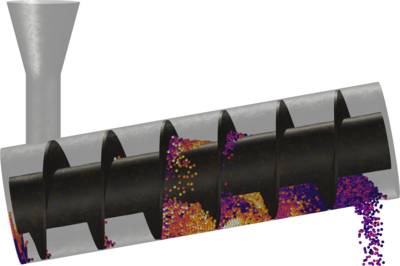
This model demonstrates the transport of grains using a screw conveyor. The grains enter the conveyor through a chute and are transported over an incline by a rotating screw. This model also demonstrates how to build and run a model method that evaluates the mass flow rate. Mehr lesen
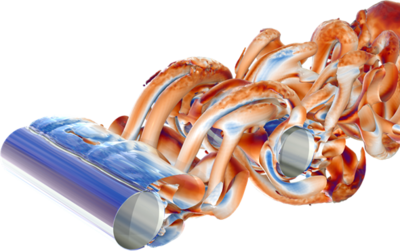
This model presents the flow noise generated by flow past the so-called tandem cylinder configuration. The test is part of the “First Workshop on Benchmark problems for Airframe Noise Computations”. The tutorial model shows the steps involved in a flow-induced noise simulation in COMSOL ... Mehr lesen
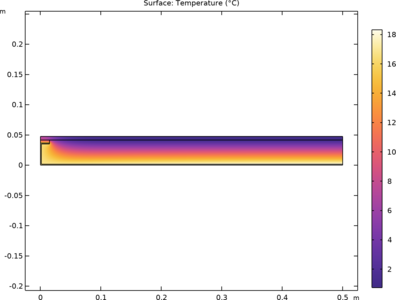
This example studies heat transfer in a composite two-dimensional structure. Four materials with distinct thermal conductivities k compose the structure. The top and bottom boundaries are facing environments respectively at 0°C and 20°C. The temperature distribution and the heat flux ... Mehr lesen
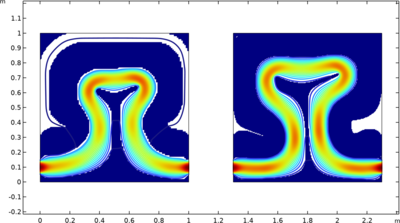
This model demonstrates topology optimization of a 2D heat exchanger with laminar flow. The flow is pressure driven and the objective is to maximize the heat transfer. The density method is used with the (now) classical approach of a single design variable and two flow interfaces. ... Mehr lesen

The aerodynamic properties of a wing, propeller, or turbine blade are to a large extent determined by the precise shape of the airfoil that is used. The NACA Airfoil Optimization application computes the two main aerodynamic properties (the lift and drag coefficients) of a fully ... Mehr lesen
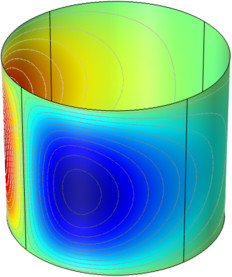
Journal bearings are used to carry radial loads, for example, to support a rotating shaft. A simple journal bearing consists of two rigid cylinders. The outer cylinder (bearing) wraps the inner rotating journal (shaft). The new thin-film flow user interfaces of the CFD Module enables ... Mehr lesen

This tutorial model illustrates the use of the nucleate boiling heat flux features to compute the transient cooling of a cylindrical rod plated with nickel, and immersed in a pool of boiling water. The temperature and heat flux results obtained with a 3D time-dependent computation, with ... Mehr lesen
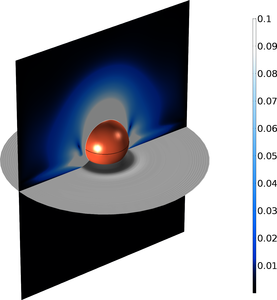
This model shows modeling of a sphere falling on a water surface. Specifically, it models the oscillating motion of a buoyant sphere as it falls through air and interacts with the air-water interface to finally float on water. Get more details in our blog post: Modeling a Sphere Falling ... Mehr lesen

This tutorial illustrates the use of the connecting features in the Heat Transfer in Solids and Heat Transfer in Shells interfaces, to couple them to a Lumped Thermal System interface. The results obtained with the solid and shell models are compared. Mehr lesen


