
Die Application Gallery bietet COMSOL Multiphysics® Tutorial- und Demo-App-Dateien, die für die Bereiche Elektromagnetik, Strukturmechanik, Akustik, Strömung, Wärmetransport und Chemie relevant sind. Sie können diese Beispiele als Ausgangspunkt für Ihre eigene Simulationsarbeit verwenden, indem Sie das Tutorial-Modell oder die Demo-App-Datei und die dazugehörigen Anleitungen herunterladen.
Suchen Sie über die Schnellsuche nach Tutorials und Apps, die für Ihr Fachgebiet relevant sind. Beachten Sie, dass viele der hier vorgestellten Beispiele auch über die Application Libraries zugänglich sind, die in die COMSOL Multiphysics® Software integriert und über das Menü File verfügbar sind.
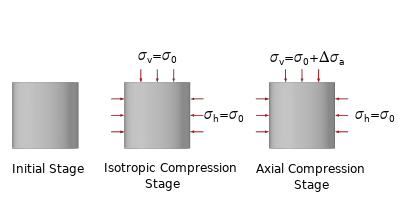
The triaxial test is one of the most common tests used in laboratory soil testing. The soil sample is normally placed inside a rubber membrane and then compressed maintaining a radial pressure. In this model, a vertical displacement and a confinement pressure are applied on the sample ... Mehr lesen
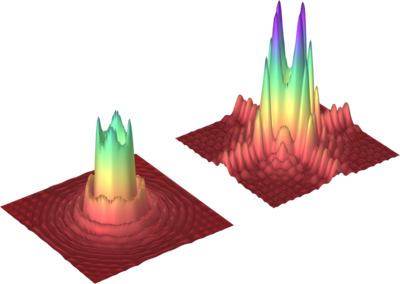
This example presents transient analysis of the wave propagation in rock mass caused by a short duration load on the surface. Such loads are typical during tunnel constructions and other excavations using blasting. The example shows the use of the Low-reflecting boundary conditions to ... Mehr lesen
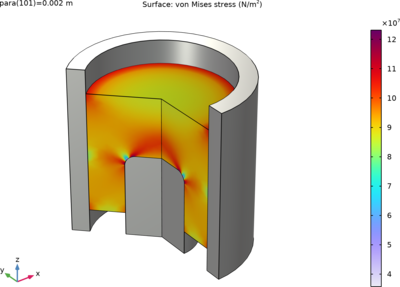
The fabrication of a cup through powder compaction is simulated in this tutorial model. The powder compaction process is becoming common in the manufacturing industry, due to its potential for producing components of complex shape and high strength. Combining the Fleck–Kuhn–McMeeking ... Mehr lesen
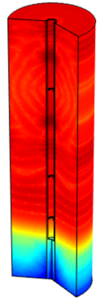
This model demonstrates how to simulate a piezoelectric transducer as both a sound transmitter and a receiver in a well logging setup. Other applications of this setup are, for example, in the field of nondestructive testing. A transmitting transducer is connected to an electrical ... Mehr lesen

This example shows how to implement a stress dependent material model. The Young's modulus changes based on the stress value. Mehr lesen
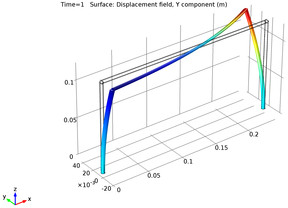
This is a benchmark model for flexible multibody dynamics. This model simulates the dynamic behavior of a planar four-bar mechanism when one of the joints has a defect. The out-of-plane motion in the mechanism, caused by the defect in the joint, is compared with the results from the ... Mehr lesen
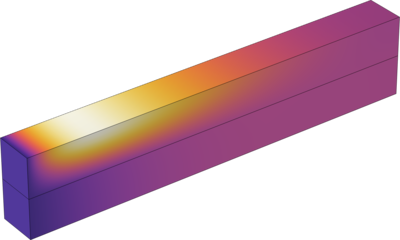
This example models heat generation in a beam-like structure subjected to small amplitude vibrations. The model computes the linear elastic response in the frequency domain. The transient heat-transfer analysis simulates the slow-rising temperature in the beam using the heat generated ... Mehr lesen
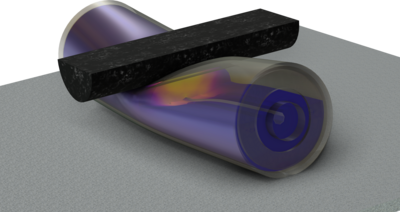
Eindrücktests werden häufig zur Bewertung der Sicherheit von Batterien eingesetzt, indem das Risiko interner Kurzschlüsse unter äußeren mechanischen Belastungen beurteilt wird. Dieses Beispiel veranschaulicht, wie ein solcher Versuch aufgebaut wird, bei dem ein Eindrückkörper auf eine ... Mehr lesen


