
Die Application Gallery bietet COMSOL Multiphysics® Tutorial- und Demo-App-Dateien, die für die Bereiche Elektromagnetik, Strukturmechanik, Akustik, Strömung, Wärmetransport und Chemie relevant sind. Sie können diese Beispiele als Ausgangspunkt für Ihre eigene Simulationsarbeit verwenden, indem Sie das Tutorial-Modell oder die Demo-App-Datei und die dazugehörigen Anleitungen herunterladen.
Suchen Sie über die Schnellsuche nach Tutorials und Apps, die für Ihr Fachgebiet relevant sind. Beachten Sie, dass viele der hier vorgestellten Beispiele auch über die Application Libraries zugänglich sind, die in die COMSOL Multiphysics® Software integriert und über das Menü File verfügbar sind.

Dieses Modell zeigt eine vollständige vibroakustische Analyse eines Lautsprechers einschließlich Treiber, Gehäuse und Ständer. Sie können eine nominale Antriebsspannung anlegen und den resultierenden Schalldruckpegel im Gehäuse und im Außenraum sowie die Verformung des Gehäuses und des ... Mehr lesen

This model describes a static stress analysis to obtain the stress distribution in the vicinity of a small hole in an infinite plate. The model is a classic benchmark and is described in Mechanics of Material, by D. Roylance. The stress level is then compared with the theoretical values. Mehr lesen
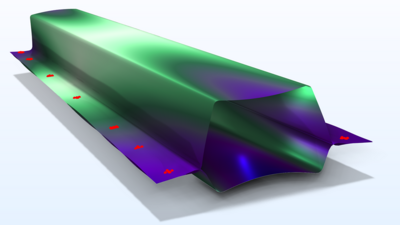
In this example, the natural frequencies of a double hat beam are studied. The beam is made of two thin steel plates, joined together by spot welds along the flanges. The Spot Welds feature sets up multiple mesh-independent connections between the shells. Mehr lesen
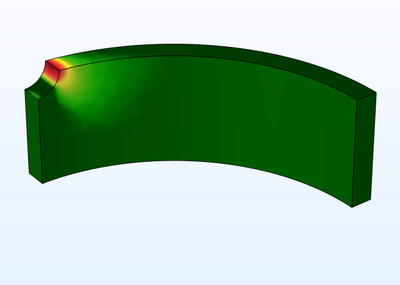
A load carrying component of a structure is subjected to multi-axial cyclic loading during which localized yielding of the material occurs. In this model you perform a low cycle fatigue analysis of the part based on the Smith-Watson-Topper (SWT) model. Due to localized yielding, you ... Mehr lesen
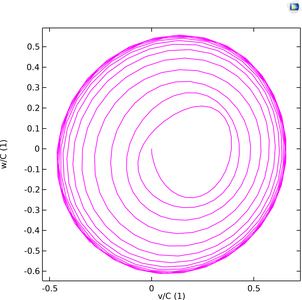
The Whirling of a Uniform Shaft tutorial model demonstrates how to perform a transient analysis of a uniform shaft under gravity. The shaft is supported by two hydrodynamic bearings at its ends. The gyroscopic effect causes the rotor to whirl about its initial axis, until it eventually ... Mehr lesen
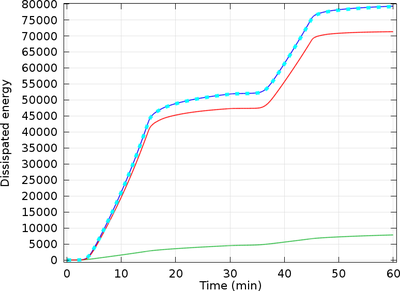
Fatigue testing of nonlinear materials with creep mechanism is a time-consuming process. In accelerated life testing the experiment time is greatly reduced by subjecting the material to testing conditions in excess of the operating one. In the model an aggressive thermal load cycle is ... Mehr lesen
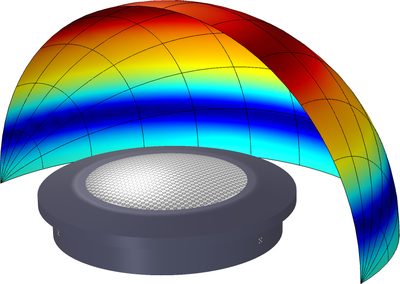
Model used as demonstration in the APEI/AES session on August 11. https://audioproducteducationinstitute.org/speakers-and-microphones-simulation-and-testing/ The geometry is invented and uses parts from two models: https://www.comsol.com/model/head-and-torso-simulator-acoustics-74381 ... Mehr lesen
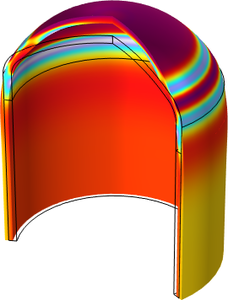
A thin-walled container made of rolled steel is subjected to an internal overpressure. As an effect of the manufacturing method, one of the three material principal directions — the out-of- plane direction — has a higher yield stress than the other two. Hill’s orthotropic plasticity is ... Mehr lesen


