
Die Application Gallery bietet COMSOL Multiphysics® Tutorial- und Demo-App-Dateien, die für die Bereiche Elektromagnetik, Strukturmechanik, Akustik, Strömung, Wärmetransport und Chemie relevant sind. Sie können diese Beispiele als Ausgangspunkt für Ihre eigene Simulationsarbeit verwenden, indem Sie das Tutorial-Modell oder die Demo-App-Datei und die dazugehörigen Anleitungen herunterladen.
Suchen Sie über die Schnellsuche nach Tutorials und Apps, die für Ihr Fachgebiet relevant sind. Beachten Sie, dass viele der hier vorgestellten Beispiele auch über die Application Libraries zugänglich sind, die in die COMSOL Multiphysics® Software integriert und über das Menü File verfügbar sind.

In diesem Tutorial wird das akustische Verhalten eines Lautsprechertreibers modelliert, der in einem Bassreflex-Gehäuse montiert ist. Das Gehäuse, das manchmal auch als Box bezeichnet wird, verändert die Empfindlichkeit und die Abstrahlcharakteristik des Lautsprechers erheblich und wird ... Mehr lesen

Diese App demonstriert, wie der Application Builder in der COMSOL Multiphysics® Software verwendet werden kann, um fortgeschrittene Kabelmodellierung einem allgemeinen Publikum zugänglich zu machen. Kernstück ist ein Multiphysik-Modell, das auf der Technologie basiert, die in der ... Mehr lesen

This example considers the natural convection of air above a smoldering incense stick. This kind of flow often shows a transition from laminar to turbulent which is nicely visualized by the smoke produced by the slow burning of the incense. The model uses the Nonisothermal Flow, LES RBVM ... Mehr lesen
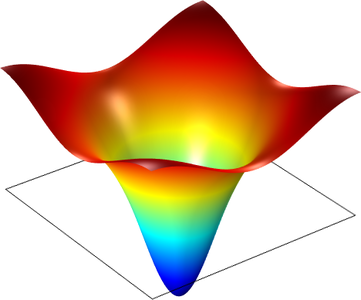
Dieses Modell untersucht die Wellenausbreitung in einem photonischen Kristall, der aus GaAs-Säulen besteht, die in gleichem Abstand zueinander angeordnet sind. Der Abstand zwischen den Säulen bestimmt eine Beziehung zwischen der Wellenzahl und der Frequenz des Lichts, die verhindert, ... Mehr lesen
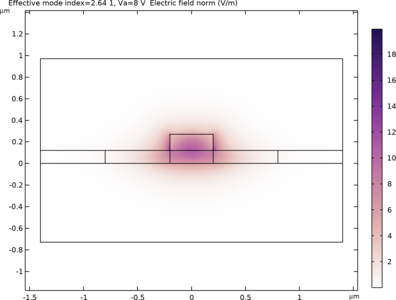
This tutorial demonstrates how to model a Silicon-on-Insulator (SoI) Modulator – a well-known optics device configuration that takes advantage of the free-carrier plasma dispersion effect and allows for the electrical control of the optical waveguide properties. The simulation couples ... Mehr lesen
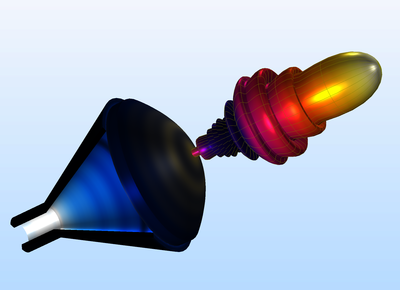
An axisymmetric 3D structure such as a conical horn antenna can be simulated in a fast and efficient way using only its 2D layout. In this model, the antenna radiation and matching characteristics are computed very quickly with respect to the dominant TE mode from the given circular ... Mehr lesen
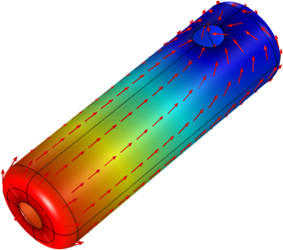
A goal for many applications is to predict physics in thin structures, such as shells, without modeling the thickness of the structure. This is because large aspect ratios can cause meshing and geometry analysis problems. This model demonstrates how to use the tangential derivative ... Mehr lesen
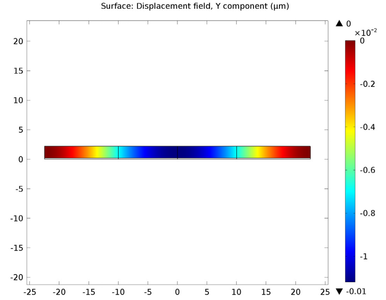
Silicon micromechanical resonators have long been used for designing sensors and are now becoming increasingly important as oscillators in the consumer electronics market. In this series of models, a surface micromachined MEMS resonator, designed as part of a micromechanical filter, is ... Mehr lesen
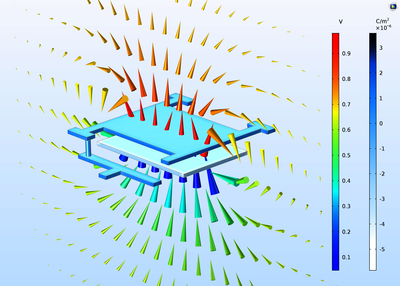
The electrostatically tunable parallel plate capacitor in this example is a typical component in various MEMS devices for radio frequencies that range between 300 MHz and 300 GHz. You can modify the distance between the two plates, as the applied voltage changes, through a spring ... Mehr lesen
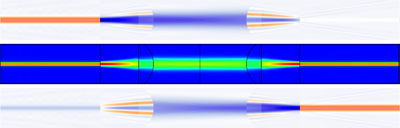
Focusing a laser beam onto the tip of a single mode fiber is a common way to couple light. To achieve good coupling efficiency, the spatial mode of the light field has to match the spatial mode of the fiber. In this model, we use the beam envelopes method to compute a small free-space ... Mehr lesen


