
Die Application Gallery bietet COMSOL Multiphysics® Tutorial- und Demo-App-Dateien, die für die Bereiche Elektromagnetik, Strukturmechanik, Akustik, Strömung, Wärmetransport und Chemie relevant sind. Sie können diese Beispiele als Ausgangspunkt für Ihre eigene Simulationsarbeit verwenden, indem Sie das Tutorial-Modell oder die Demo-App-Datei und die dazugehörigen Anleitungen herunterladen.
Suchen Sie über die Schnellsuche nach Tutorials und Apps, die für Ihr Fachgebiet relevant sind. Beachten Sie, dass viele der hier vorgestellten Beispiele auch über die Application Libraries zugänglich sind, die in die COMSOL Multiphysics® Software integriert und über das Menü File verfügbar sind.

This benchmark model simulates the rigid body dynamics of Andrew’s squeezing mechanism. The mechanism is force driven and exhibits dynamics over a very short time scale. The computed angles of various components in the mechanism are compared with reference results to validate the model. Mehr lesen
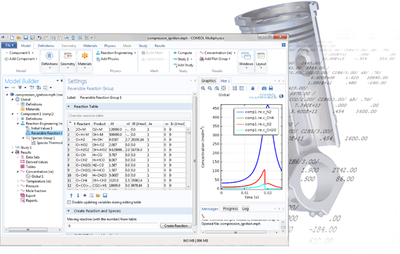
Homogeneous Charge Compression Ignition (HCCI) engines are being considered as an alternative to traditional spark- and compression-ignition engines. As the name implies, a homogeneous fuel/oxidant mixture is auto-ignited by compression with simultaneous combustion occurring throughout ... Mehr lesen
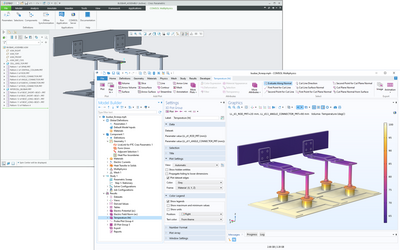
This tutorial model of the Joule heating effect in a busbar demonstrates how to synchronize an assembly between the PTC Creo Parametric™ software and the COMSOL Multiphysics® software, how to modify the geometry from COMSOL Multiphysics®, and how to run a ... Mehr lesen

This conceptual example shows how to calculate critical points in models with contact. The model consists of two contacting arches modeled with the Shell interface. The contact problem is solved using the penalty method. The upper arch is loaded with displacement controlled edge loads ... Mehr lesen
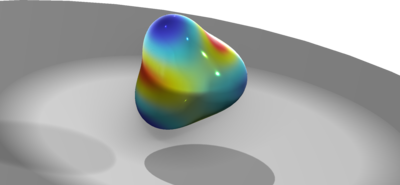
In this tutorial, the eigenmodes and eigenfrequencies of an air bubble in water are modeled and compared with analytical solutions. The effects of surface tension are included, allowing both the pulsating mode and the surface modes of the bubble to be modeled. Lastly, the effect of the ... Mehr lesen
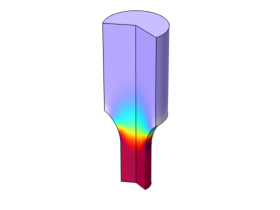
The model shows how to calibrate the probability distribution of the Young's modulus and Poisson ratio based on a tensile test. The test measures the tensile force and the radial displacement for different values of the prescribed displacement. The model is based on synthetic data ... Mehr lesen
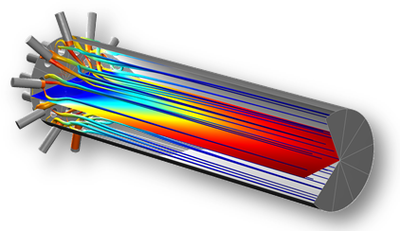
In a polymerization reactor for polyester manufacturing, the mixing in the reactor is achieved by impinging turbulent jets of reactants onto each other. The turbulence affects the reaction kinetics and quality of the polymer linkage. Turbulent flows involving rapid reaction kinetics are ... Mehr lesen

As oil flows through a pipeline section heat is released due to the work of internal friction forces in the fluid. With good insulation of the pipeline, this generated heat can be used to avoid preheating of the oil, despite the fact that it is to be transported in a cold environment ... Mehr lesen


