
Die Application Gallery bietet COMSOL Multiphysics® Tutorial- und Demo-App-Dateien, die für die Bereiche Elektromagnetik, Strukturmechanik, Akustik, Strömung, Wärmetransport und Chemie relevant sind. Sie können diese Beispiele als Ausgangspunkt für Ihre eigene Simulationsarbeit verwenden, indem Sie das Tutorial-Modell oder die Demo-App-Datei und die dazugehörigen Anleitungen herunterladen.
Suchen Sie über die Schnellsuche nach Tutorials und Apps, die für Ihr Fachgebiet relevant sind. Beachten Sie, dass viele der hier vorgestellten Beispiele auch über die Application Libraries zugänglich sind, die in die COMSOL Multiphysics® Software integriert und über das Menü File verfügbar sind.
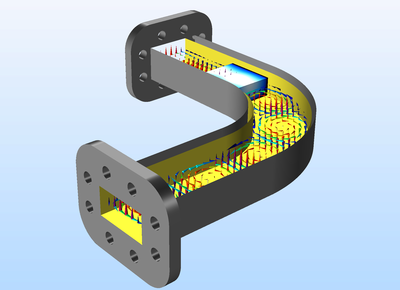
This is a model of an RF waveguide bend with a dielectric block inside. There are electromagnetic losses in the block as well as on the waveguide walls which cause the assembly to heat up over time. The material properties of the block are functions of temperature. The transient thermal ... Mehr lesen

Droplet evaporation is ubiquitous in everyday life and is essential in many industrial processes, such as inkjet printing, cleaning/coating of surfaces, and phase change heat transfer. This model demonstrates how to model phase transition by a moving exterior boundary condition using ... Mehr lesen
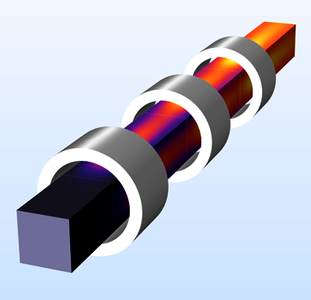
Diese App demonstriert: Geometrieteile und parametrisierte Geometrien Verwendung von Tabellen für Benutzereingabeparameter Visualisierung in einem 2D-Querschnitt einer 3D-Geometrie Verbesserte Visualisierung und Benutzererfahrung, wenn ein Geometrieobjekt (das Luftobjekt) ausgeblendet ... Mehr lesen
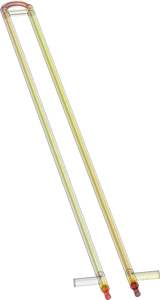
Double-pipe heat exchangers, with their typical U-turn shape, are one of the simplest and cheapest type of heat exchangers used in the chemical process industry. This example studies the cooling of hot oil (130°C) by a cool oil (60°C) entering in counter-current. As the oils flow ... Mehr lesen
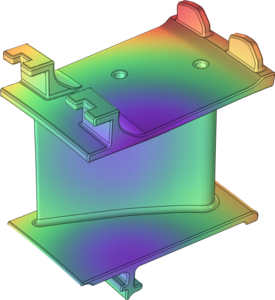
This example shows how to compute thermally induced stresses in a turbine stator blade using the Thermal Stress, Solid interface. The conditions within gas turbines are extreme. The pressure can be as high as 40 bar, and the temperature more than 1000 K. Any new component must therefore ... Mehr lesen

Thermische Energiespeicher werden zur Speicherung von Wärmeenergie aus Solar-, Geothermie- oder Abwärmequellen verwendet. Die einfachsten Anlagen bestehen aus Wassertanks, die häufig in Haushalten zu finden sind und in denen die Sonnenenergie als fühlbare Wärme gespeichert wird. Die ... Mehr lesen
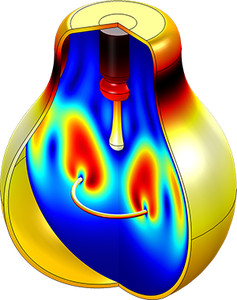
Dieses Modell behandelt die freie Konvektion von Argongas in einer Glühbirne. Es zeigt die Kopplung des Wärmetransports (Leitung, Strahlung und Konvektion) mit dem Impulstransport (nicht-isotherme Strömung), der durch temperaturbedingte Dichteänderungen verursacht wird. Das COMSOL ... Mehr lesen

During the design of a building, environmental issues have gained considerable influence in the entire project. One of the first concerns is to improve thermal performances. In this process, simulation software are key tools to model thermal losses and performances in the building. The ... Mehr lesen

This example studies heat transfer in a composite two-dimensional structure. Four materials with distinct thermal conductivities k compose the structure. The top and bottom boundaries are facing environments respectively at 0°C and 20°C. The temperature distribution and the heat flux ... Mehr lesen
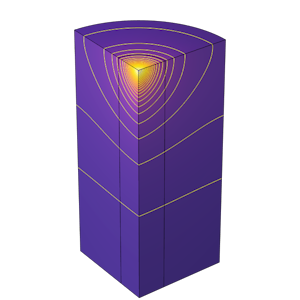
This tutorial shows how to use the Radiative Beam in Absorbing Media interface (Heat Transfer Module) to model the attenuation of a laser light going through a sample of silica glass, and the heat source generated by the absorption. Mehr lesen


