
Die Application Gallery bietet COMSOL Multiphysics® Tutorial- und Demo-App-Dateien, die für die Bereiche Elektromagnetik, Strukturmechanik, Akustik, Strömung, Wärmetransport und Chemie relevant sind. Sie können diese Beispiele als Ausgangspunkt für Ihre eigene Simulationsarbeit verwenden, indem Sie das Tutorial-Modell oder die Demo-App-Datei und die dazugehörigen Anleitungen herunterladen.
Suchen Sie über die Schnellsuche nach Tutorials und Apps, die für Ihr Fachgebiet relevant sind. Beachten Sie, dass viele der hier vorgestellten Beispiele auch über die Application Libraries zugänglich sind, die in die COMSOL Multiphysics® Software integriert und über das Menü File verfügbar sind.

This model shows a setup of two parallel wires with a constant current running through both. Their cross-sections are successively reduced until a set force per unit length is reached. Mehr lesen
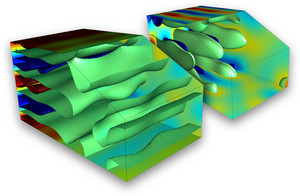
Sound is generated by a point source located in the wall of this test bench car interior. The sound pressure level response at a point of measurement is investigated for a range of frequencies and four different mesh resolutions. The model is first solved with the default direct solvers. ... Mehr lesen

MEMS scanning mirrors are a type of MEMS device that realizes optical path control by controlling mirror torsion through a microdriver. The torsion can be single axis or double axis. MEMS scanning mirrors are widely used in laser projection, laser radar, laser processing, and other ... Mehr lesen

This model represents a test case of a flow in an elastic tube which is present in several applications. This specific case models viscoelastic flow and represents steady flow in a channel in which part of the upper wall is replaced by an elastic plate subjected to an external pressure. ... Mehr lesen
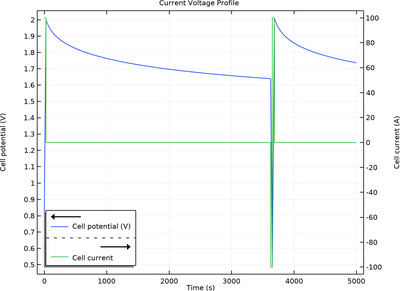
This model illustrates the effect of oxygen and hydrogen formation and recombination on the performance and self-discharge of an electrochemical capacitor with a water-based electrolyte. A load cycle consisting of mixed constant current pulses and rest periods at an open circuit is ... Mehr lesen
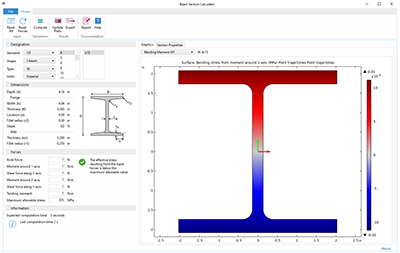
This app demonstrates: Light theme This app allows you to evaluate cross-section data for a wide range of American and European standard beams. Given a set of forces and moments acting on the section, you can also compute a detailed stress distribution. Calculated cross-section data ... Mehr lesen
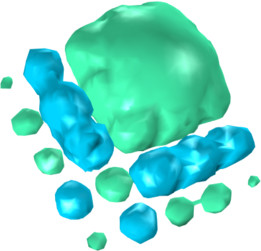
Das Bessel-Array ist eine Möglichkeit, eine Reihe von Lautsprechern so anzuordnen, dass die Winkelschallverteilung der eines einzelnen Lautsprechers ähnelt. Bei diesem Modell werden fünf Bessel-Paneele in demselben Muster kombiniert, um ein rein radiales Schallfeld zu simulieren. Die ... Mehr lesen

This example studies the deflection of a cantilever beam undergoing very large deflections. The beam is modeled using the Solid Mechanics, Shell, and Beam interfaces. The results are compared with each other and with a benchmark solution from NAFEMS. In addition, a linear buckling ... Mehr lesen


