
Die Application Gallery bietet COMSOL Multiphysics® Tutorial- und Demo-App-Dateien, die für die Bereiche Elektromagnetik, Strukturmechanik, Akustik, Strömung, Wärmetransport und Chemie relevant sind. Sie können diese Beispiele als Ausgangspunkt für Ihre eigene Simulationsarbeit verwenden, indem Sie das Tutorial-Modell oder die Demo-App-Datei und die dazugehörigen Anleitungen herunterladen.
Suchen Sie über die Schnellsuche nach Tutorials und Apps, die für Ihr Fachgebiet relevant sind. Beachten Sie, dass viele der hier vorgestellten Beispiele auch über die Application Libraries zugänglich sind, die in die COMSOL Multiphysics® Software integriert und über das Menü File verfügbar sind.

This tutorial demonstrates how to model ultrasound imaging in human tissue using an imaging probe composed of piezoelectric arrays that generate steered and focused beams. Simulating this process requires a transient multiphysics model to accurately capture sound generation, propagation, ... Mehr lesen

This model is an introduction to defining and verifying a satellite orbit, and computing the solar, albedo, and Earth infrared thermal loads. A 1U CubeSat is in a circular orbit at 400km altitude, inclination of 50°, and longitude of ascending node of 0°. The satellite is rotating slowly ... Mehr lesen

This example demonstrates how to compute transmission line parameters such as series resistance, series inductance, shunt conductance, and shunt capacitance per unit length using the predefined Transmission Line RLGC Parameters multiphysics interface. The demonstration also includes the ... Mehr lesen

In this model, two fluids are separated by a solid elastic structure. An acoustic pressure wave impacts the structure resulting in a reflected wave and a wave transmitted with a loss through the structure. This model investigates the transmission loss through the structure. The effects ... Mehr lesen
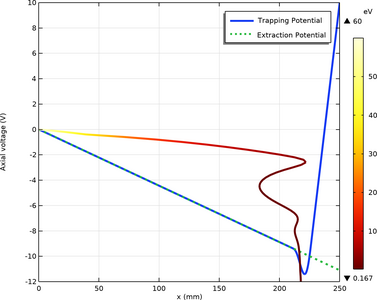
A radio frequency quadrupole ion trap utilizes a radio frequency quadrupole (RFQ) in order to trap an ion beam. A continuous high energy ion beam is first cooled and converted into a spatially confined bunch, which can then be released with minimal heating of the beam. The device is also ... Mehr lesen

This example shows how to make a simple model for a binary distillation process. A thermodynamics property package, available in the Chemical Reaction Engineering Module, is created to study the separation of a nonideal mixture of ethanol and water. The required equilibrium relationship ... Mehr lesen
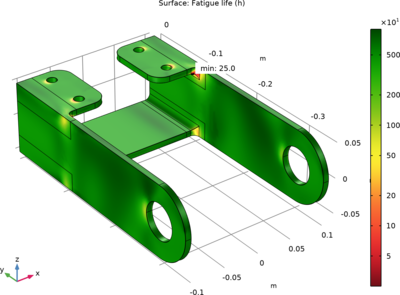
This example shows how to perform a fatigue analysis of a structure subjected to random vibrations. Times to failure using the cycle counting models according to Bendat and Dirlik are compared. Mehr lesen

Wenn elektrische Energie in einem Elektromotor in mechanische Arbeit umgewandelt wird, wird die "verschwendete" Energie, die zur Erwärmung des Geräts führt, gewöhnlich als Verlust bezeichnet. Das Verhältnis von nutzbarer Arbeit zu eingegebener Energie, oder der Wirkungsgrad des Motors, ... Mehr lesen
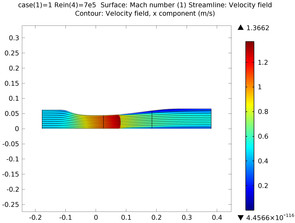
In this model the high speed turbulent gas flow in a converging and diverging nozzle is modeled using the High Mach Number Flow interface. The diffuser is transonic in the sense that the flow at the inlet is subsonic, but due to the contraction and the low outlet pressure, the flow ... Mehr lesen
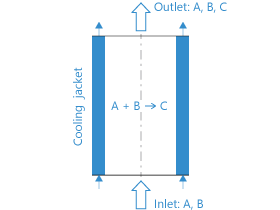
Diese App für einen Rohrreaktor und das dazugehörige eingebettete Modell zeigt, wie die Rechengeschwindigkeit durch die Verwendung eines Ersatzmodells im Gegensatz zu einem vollwertigen Finite-Elemente-Modell erhöht werden kann. Ein Ersatzmodell ist ein einfacheres, in der Regel ... Mehr lesen


