
Die Application Gallery bietet COMSOL Multiphysics® Tutorial- und Demo-App-Dateien, die für die Bereiche Elektromagnetik, Strukturmechanik, Akustik, Strömung, Wärmetransport und Chemie relevant sind. Sie können diese Beispiele als Ausgangspunkt für Ihre eigene Simulationsarbeit verwenden, indem Sie das Tutorial-Modell oder die Demo-App-Datei und die dazugehörigen Anleitungen herunterladen.
Suchen Sie über die Schnellsuche nach Tutorials und Apps, die für Ihr Fachgebiet relevant sind. Beachten Sie, dass viele der hier vorgestellten Beispiele auch über die Application Libraries zugänglich sind, die in die COMSOL Multiphysics® Software integriert und über das Menü File verfügbar sind.
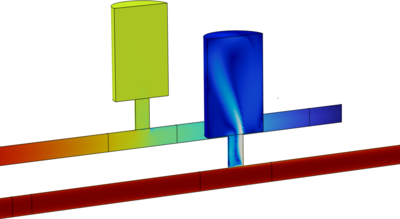
Helmholtz resonators are used in exhaust systems, as they can attenuate a specific narrow frequency band. The presence of a flow in the system alters the acoustic properties of the resonator and the transmission loss of the subsystem. In this tutorial model, a Helmholtz resonator is ... Mehr lesen
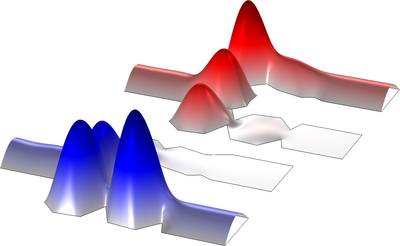
A diplexer is a device that combines or splits signals into two different frequency bands, widely used in mobile communication systems. This example simulates splitting properties using a simplified 2D geometry. The geometry is optimized using shape optimization in order to get the ... Mehr lesen

This tutorial shows how to include local nonlinear effects when simulating the acoustics of an exponential horn. Nonlinear effects become important when an acoustic horn is used for high amplitude signaling. The Nonlinear Acoustics (Westervelt) Contributions feature available for the ... Mehr lesen
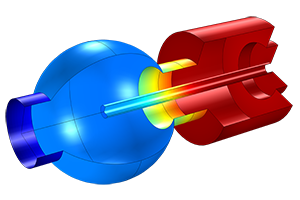
This model shows how to simulate the time-dependent adsorption and desorption of water in a vacuum system at low pressures. The water is introduced into the system when a gate valve to a load lock is opened and the subsequent migration and pumping of the water is modeled. Mehr lesen
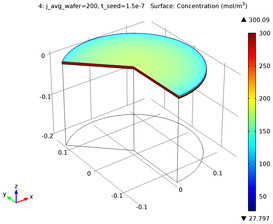
This example extends the analysis made in the model Electrodeposition on a Resistive Patterned Wafer by including the diffusion and convection of copper ions in the electrolyte. The coupled mass transport convection-diffusion effects are of interest in this type of reactor since they ... Mehr lesen
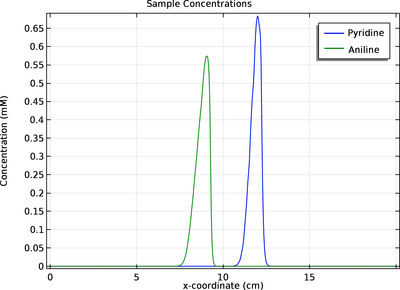
Zone electrophoresis (ZE) is an electrophoretic separation technique typically used for analyzing proteins, nucleic acids, and biopolymers. During the process, different species in a sample are transported in a continuous electrolyte buffer system, subject to a potential gradient. Due to ... Mehr lesen
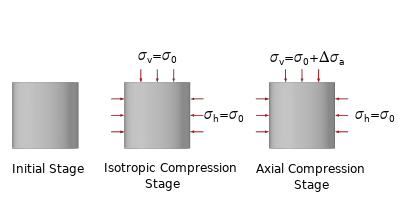
The triaxial test is one of the most common tests used in laboratory soil testing. The soil sample is normally placed inside a rubber membrane and then compressed maintaining a radial pressure. In this model, a vertical displacement and a confinement pressure are applied on the sample ... Mehr lesen

A circular waveguide filter is designed using a 2D axisymmetric model. Six annular rings added to the waveguide form circular cavities connected in series, and each cavity cutoff frequency is close to the center frequency of the filter. The simulated S-parameters show a bandpass ... Mehr lesen


