
Die Application Gallery bietet COMSOL Multiphysics® Tutorial- und Demo-App-Dateien, die für die Bereiche Elektromagnetik, Strukturmechanik, Akustik, Strömung, Wärmetransport und Chemie relevant sind. Sie können diese Beispiele als Ausgangspunkt für Ihre eigene Simulationsarbeit verwenden, indem Sie das Tutorial-Modell oder die Demo-App-Datei und die dazugehörigen Anleitungen herunterladen.
Suchen Sie über die Schnellsuche nach Tutorials und Apps, die für Ihr Fachgebiet relevant sind. Beachten Sie, dass viele der hier vorgestellten Beispiele auch über die Application Libraries zugänglich sind, die in die COMSOL Multiphysics® Software integriert und über das Menü File verfügbar sind.
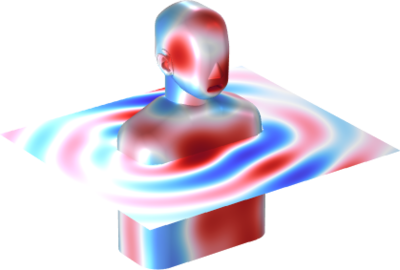
In this model, we use the Pressure Acoustics, Boundary Elements physics interface to analyze the acoustics of a generic head and torso simulator. This is a manikin head used to do standardized measurements for hearing aids, mobile phones, and headphones. The model showcases some ... Mehr lesen

Optical computing has been a promising paradigm alternative to the current electronic computers. This model simulates an optical 4-by-4 unitary matrix multiplication device based on a network of six Mach–Zehnder interferometers (MZIs). A more detailed description of this model can be ... Mehr lesen

Microwave filters are used to eliminate unwanted frequency components in the output from microwave transmitters. They are typically inserted between a power amplifier and an antenna. The amplifiers are nonlinear and produce harmonics that must be eliminated with filters that have a ... Mehr lesen
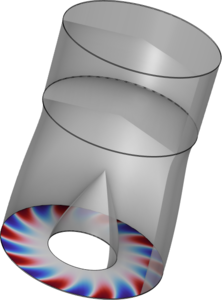
The acoustic field in a model of an axially symmetric lined aero-engine duct, based on modal sound transmission, is analyzed. The source is generated by a single mode excitation at a boundary. Sources and nonreflecting conditions are applied using port boundary conditions. The model ... Mehr lesen

This tutorial illustrates the use of the connecting features in the Heat Transfer in Solids and Heat Transfer in Shells interfaces, to couple them to a Lumped Thermal System interface. The results obtained with the solid and shell models are compared. Mehr lesen
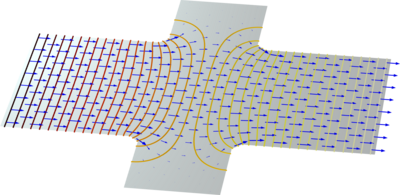
This example uses the Electric Currents in Layered Shells interface and the Layered Shell interface to model a piezoresistive pressure sensor. The tutorial considers the design of the MPX100 series pressure sensors originally manufactured by Motorola Inc. Although the sensor is no ... Mehr lesen
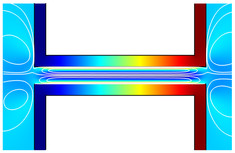
This model is a benchmark model for the Slip Flow interface. It is based on both analytic and numeric calculations. Air at atmospheric pressure flows through a conducting micro-channel connecting two reservoirs maintained at different temperatures. A flow between the two reservoirs ... Mehr lesen
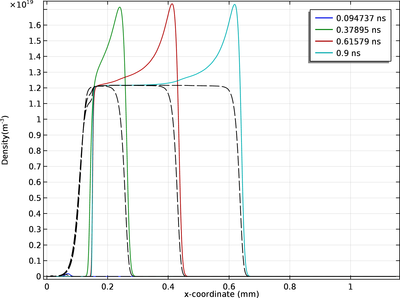
Streamers are transient filamentary electric discharges that can develop in a nonconducting background in the presence of an intense electric field. These discharges can attain high electron number density and consequently a high concentration of chemical active species that are relevant ... Mehr lesen


