
Die Application Gallery bietet COMSOL Multiphysics® Tutorial- und Demo-App-Dateien, die für die Bereiche Elektromagnetik, Strukturmechanik, Akustik, Strömung, Wärmetransport und Chemie relevant sind. Sie können diese Beispiele als Ausgangspunkt für Ihre eigene Simulationsarbeit verwenden, indem Sie das Tutorial-Modell oder die Demo-App-Datei und die dazugehörigen Anleitungen herunterladen.
Suchen Sie über die Schnellsuche nach Tutorials und Apps, die für Ihr Fachgebiet relevant sind. Beachten Sie, dass viele der hier vorgestellten Beispiele auch über die Application Libraries zugänglich sind, die in die COMSOL Multiphysics® Software integriert und über das Menü File verfügbar sind.

Magnetic prospecting is a geological exploration method that is applicable to certain types of iron ore deposits, in particular those made up of magnetite and hematite. The method consists of measuring the magnetic anomalies (changes in the earth's magnetic field) due to the presence of ... Mehr lesen
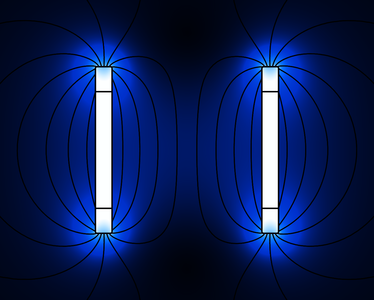
In dieser Reihe von Verifikationsmodellen und der dazugehörigen Dokumentation wird die Genauigkeit von Berechnungen der elektromagnetischen Kraft untersucht. Mit verschiedenen Techniken werden die Gesamtkraft und das Drehmoment auf einen starren Körper bestimmt und mit analytischen ... Mehr lesen
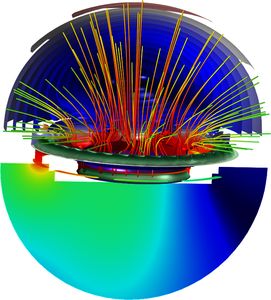
Dieses Modell analysiert die elektromagnetischen, mechanischen und akustischen Eigenschaften des Lautsprechers OWS-1943T-8CP (nicht mehr lieferbar). Abgesehen von einigen Details sind die Geometrie, die Materialeigenschaften und die Messungen durch Ole Wolff urheberrechtlich geschützt. ... Mehr lesen
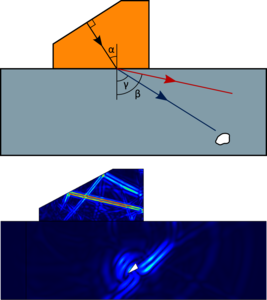
Ultraschall-Winkelprüfsysteme werden für die zerstörungsfreie Prüfung von festen Objekten, wie Metallrohren, verwendet. Sie sind besonders nützlich für die Erkennung von Fehlern in und um Schweißbereiche, wie Poren, kleine Risse oder fehlende Verschmelzung. Die zerstörungsfreie Prüfung ... Mehr lesen
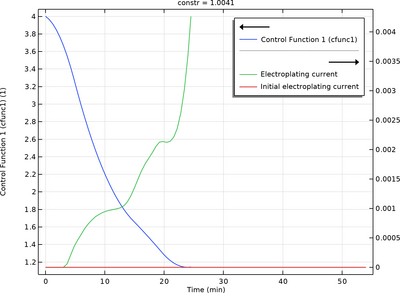
This model demonstrates how to optimize the charging profile of a battery using gradient based optimization. The optimization solver minimizes the time required for charging the battery from 0% to 90% state of charge, while at the same time constraining the amount lithium inventory lost ... Mehr lesen
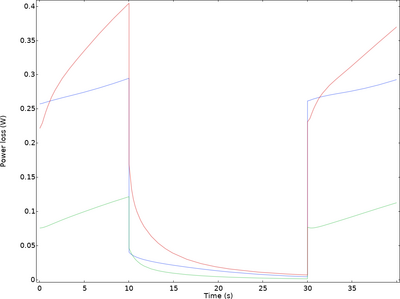
This example computes the power losses in a lithium-ion battery when exposed to high current pulses in a hybrid pulse power characterization (HPPC) test. Power loss contributions stemming from different phenomena are analyzed, as well as the total power losses pertaining to the ... Mehr lesen

This example model consists of a two-hot-arm thermal actuator made of polysilicon. The actuator is activated through thermal expansion. The temperature increase required to deform the two hot arms, and thus displace the actuator, is obtained through Joule heating (resistive heating). The ... Mehr lesen
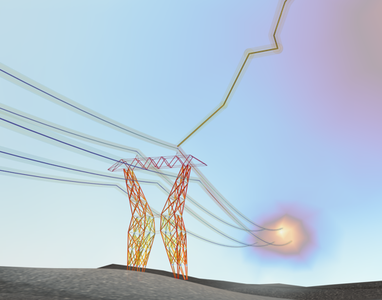
This model demonstrates the analysis of lightning surges on high voltage transmission line towers. Lightning carrying a current of 10 kA struck one of the tower's shielded wires. The induced voltage at the three-phase conductors are computed. Some highlights of this model: Perform ... Mehr lesen
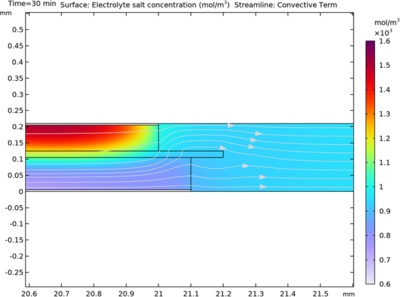
The electrodes of a lithium-ion battery are porous and consist of an active solid electrode material, a binder, and pores filled with a liquid electrolyte. Expansion of the active material due to lithium intercalation changes the volume fraction of electrolyte-filled pores in the ... Mehr lesen
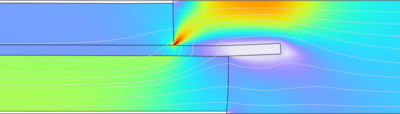
The electrodes of a lithium-ion battery are porous, consisting of an active solid material, a binder, and pores filled with liquid electrolyte. If a force is applied on the porous layers of a battery, this will affect the volume fraction of the electrolyte-filled pores in the electrodes, ... Mehr lesen


