
Die Application Gallery bietet COMSOL Multiphysics® Tutorial- und Demo-App-Dateien, die für die Bereiche Elektromagnetik, Strukturmechanik, Akustik, Strömung, Wärmetransport und Chemie relevant sind. Sie können diese Beispiele als Ausgangspunkt für Ihre eigene Simulationsarbeit verwenden, indem Sie das Tutorial-Modell oder die Demo-App-Datei und die dazugehörigen Anleitungen herunterladen.
Suchen Sie über die Schnellsuche nach Tutorials und Apps, die für Ihr Fachgebiet relevant sind. Beachten Sie, dass viele der hier vorgestellten Beispiele auch über die Application Libraries zugänglich sind, die in die COMSOL Multiphysics® Software integriert und über das Menü File verfügbar sind.

This app demonstrates the following: A model using symmetry while the results are visualized in full 3D Provides info if the results are above or below certain critical values Selecting predefined or user-defined materials Error control of geometry parameters using methods and ... Mehr lesen
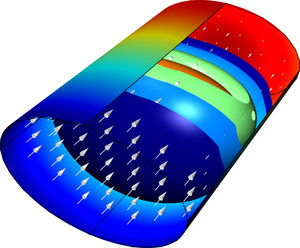
Several factors influence a diesel particulate filter’s (DPF) efficiency and durability. Important issues include the removal of soot particles from the filter membranes and the influence of thermal stress on the ceramic structure, stress that arises during repeated operating cycles. ... Mehr lesen

This case shows how to simulate moisture transport in a homogeneous wall under isothermal conditions. With this assumption, an analytical solution can be calculated. The homogeneous layer is initialized in moisture balance. At the beginning of the simulation, the relative humidity of ... Mehr lesen
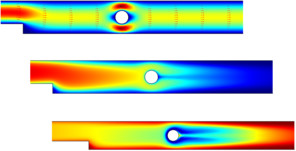
In this tutorial, the heat and mass transport equations are coupled to laminar flow in order to model exothermic reactions in a parallel plate reactor. It exemplifies how you can use COMSOL Multiphysics to systematically set up and solve increasingly sophisticated models using predefined ... Mehr lesen

This industrial-scale proof of concept (POC) model demonstrates how to perform an electric-thermal analysis of a high-power insulated-gate bipolar transistor module (IGBT module). The module has a rated voltage of 1200 V, and nominal current of 1800 A. Using a stationary study the ... Mehr lesen
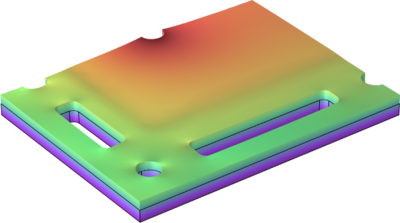
A fuel cell stack operates at temperatures just below 100 °C, which means that it has to be heated at start-up. The fuel cell stack consists of unit cell of anode, membrane, and cathode connected in series through bipolar plates. This study presents a model that couples the thermal and ... Mehr lesen

The purpose of this model is to introduce the specular reflection in Surface-to-Surface Radiation using the ray-shooting algorithm. Different parameters are available to the user to yield better accuracy in the results when using the ray-shooting algorithm. The model is a standard ... Mehr lesen

When radiation occurs across a very narrow gap this is often well-approximated as radiation between infinite parallel plates. This model considers three aluminum plates separated by narrow air gaps. The model compares the classical approach, based on the Surface-to-Surface Radiation ... Mehr lesen
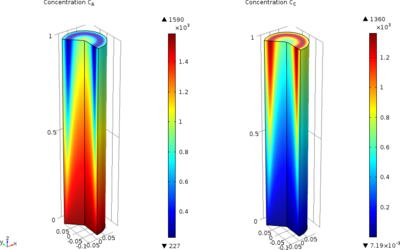
This application uses the Chemical Reaction Engineering Module to study an elementary, exothermic, irreversible reaction in a tubular reactor (liquid phase, laminar flow regime). To keep its temperature down, the reactor uses a cooling jacket with a constant coolant temperature. The ... Mehr lesen
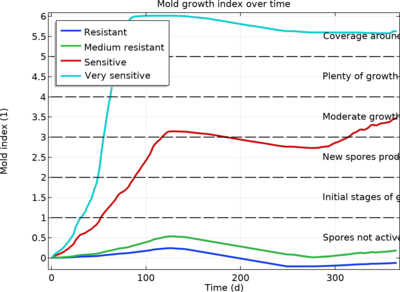
This tutorial demonstrates how to use the temperature and relative humidity computed from a heat and moisture transport simulation of an insulated roof as inputs for a mold prediction model. The VTT model for mold growth and decline prediction calculates a mold index M by solving an ... Mehr lesen