
Die Application Gallery bietet COMSOL Multiphysics® Tutorial- und Demo-App-Dateien, die für die Bereiche Elektromagnetik, Strukturmechanik, Akustik, Strömung, Wärmetransport und Chemie relevant sind. Sie können diese Beispiele als Ausgangspunkt für Ihre eigene Simulationsarbeit verwenden, indem Sie das Tutorial-Modell oder die Demo-App-Datei und die dazugehörigen Anleitungen herunterladen.
Suchen Sie über die Schnellsuche nach Tutorials und Apps, die für Ihr Fachgebiet relevant sind. Beachten Sie, dass viele der hier vorgestellten Beispiele auch über die Application Libraries zugänglich sind, die in die COMSOL Multiphysics® Software integriert und über das Menü File verfügbar sind.
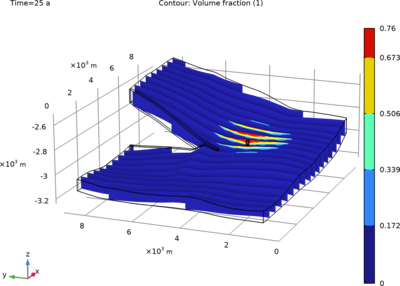
Dieses Beispiel simuliert die unterirdische Speicherung von CO2 in einem Teil der Johansen-Formation vor der Küste Norwegens. Das CO2 wird über einen Injektionsbrunnen mit einer Rate von 15 kg/s über einen Zeitraum von 25 Jahren injiziert, danach wird der Brunnen geschlossen. Das Modell ... Mehr lesen
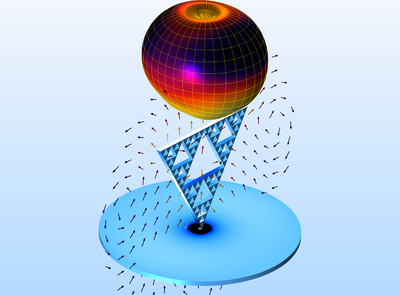
A fractal is a mathematical form showing self-repeating patterns. By virtue of its geometrical properties, a fractal structure can generate multiple resonances in RF applications. This antenna model uses a 3rd order Sierpinski triangle and the calculated S-parameters shows good input ... Mehr lesen

A 2D model of a steel bar is used to simulate oil quenching from an austenitic state. Both diffusive and displacive phase transformations are used, and the phase composition is computed in the radial direction of the bar. Mehr lesen
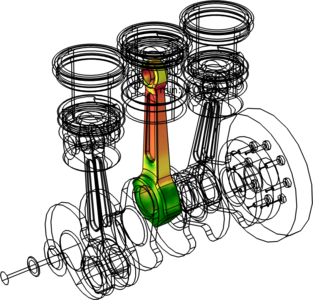
In a reciprocating piston engine the connecting rods transfer rotating motion into reciprocating motion. The connecting rods are constantly under high stresses and the load increases with the engine speed. A failure of one part in the engine usually results in a replacement of the whole ... Mehr lesen
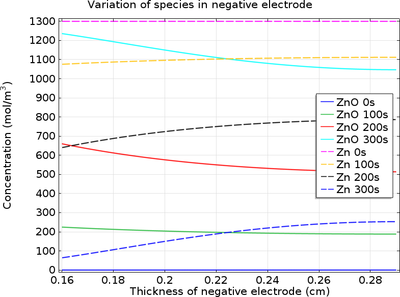
Zinc-Silver oxide (Zn-AgO) batteries are used in different industries due to their high capacity per unit weight. In this work, discharge of a Zn-AgO battery is simulated using the Battery with Binary Electrolyte interface. The electrochemical reactions in the positive and negative ... Mehr lesen
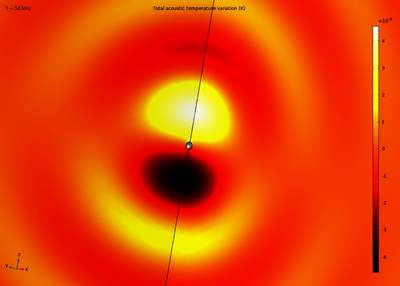
This tutorial simulates a small vibrating hemispherical particle in water. The particle has a radius of 1 mm and is oscillating in the axial direction at a frequency of 50 kHz. The vibrations induce acoustic waves in the fluid. The example demonstrates how to set up a thermoviscous ... Mehr lesen

This example models 3D supersonic flow, including the effect of a shock, in a straight channel with a small obstacle on one of the walls. As the flow hits the obstacle, shock waves are diffracted from the obstacle and walls of the channel. The propagating shock waves form a pattern in ... Mehr lesen
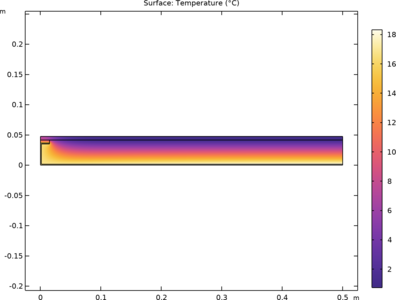
This example studies heat transfer in a composite two-dimensional structure. Four materials with distinct thermal conductivities k compose the structure. The top and bottom boundaries are facing environments respectively at 0°C and 20°C. The temperature distribution and the heat flux ... Mehr lesen

The Free Molecular Flow interface, available in the Molecular Flow Module, is an efficient tool for modeling extremely rarefied gases when the gas molecules move much faster than any geometric entities in the domain. For turbomolecular pumps, in which the blades move at speeds comparable ... Mehr lesen
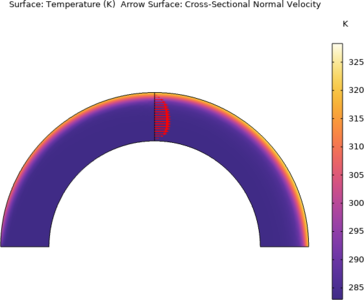
This tutorial illustrates how to use built-in variables and operators, for the evaluation of the bulk temperature along a geometry like a channel, a pipe or a chimney, in a nonisothermal flow in 2D and 3D. The bulk temperature may be needed to compute the heat transfer coefficient for an ... Mehr lesen