
Die Application Gallery bietet COMSOL Multiphysics® Tutorial- und Demo-App-Dateien, die für die Bereiche Elektromagnetik, Strukturmechanik, Akustik, Strömung, Wärmetransport und Chemie relevant sind. Sie können diese Beispiele als Ausgangspunkt für Ihre eigene Simulationsarbeit verwenden, indem Sie das Tutorial-Modell oder die Demo-App-Datei und die dazugehörigen Anleitungen herunterladen.
Suchen Sie über die Schnellsuche nach Tutorials und Apps, die für Ihr Fachgebiet relevant sind. Beachten Sie, dass viele der hier vorgestellten Beispiele auch über die Application Libraries zugänglich sind, die in die COMSOL Multiphysics® Software integriert und über das Menü File verfügbar sind.
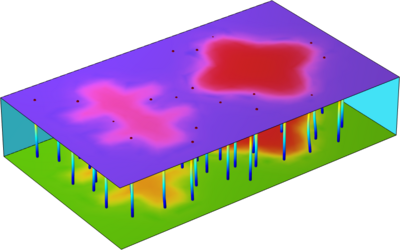
This is a model from electric impedance tomography, a method of imaging the interior permittivity distribution of a body by measuring current and voltage at the surface. This model demonstrates how the shape and placement of figures with different material properties inside a closed ... Mehr lesen

Crystallization is an important separation process in the chemical industry. It is used for the production of pharmaceuticals and industrial chemicals. It can also be used in resource recovery as a way of separating valuable materials from waste. This model solves a discretized ... Mehr lesen

In diesem Modell ist ein Knowles-ED23146-Receiver (Miniaturlautsprecher) mit einem Testaufbau verbunden, der aus einem 50 mm (1 mm Durchmesser) Ohrpassstück und einem so genannten 0.4-cc-Koppler besteht. Der Empfänger wird mit einem Lumped-Spice-Netzwerk modelliert und am Röhreneingang ... Mehr lesen
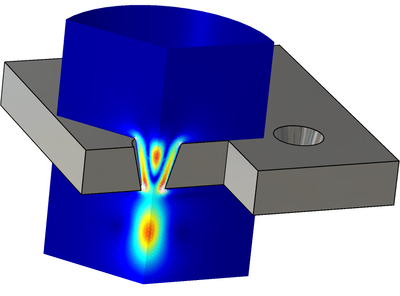
Dieses Modell analysiert die nichtlineare Transferimpedanz einer sich verjüngenden Öffnung, die Teil einer perforierten oder mikroperforierten Platte (MPP) sein kann. Die Analyse wird für verschiedene Verjüngungsgrade der Perforation und für einen Frequenzbereich durchgeführt. Eine ... Mehr lesen
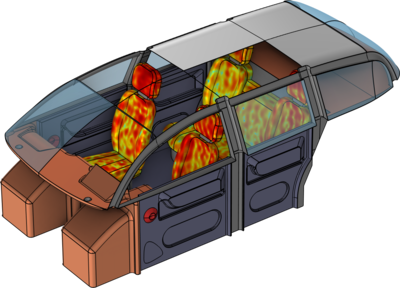
Dieses Tutorial zeigt die Analyse eines Fahrzeuginnenraums, um die Leistung eines Soundsystems im niedrigen bis mittleren Frequenzbereich zu untersuchen. Die Fahrzeugkabine ist eine typische Limousine, d.h. das Innere eines Familienautos mit festem Verdeck. Das Modell untersucht den ... Mehr lesen
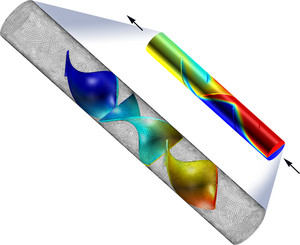
In static mixers, also called motionless or in-line mixers, a fluid is pumped through a pipe containing stationary blades. This mixing technique is particularly well suited for laminar flow mixing because it generates only small pressure losses in this flow regime. This example studies ... Mehr lesen
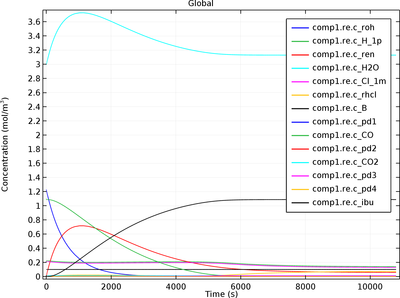
Kinetic analysis of catalytic reactions is essential for understanding rate behavior as well as the reaction mechanism. Developing knowledge of intrinsic reaction kinetics and of rate equations is central to reaction engineering studies aimed at improving reactor design. This model ... Mehr lesen
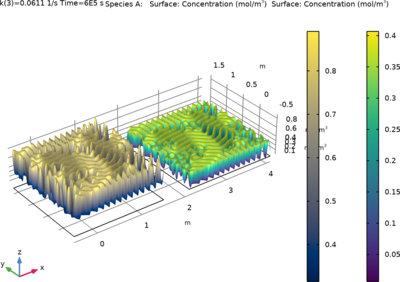
A deceptively simple system of two species and two reactions, describing the autocatalytic conversion of a substance, is shown to display a surprisingly exotic behavior. Starting from a 0D CSTR description, a 2D reaction-diffusion problem is formulated showing rich patterns stemming from ... Mehr lesen
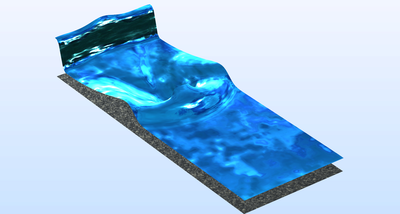
This example uses the Shallow Water equations to model the impact of a water wave on a column. A body of water with a height of 0.3 meters is initially contained behind a gate. At the start of the simulation, the gate is suddenly released and the body of water forms a wave moving toward ... Mehr lesen
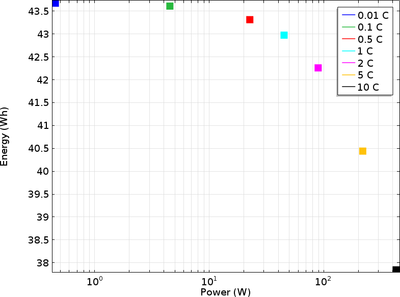
A battery’s possible energy and power outputs are crucial to consider when deciding in which type of device it can be used. A cell with high rate capability is able to generate a considerable amount of power, that is, it suffers from little polarization (voltage loss) even at high ... Mehr lesen


