
Die Application Gallery bietet COMSOL Multiphysics® Tutorial- und Demo-App-Dateien, die für die Bereiche Elektromagnetik, Strukturmechanik, Akustik, Strömung, Wärmetransport und Chemie relevant sind. Sie können diese Beispiele als Ausgangspunkt für Ihre eigene Simulationsarbeit verwenden, indem Sie das Tutorial-Modell oder die Demo-App-Datei und die dazugehörigen Anleitungen herunterladen.
Suchen Sie über die Schnellsuche nach Tutorials und Apps, die für Ihr Fachgebiet relevant sind. Beachten Sie, dass viele der hier vorgestellten Beispiele auch über die Application Libraries zugänglich sind, die in die COMSOL Multiphysics® Software integriert und über das Menü File verfügbar sind.
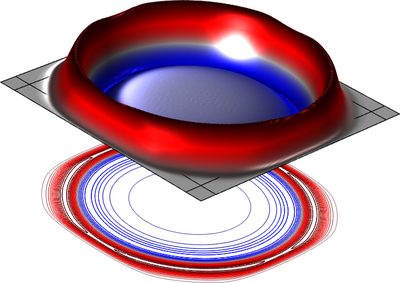
This tutorial simulates a standard test and benchmark model for perfectly matched layers (PMLs) as absorbing boundary conditions in the time domain. It involves the propagation of a transient Gaussian pulse with no flow. The Pressure Acoustics, Transient interface is used together with ... Mehr lesen
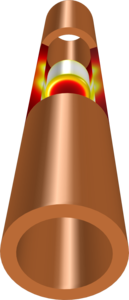
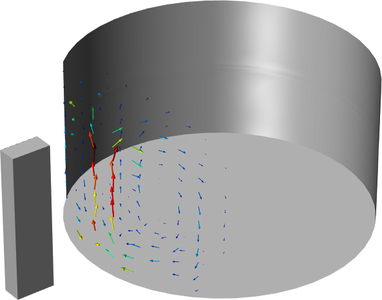
A cylindrical magnet falling through a copper tube induces eddy currents on the tube walls, which in turn, create a magnetic field that opposes the magnetic field of the magnet and induces a braking force that opposes the motion of the magnet. This model computes the velocity of the ... Mehr lesen
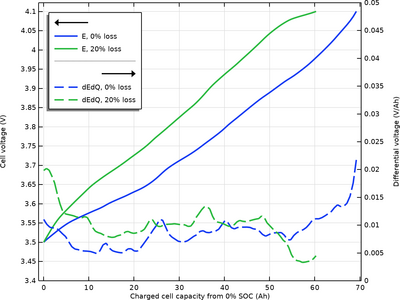
How the open-circuit voltage (OCV) of a lithium-ion battery varies with the state of charge is governed by various physical properties such as the thermodynamics of the electrode reactions, the relative capacities of the electrode materials, and the amount of cyclable lithium, but also ... Mehr lesen

A vessel traveling on the surface or under water gives rise to detectable local disturbances in the Earth’s magnetic field. These disturbances can be used to trigger weapon systems. The magnetic signature of a ship can be reduced by generating a counteracting magnetic field of suitable ... Mehr lesen
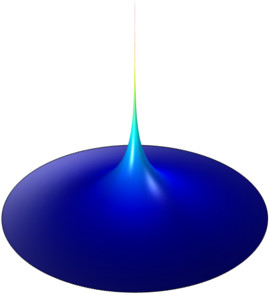
This model solves Poisson's equation on a unit disk with a point source at the origin. The mesh density is higher close to the origin to resolve the singularity. The computed solution is compared to the analytical solution. Mehr lesen
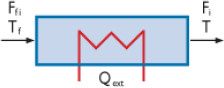
This example considers the thermal cracking of acetone, which is a key step in the production of acetic anhydride. The gas phase reaction takes place under nonisothermal conditions in a plug-flow reactor. As the cracking chemistry is endothermic, control over the temperature in the ... Mehr lesen
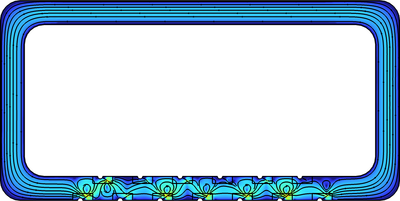
This tutorial uses a 2D model of an acoustically driven microfluidic pump. The acoustic microfluidic pump is driven by acoustic streaming originating from sharp edges in the microfluidic channel. It drives a flow around a closed microfluidic channel loop. The acoustic field is modeled ... Mehr lesen
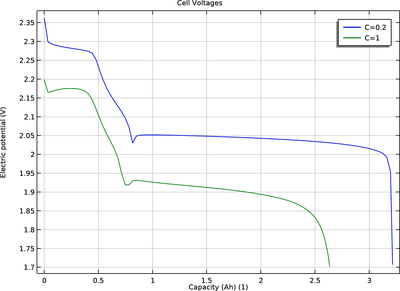
Lithium-sulfur (Li-S) batteries are used in niche applications with high demands for specific energy densities, which may be as high as 500-600 Wh/kg. The chemistry is fairly complex, since multiple polysulfide species participate in the various charge transfer reactions. The chemistry ... Mehr lesen
Dies ist eine Anleitung, wie Sie elektrische Maschinen in 3D mit einer Kombination aus den Interfaces Magnetic Fields und Magnetic Fields, No Currents aufbauen können. Mehr lesen
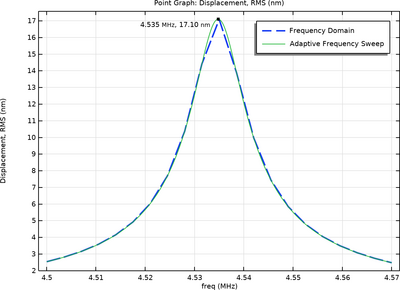
This tutorial shows how to model a miniaturized magnetostrictive antenna developed for use inside living cells. The stress in the antenna, the magnetic flux density, the current density, and the displacement of the tip of the device are investigated at the resonance frequency. Mehr lesen


