
Die Application Gallery bietet COMSOL Multiphysics® Tutorial- und Demo-App-Dateien, die für die Bereiche Elektromagnetik, Strukturmechanik, Akustik, Strömung, Wärmetransport und Chemie relevant sind. Sie können diese Beispiele als Ausgangspunkt für Ihre eigene Simulationsarbeit verwenden, indem Sie das Tutorial-Modell oder die Demo-App-Datei und die dazugehörigen Anleitungen herunterladen.
Suchen Sie über die Schnellsuche nach Tutorials und Apps, die für Ihr Fachgebiet relevant sind. Beachten Sie, dass viele der hier vorgestellten Beispiele auch über die Application Libraries zugänglich sind, die in die COMSOL Multiphysics® Software integriert und über das Menü File verfügbar sind.
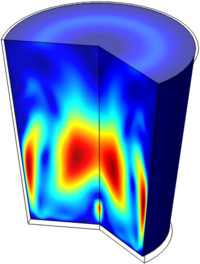
Dieses Modell behandelt die freie Konvektion und den Wärmetransport eines Glases mit kaltem Wasser, das sich auf Raumtemperatur erwärmt. Zu Beginn haben das Glas und das Wasser eine Temperatur von 5 °C und werden dann auf einen Tisch in einem Raum mit 25 °C gestellt. Die nicht-isotherme ... Mehr lesen
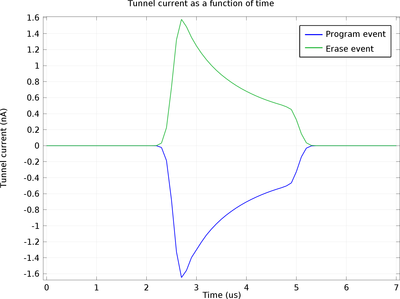
This model calculates the current and charge characteristics of a floating gate Electrically Erasable Programmable Read-Only Memory (EEPROM) device. A stationary study demonstrates the effects of varying the charge stored on the floating gate by computing Current-Voltage curves as a ... Mehr lesen
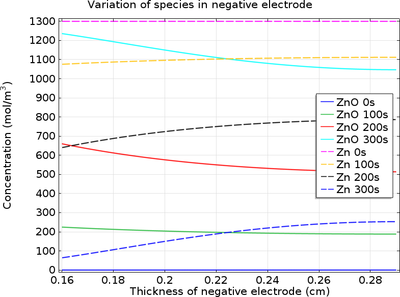
Zinc-Silver oxide (Zn-AgO) batteries are used in different industries due to their high capacity per unit weight. In this work, discharge of a Zn-AgO battery is simulated using the Battery with Binary Electrolyte interface. The electrochemical reactions in the positive and negative ... Mehr lesen
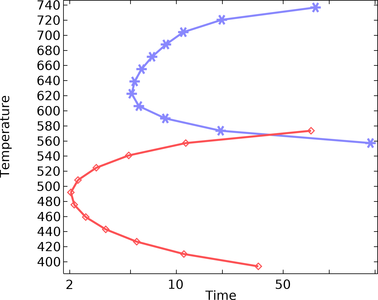
During quenching of steel, austenite decomposes into phases such as ferrite, pearlite, bainite, and martensite. A common way to illustrate the phase transformation characteristics of a particular steel alloy is to use transformation diagrams. Two of the most commonly used diagram types ... Mehr lesen
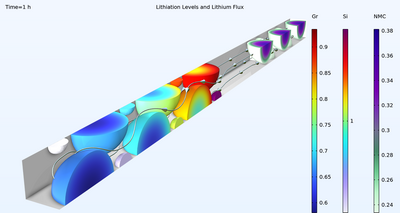
Dieses Modell beschreibt das Verhalten einer Lithium-Ionen-Akku-Einheitszelle, die anhand einer idealisierten dreidimensionalen Geometrie modelliert wird. Die Geometrie ahmt die strukturellen Details in den porösen Elektroden nach. Solche Modelle werden als heterogene Modelle ... Mehr lesen
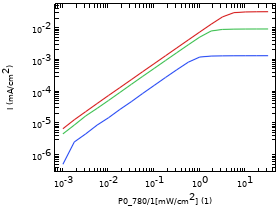
This example shows an approximate approach to model a dot-in-well solar cell as described by Asahi et al. in the reference paper. The quantum wells and the layers of quantum dots are each treated as lumped energy levels in the band gap. The authors specify transitions between the dot ... Mehr lesen
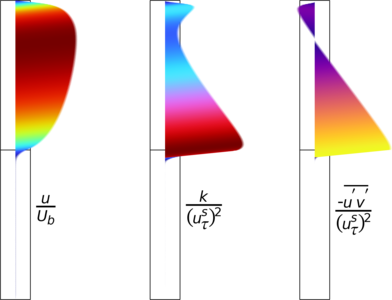
This setup demonstrates how the characteristics of turbulent flow in a channel are modified by the presence of an adjacent porous region. Asymmetric velocity profiles, higher turbulence levels, and higher friction coefficients both at the solid wall and the fluid-porous interface are ... Mehr lesen
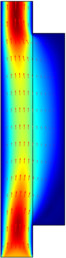
This is a tutorial model of the coupling between flow of a fluid in an open channel and a porous block attached to one of the channel walls. The flow is described by the Navier-Stokes equation in the free region and a Forchheimer-corrected version of the Brinkman equations in the porous ... Mehr lesen
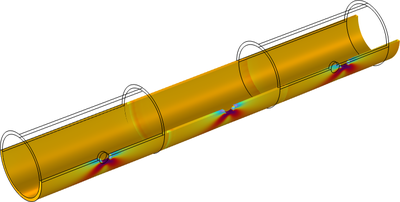
This tutorial model shows how to model a structure using both shell and solid elements, and how to create the transition between them. Results are compared between the shell solution and the full 3D solution, and the effects of the transition are highlighted. Mehr lesen
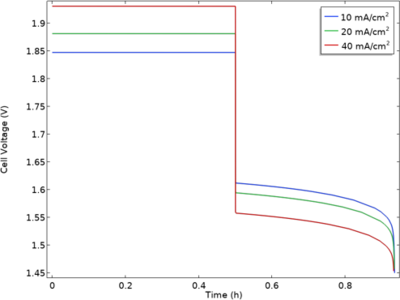
The zinc bromine redox flow battery is an electrochemical energy storage technology suitable for stationary applications. Compared to other flow battery chemistries, the Zn-Br cell potentially features lower cost, higher energy densities and better energy efficiencies. In the cell ... Mehr lesen