
Die Application Gallery bietet COMSOL Multiphysics® Tutorial- und Demo-App-Dateien, die für die Bereiche Elektromagnetik, Strukturmechanik, Akustik, Strömung, Wärmetransport und Chemie relevant sind. Sie können diese Beispiele als Ausgangspunkt für Ihre eigene Simulationsarbeit verwenden, indem Sie das Tutorial-Modell oder die Demo-App-Datei und die dazugehörigen Anleitungen herunterladen.
Suchen Sie über die Schnellsuche nach Tutorials und Apps, die für Ihr Fachgebiet relevant sind. Beachten Sie, dass viele der hier vorgestellten Beispiele auch über die Application Libraries zugänglich sind, die in die COMSOL Multiphysics® Software integriert und über das Menü File verfügbar sind.
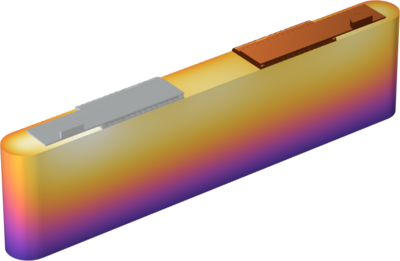
This model exemplifies how to compute the internal temperature distribution in a prismatic battery during a high-rate charge. The electrochemistry is described by a a lumped two-electrode model, which is coupled to the heat transfer model. The heat transfer model includes the effects of ... Mehr lesen
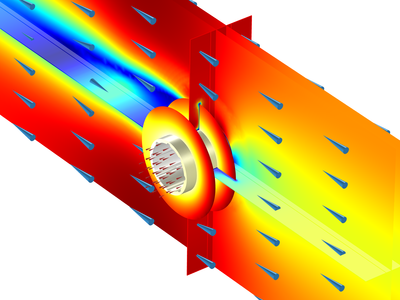
This app demonstrates the following: Geometry parts and parameterized geometry A results table form object containing outputs Finned pipes are used for coolers, heaters, or heat exchangers to increase heat transfer. They come in different sizes and designs depending on the ... Mehr lesen
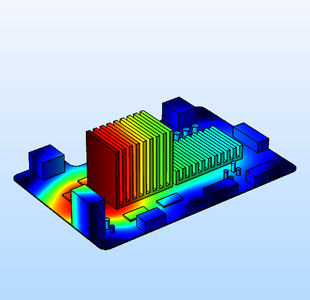
Electronic equipment often has to be certified to function after having been subjected to a specified shock load. In this example, the effect of an 50g 11ms half sine shock on a circuit board is investigated using response spectrum analysis. The results are compared with a time domain ... Mehr lesen
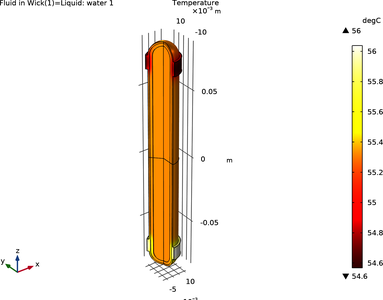
Wärmerohre sind für den effizienten Wärmetransport durch Verdampfung, Stoffaustausch und Kondensation eines Fluids konzipiert. Sie kommen in einer Vielzahl von Anwendungen zum Einsatz, bei denen die Wärmeregulierung von Bedeutung ist, zum Beispiel bei der Kühlung von Elektronik. In ... Mehr lesen
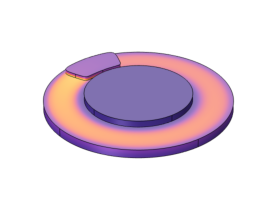
This example models the transient heating, and final temperature, of a disc brake of a car in brake-and-release sequence. It is important to model the transient heating and the following convective cooling to determine the minimum interval between a series of similar brake engagements. ... Mehr lesen

Thermoelectric elements are often used to cool or heat electronic components to a desired temperature. In such simulations, you are typically not interested in the behavior of the thermoelectric element itself but want to use its performance characteristics to model the overall response ... Mehr lesen
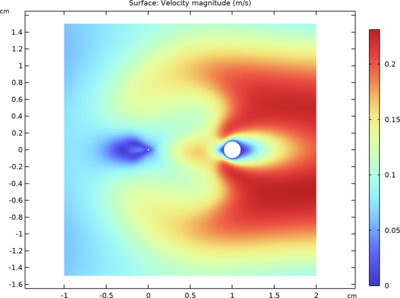
This model simulates the velocity of the ionic wind generated by a wire-to-wire corona discharge. Ionic wind, created by the movement of charged particles in an electric field, can be harnessed for various applications, including cooling electronic components and enhancing heat ... Mehr lesen
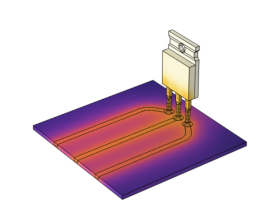
In every system where there is conduction of electric current, and where the conductivity of the material is finite, there will be electric heating. Electric heating, also referred to as Joule heating, is in many cases an undesired by-product of current conduction. This model simulates a ... Mehr lesen
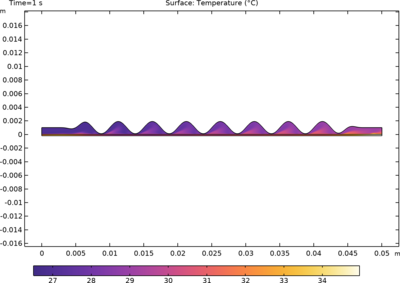
The heat exchanger in this tutorial model contains a dynamic wall with an oscillating wave shape. The deformation induces mixing in the fluid and reduces the formation of thermal boundary layers. Hence, it increases heat transfer between the walls and the fluid. In addition, the wave ... Mehr lesen
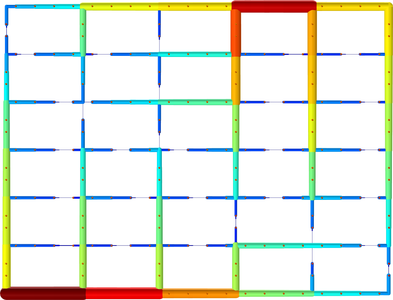
The layout of a district heating network is designed using topology optimization. Mehr lesen