
Die Application Gallery bietet COMSOL Multiphysics® Tutorial- und Demo-App-Dateien, die für die Bereiche Elektromagnetik, Strukturmechanik, Akustik, Strömung, Wärmetransport und Chemie relevant sind. Sie können diese Beispiele als Ausgangspunkt für Ihre eigene Simulationsarbeit verwenden, indem Sie das Tutorial-Modell oder die Demo-App-Datei und die dazugehörigen Anleitungen herunterladen.
Suchen Sie über die Schnellsuche nach Tutorials und Apps, die für Ihr Fachgebiet relevant sind. Beachten Sie, dass viele der hier vorgestellten Beispiele auch über die Application Libraries zugänglich sind, die in die COMSOL Multiphysics® Software integriert und über das Menü File verfügbar sind.
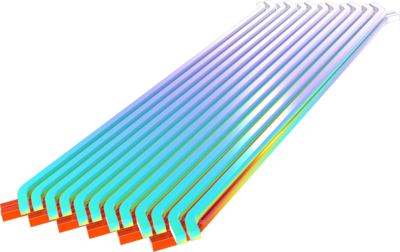
In a polymer electrolyte membrane fuel cell (PEMFC), water is produced at the cathode. The cell is also fed with water vapor via the inlet gas streams, in order to keep the polymer electrolyte membrane humidified. If the water partial pressure in the gas phase exceeds the vapor ... Mehr lesen

In diesem Tutorial wird die Stromverteilung in einer Niedertemperatur-PEMFC bei Verwendung von serpentinenbasierten Strömungsfeldmustern untersucht. Die Zelle wird im Gegenstromverfahren betrieben, so dass sich die Sauerstoff- und Wasserstoffeinlassströme auf gegenüberliegenden Seiten ... Mehr lesen

This tutorial demonstrates how to use stationary polarization data to perform parameter estimation of a polymer electrolyte membrane fuel cell (PEMFC) model. The model, defining a 5-layer membrane electrode assembly (MEA) is two-dimensional and includes electronic and ionic charge ... Mehr lesen
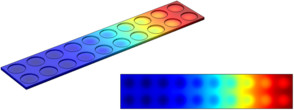
In small PEM fuel cell systems (in the sub-100 W range) no active devices for cooling or air transport are normally used. This is due to the desire to minimize parasitic power losses from pumps and fans, and to reduce the system complexity, size, and cost. The reactants at the cathode ... Mehr lesen

In diesem Modellbeispiel wird der Transport von Reaktanten und Wasser in einer Hochtemperatur-Polymerelektrolytmembran-Brennstoffzelle untersucht. Das Modell umfasst Stoff- und Impulstransportphänomene in den Strömungskanälen, Gasdiffusionsschichten (GDLs) und porösen Elektroden sowie ... Mehr lesen
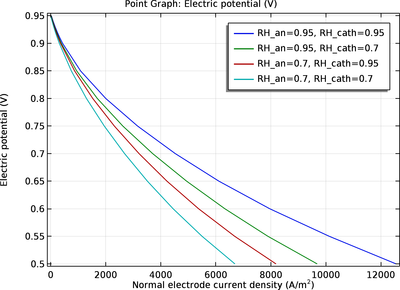
This tutorial models how the relative humidity of the inlet gases impacts the performance of a low-temperature polymer electrolyte membrane-electrode assembly. The model includes humidity-dependent ionomer (electrolyte) conductivities, gas phase mass transport and water ionomer ... Mehr lesen

This model illustrates an application that maximizes surface-to-surface radiative fluxes and minimizes conductive heat fluxes. A thermo-photo-voltaic (TPV) cell generates electricity from the combustion of fuel and through radiation. The fuel burns inside an emitting device that ... Mehr lesen
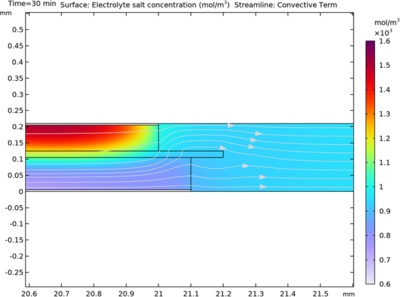
The electrodes of a lithium-ion battery are porous and consist of an active solid electrode material, a binder, and pores filled with a liquid electrolyte. Expansion of the active material due to lithium intercalation changes the volume fraction of electrolyte-filled pores in the ... Mehr lesen
The chlor-alkali membrane process is one of the largest in industrial electrolysis with the production of roughly 40 million metric tons of both chlorine and caustic soda per year. Chlorine is used predominantly for the production of vinyl chloride monomer, which in turn is used for the ... Mehr lesen

In a polymer electrolyte membrane water electrolyzer cell, hydrogen and oxygen gas is produced by electrolysis. The hydrogen and oxygen compartments are separated by a polymer membrane, that also acts as electrolyte. This introductory tutorial computes the ohmic and activation losses in ... Mehr lesen


