
Die Application Gallery bietet COMSOL Multiphysics® Tutorial- und Demo-App-Dateien, die für die Bereiche Elektromagnetik, Strukturmechanik, Akustik, Strömung, Wärmetransport und Chemie relevant sind. Sie können diese Beispiele als Ausgangspunkt für Ihre eigene Simulationsarbeit verwenden, indem Sie das Tutorial-Modell oder die Demo-App-Datei und die dazugehörigen Anleitungen herunterladen.
Suchen Sie über die Schnellsuche nach Tutorials und Apps, die für Ihr Fachgebiet relevant sind. Beachten Sie, dass viele der hier vorgestellten Beispiele auch über die Application Libraries zugänglich sind, die in die COMSOL Multiphysics® Software integriert und über das Menü File verfügbar sind.

Dieses nicht-konventionelle Modell der Strömung in porösen Medien nutzt die schleichende (Stokes-) Strömung in den Zwischenräumen eines porösen Mediums. Das Modell stammt aus den von Arturo Keller, Maria Auset und Sanya Sirivithayapakorn von der University of California, Santa Barbara, ... Mehr lesen

In this example, the mechanical impact of a golf club hitting a golf ball is studied. The contact between the two parts is modeled using a viscous penalty formulation to stabilize the dynamic event. To properly model the large deformation, the golf ball is defined using a hyperelastic ... Mehr lesen

Dieses Tutorial zeigt, wie Sie vollständige vibro-elektroakustische 3D-Multiphysik-Modelle von Lautsprechern am besten lösen. Das Modell basiert auf einer 3D-Darstellung des bestehenden achsensymmetrischen 2D-Modells loudspeaker_driver aus der Application Library der Software. Der Aufbau ... Mehr lesen

Micromirrors are used in certain MEMS devices to control optic elements. This model of a vibrating micromirror surrounded by air uses the Thermoacoustic-Shell Interaction user interface to model the fluid-solid interaction, and it thus includes the correct viscous and thermal damping of ... Mehr lesen

This example shows how to compute deformations caused by secondary creep in a turbine stator blade. The creep rate is highly influenced by temperature, and the deformation and stress relaxation is thus controlled by the temperature field. Mehr lesen
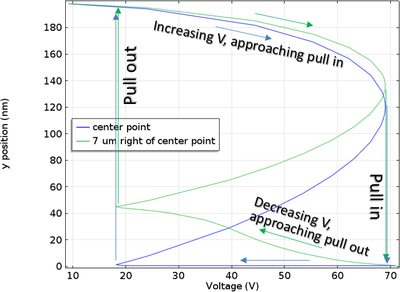
An electrostatically actuated MEMS resonator is simulated. The device is driven by an AC + DC bias voltage applied across a parallel plate capacitor. In this example, the pull-in and pull-out voltages of the resonator are computed. This is done via a quasi-static analysis of the ... Mehr lesen
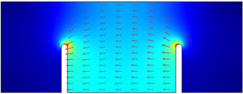
This example treats the modeling of electroosmotic flow in porous media. The system consists of a compartment of sintered porous material and two electrodes that generate an electric field. The cell combines pressure and electroosmotic driven flow. The equations that are solved are the ... Mehr lesen

The model includes a compilation of benchmark examples included in the text book: Shape Memory Alloys: Modeling and Engineering Applications. D. Lagoudas Ed. Springer 2008. The model shows the thermomechanical properties of a NiTi alloy sample subjected to uniaxial tension-compression ... Mehr lesen

Model of the sound radiation from a circular duct with uniform flow. The convected acoustic problem is described using the linearized potential flow equations, solved in the frequency domain. The acoustic inlet is treated including higher order modes using the Port boundary condition and ... Mehr lesen

Rechargeable lithium-air batteries have recently attracted great interest mainly due to their high energy density. The theoretical value is about 11400 Wh/kg which is around 10 times greater than the lithium-ion batteries. In this tutorial, discharge of a lithium-air battery is ... Mehr lesen