
Die Application Gallery bietet COMSOL Multiphysics® Tutorial- und Demo-App-Dateien, die für die Bereiche Elektromagnetik, Strukturmechanik, Akustik, Strömung, Wärmetransport und Chemie relevant sind. Sie können diese Beispiele als Ausgangspunkt für Ihre eigene Simulationsarbeit verwenden, indem Sie das Tutorial-Modell oder die Demo-App-Datei und die dazugehörigen Anleitungen herunterladen.
Suchen Sie über die Schnellsuche nach Tutorials und Apps, die für Ihr Fachgebiet relevant sind. Beachten Sie, dass viele der hier vorgestellten Beispiele auch über die Application Libraries zugänglich sind, die in die COMSOL Multiphysics® Software integriert und über das Menü File verfügbar sind.
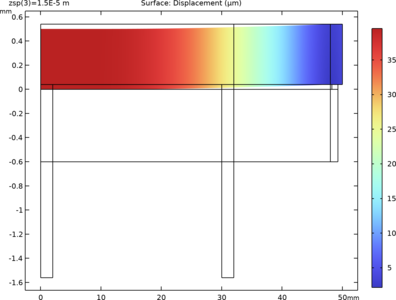
This models pressure-dependent heating of 4 inch wafer on unipolar electrostatic chuck. Wafer sits on top of ring with electrostatic force holdong down wafer to counter upward pressure from gas flowing in gap between wafer and chuck surface. It is a problem involving 4 coupled physics ... Mehr lesen
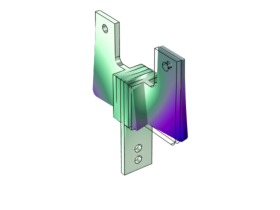
In this example, the eigenmodes of a structural damper are computed. In the damper, most of the deformation is controlled by the viscoelastic domains, which have strongly frequency-dependent stiffness and damping properties. This leads to a nonlinear eigenfrequency problem, which can be ... Mehr lesen

Wenn elektrische Energie in einem Elektromotor in mechanische Arbeit umgewandelt wird, wird die "verschwendete" Energie, die zur Erwärmung des Geräts führt, gewöhnlich als Verlust bezeichnet. Das Verhältnis von nutzbarer Arbeit zu eingegebener Energie, oder der Wirkungsgrad des Motors, ... Mehr lesen

In diesem Beispiel einer peristaltischen Pumpe quetschen Walzen einen flexiblen Schlauch zusammen und die Kompression befördert ein Fluid durch den Schlauch. Das Modell zeigt, wie Sie das Interface Fluid-Structure Interaction verwenden können. Der Hauptvorteil einer peristaltischen ... Mehr lesen

The topology optimized Tesla microvalve is used as an inspiration for an initial geometry. Second order Bernstein polynomials are used to perturb the shape of the geometry. The resulting design is remeshed in the deformed configuration and the performance is investigated for a range of ... Mehr lesen
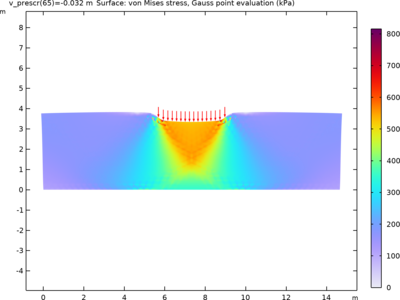
A common verification problem for geotechnical problems is a shallow stratum layer of clay. In this example a vertical load is applied on the clay strata and the static response and the collapse load are studied. The clay is modeled as an elastic-perfectly plastic material and the ... Mehr lesen
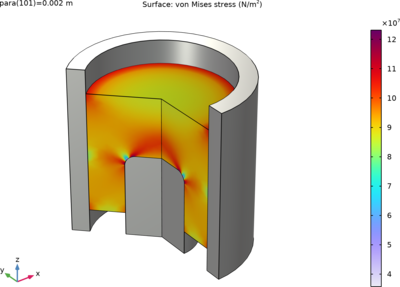
The fabrication of a cup through powder compaction is simulated in this tutorial model. The powder compaction process is becoming common in the manufacturing industry, due to its potential for producing components of complex shape and high strength. Combining the Fleck–Kuhn–McMeeking ... Mehr lesen
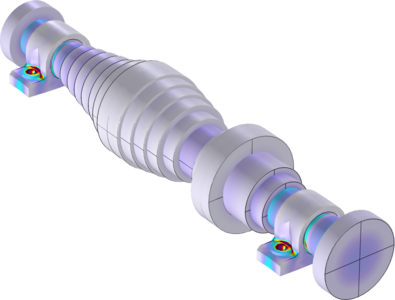
Hydrodynamic bearings generate heat due to the viscous losses in the lubricant. As a result, the temperature of the rotor increases causing deformation and thermal stresses in both the rotor and the bearing housing. This example shows how to model different physical phenomena that are ... Mehr lesen

When a linear guide is loaded above the manufacturer's specification limit, one concern is whether the contact loads will introduce fatigue spalling. In this system analysis, the entire guide has been analyzed and the mostly damaging contact load has been identified to occur on a rail ... Mehr lesen

Hydrogen embrittlement refers to the degradation of metal ductility due to the absorption of hydrogen. The metal becomes more brittle and thus cracks might initiate at lower stress levels. It is important to estimate hydrogen concentration and the speed at which it diffuses into the ... Mehr lesen


