
Die Application Gallery bietet COMSOL Multiphysics® Tutorial- und Demo-App-Dateien, die für die Bereiche Elektromagnetik, Strukturmechanik, Akustik, Strömung, Wärmetransport und Chemie relevant sind. Sie können diese Beispiele als Ausgangspunkt für Ihre eigene Simulationsarbeit verwenden, indem Sie das Tutorial-Modell oder die Demo-App-Datei und die dazugehörigen Anleitungen herunterladen.
Suchen Sie über die Schnellsuche nach Tutorials und Apps, die für Ihr Fachgebiet relevant sind. Beachten Sie, dass viele der hier vorgestellten Beispiele auch über die Application Libraries zugänglich sind, die in die COMSOL Multiphysics® Software integriert und über das Menü File verfügbar sind.
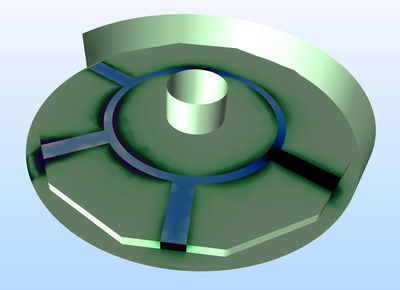
A 180° Ring Hybrid (Rat-Race Coupler) is a four-port network with 180° phase difference between two ports. It is cheaper to manufacture this type of microstrip line component compared to a wave guide 180° hybrid junction, so called magic-T. The objective of this model is to compute the S ... Mehr lesen

Die alkalische Wasserelektrolyse ist ein gut etabliertes industrielles Verfahren zur Herstellung von Wasserstoffgas. In der Zelle bildet sich Wasserstoff an der Kathode, während sich an der Anode Sauerstoff bildet. Der Elektrolyt ist eine wässrige Flüssigkeit, und wenn die entstehenden ... Mehr lesen
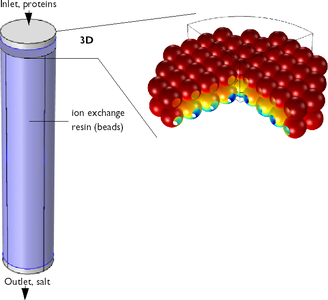
Ion-exchange is a powerful method to separate proteins from solutions and is today readily used in biotechnological and pharmaceutical industry. This model simulates an ion-exchange column for protein adsorption. The fluid phase contains four components: two proteins, solvent, and one ... Mehr lesen
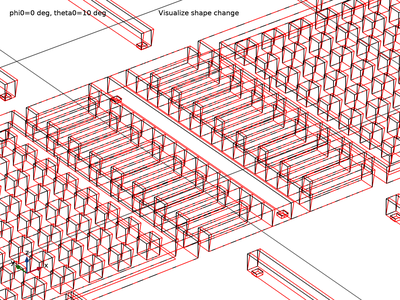
This tutorial example is kindly provided by Dr. James Ransley at Veryst Engineering, LLC. This model continues from the base model “A Micromachined Comb-Drive Tuning Fork Rate Gyroscope”, which is also provided by Dr. Ransley. The model demonstrates how to accurately compute the effects ... Mehr lesen
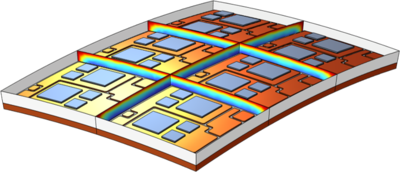
Prior to the reliability testing, surface-mount devices (SMDs) are required to go through a preconditioning process, which represents the effects of storage and the typical reflow operation in the following board assembly process. During the preconditioning process, test samples usually ... Mehr lesen
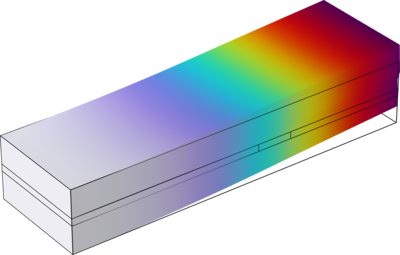
The model performs a static analysis on a piezoelectric actuator based on the movement of a cantilever beam, using the Piezoelectric Devices predefined multiphysics interface. Inspired by work done by V. Piefort and A. Benjeddou, it models a sandwich beam using the shear mode of the ... Mehr lesen
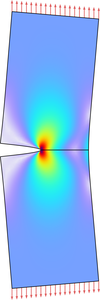
This model deals with the stability of a plate with an edge crack that is subjected to a tensile load. To analyze the stability of existing cracks, fracture mechanics theory can be utilized. A commonly used parameter in fracture mechanics, used to predict if a specific crack will cause ... Mehr lesen
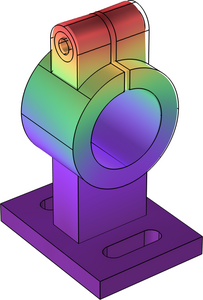
This example analyzes the deformation of a feeder clamp under stress. The clamp secures a feeder that carries high-frequency electromagnetic fields, and it is important that it remains as straight as possible. Forces on the clamp include both those from the feeder as well as those on the ... Mehr lesen


